Ukraine has publicly identified a Russian commander in Bucha war crimes, accusing him of overseeing a brutal campaign that led to mass civilian killings during the 2022 occupation. For the first time, Kyiv’s prosecutors are pointing not only at foot soldiers, but at a commanding officer, Lieutenant Yurii Vladimirovich Kim of Russia’s 76th Air Assault Division. The move signals a significant shift in Ukraine’s justice strategy and raises the stakes for Russian military leadership.
Yurii Vladimirovich Kim is a platoon commander in the 76th Air Assault Division, one of Russia’s elite airborne units. Ukrainian prosecutors say he is suspected of playing a central role in war crimes committed in Bucha between March 7 and April 1, 2022.
Kim is alleged to have ordered his troops to hunt down civilians, kill them, and then burn their bodies to hide the evidence. According to the indictment, his unit carried out 17 killings and at least four cases of ill treatment under his command.
He was born on July 3, 1997, in Moscow Oblast, and commanded a platoon in the 234th Air Assault Regiment. Kim is not currently in Ukrainian custody, making this a notice of suspicion rather than an arrest.
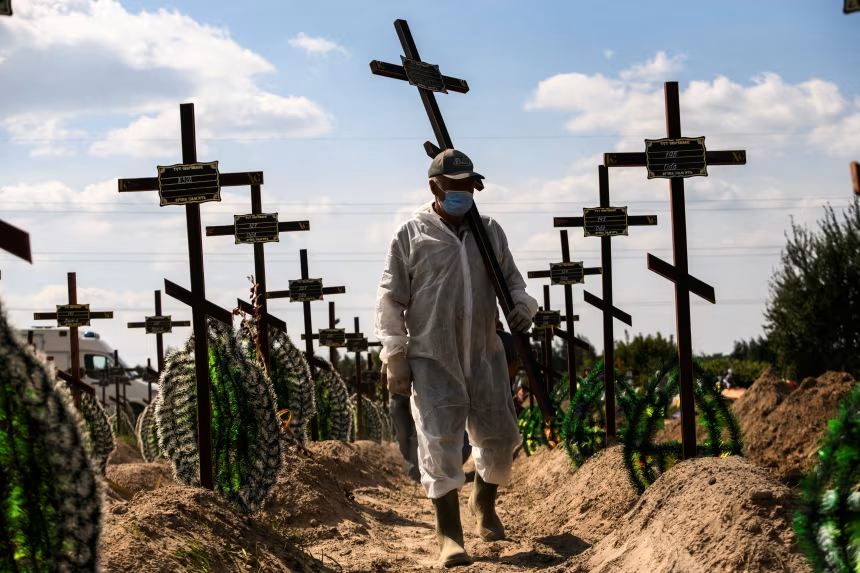
Bucha, a suburb northwest of Kyiv, became a symbol of war time atrocities when Russian troops withdrew in early April 2022, leaving behind bodies scattered across the streets, basements, and mass graves. The carnage shocked the world, with reports of torture, executions, and civilian horrors emerging almost immediately.
The Ukrainian case argues that these were not random acts of violence, but part of an organized, coordinated plan. Investigators say the killings during those weeks were systematically carried out. Kim’s alleged orders to burn the bodies were, according to the case file, designed to conceal evidence of those killings.
Ukraine’s legal team used a variety of tools to build the case, relying on witness testimonies, forensic work, crime scene reconstructions, maps, identity parades, and open source intelligence. Investigators say this volume of evidence suggests that the crimes were not isolated, but carried out under a clear chain of command.
Global Rights Compliance, which helped draft the notice of suspicion, highlighted that Kim allegedly ordered his forces to hunt, harm and kill those he believed were supporting Ukrainian armed or security forces. The organization also noted that after the killings, evidence shows the bodies were burned.
The decision to name a commander is a major step. Up until now, most Ukrainian indictments focused on lower ranking soldiers. Now, prosecutors aim to trace criminal responsibility up the chain of command. First Deputy Head of the National Police, Maksym Tsutskiridze, said this marks a shift from targeting just front line troops to holding leaders accountable.
If proven, the case could form the basis for broader war crimes investigations, possibly implicating higher levels of military and political leadership in Moscow. This aligns with the idea that the Bucha massacre may have been part of a systematic and coordinated criminal plan.
The Kremlin has strongly denied the charges. Russian officials have called the Bucha reports fake and accused Ukraine of fabricating evidence. As for Kim, Russia’s Defense Ministry has not publicly addressed the notice of suspicion.
Holding someone like Yurii Kim to account is more than symbolism. It is a test of whether Ukraine and international partners can apply the rule of law to senior military figures. If successful, the case could reshape how war crimes are prosecuted in this conflict, not just as isolated atrocities, but as actions directed by command structures.
For Ukrainian survivors and the families of victims, naming a commander is a critical step toward justice. For the international community, it is a reminder that the chain of command matters. These are not random acts of violence, but potentially deliberate strategies carried out by trained military units.
Delivering justice will be difficult. Without Kim in custody, Ukraine may struggle to bring him to trial. Extraditing a Russian officer is politically complex, especially in a war zone. And even if a trial proceeds, gathering reliable witnesses and preserving forensic evidence years later is challenging.
Additionally, pursuing a commander could provoke backlash. Russia might refuse to cooperate or increase its disinformation efforts. However, Ukrainian authorities appear committed to pursuing the case because of its legal and symbolic importance.
The identification of a Russian commander in Bucha war crimes, Lieutenant Yurii Vladimirovich Kim, is a watershed moment in Ukraine’s pursuit of accountability. The charges of 17 civilian killings, ill treatment, and cover up operations speak to a deeply disturbing, coordinated pattern of abuse. Whether this case leads to a trial or remains a bold legal declaration, it already sends a message. Ukraine is determined to trace these horrors back to their source, not only punish individual soldiers but hold command leaders responsible.