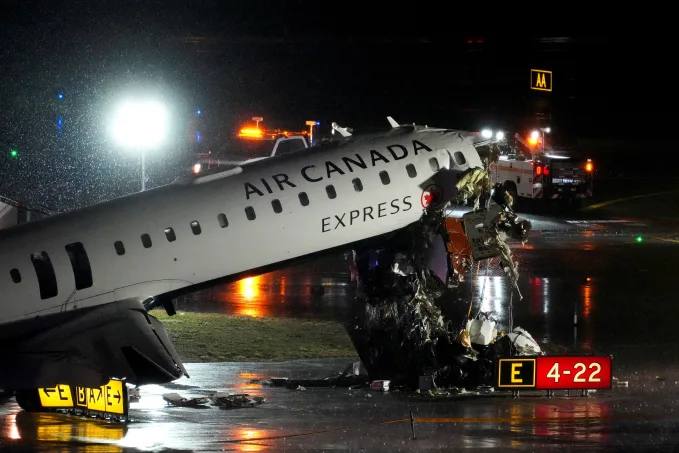
An Air Canada regional jet collided with an airport fire truck while landing at LaGuardia Airport late Sunday night, leaving two pilots dead, dozens injured, and one of the nation’s busiest aviation hubs temporarily shut down, officials said.
The crash occurred at approximately 11:40 p.m., when a Jazz Aviation-operated flight on behalf of Air Canada struck a Port Authority Aircraft Rescue and Firefighting vehicle that had been dispatched to respond to a separate in-flight emergency elsewhere on the airfield. Authorities say the sequence of events unfolded rapidly, raising urgent questions about runway coordination, visibility, and communication between ground crews and incoming aircraft.
According to the Port Authority of New York and New Jersey, emergency response protocols were activated immediately after the collision. Fire crews, paramedics, and law enforcement units flooded the runway within minutes, as plumes of smoke and flashing lights illuminated the darkened airfield.
The aircraft, identified as Air Canada Flight 8646, had departed from Montréal–Trudeau International Airport shortly after 10:30 p.m. Eastern Time and was approaching LaGuardia under what officials described as marginal weather conditions, including light rain and patches of fog. The aircraft was carrying 72 passengers and four crew members at the time of the crash.
Officials confirmed early Monday that both the pilot and copilot were killed in the collision, a devastating loss that has sent shockwaves through the aviation community. Their identities have not yet been released pending notification of family members.
At least 41 passengers and crew were transported to nearby hospitals following the incident, according to Port Authority Executive Director Kathryn Garcia. Thirty-two of those injured were later released after receiving treatment for what were described as mostly minor injuries, including cuts, bruises, and smoke inhalation. Several others remain under observation.
Two firefighters who were inside the emergency vehicle at the time of the crash were also hospitalized and are reported to be in stable condition.
Passengers who were able to evacuate the aircraft were escorted to the terminal and directed to Air Canada’s ticketing area, where airline staff and emergency responders worked through the night to reunite them with family members. Among those on board was an unaccompanied minor, Garcia noted, underscoring the human toll and emotional distress caused by the incident.
Images and video footage captured at the scene show significant damage to the nose section of the aircraft, which appeared crushed and partially torn apart upon impact. The fire truck also sustained heavy damage, though it did not catch fire.
Preliminary information suggests that the fire truck had been cleared to enter and cross the runway as it responded to a separate emergency involving another aircraft. That aircraft, identified in air traffic control recordings as a United Airlines flight, had aborted its takeoff after a warning light illuminated in the cockpit and crew members reported a concerning odor in the cabin that allegedly caused discomfort among flight attendants.
Audio from LiveATC.com reveals the tense moments leading up to the collision. Air traffic controllers can be heard coordinating the emergency response, granting the fire truck permission to proceed across the runway. Seconds later, as the Air Canada jet approached for landing, the situation escalated.
“Truck One, stop, stop, stop!” a controller urgently radioed, according to the recording. Moments later, the same controller addressed the arriving aircraft: “JAZZ 646, I see you collided with the vehicle. Just hold position. I know you can’t move. Vehicles are responding to you now.”
By then, the collision had already occurred.
Flight tracking data from FlightRadar24 indicates that the aircraft was traveling at approximately 130 miles per hour in the final moments before impact. Aviation experts note that at such speeds, even a brief lapse in coordination or visibility can have catastrophic consequences.
The Federal Aviation Administration quickly issued a ground stop at LaGuardia following the incident, halting all incoming and outgoing flights due to what it described as an “aircraft emergency.” The airport remained closed into Monday afternoon to allow investigators to secure the scene and begin a comprehensive inquiry.
The National Transportation Safety Board has deployed a team of investigators to the site and is expected to lead the probe into the cause of the crash. Officials say the investigation will examine a range of factors, including air traffic control procedures, runway visibility, communication protocols, and the actions of both the flight crew and ground personnel.
LaGuardia Airport, the third-busiest airport in the New York metropolitan area, serves as a critical hub for domestic travel. Its sudden closure triggered widespread disruptions across the national air travel network. By early Monday, more than 500 flights had been canceled, according to FlightAware, leaving thousands of passengers stranded or scrambling to rebook their travel plans.
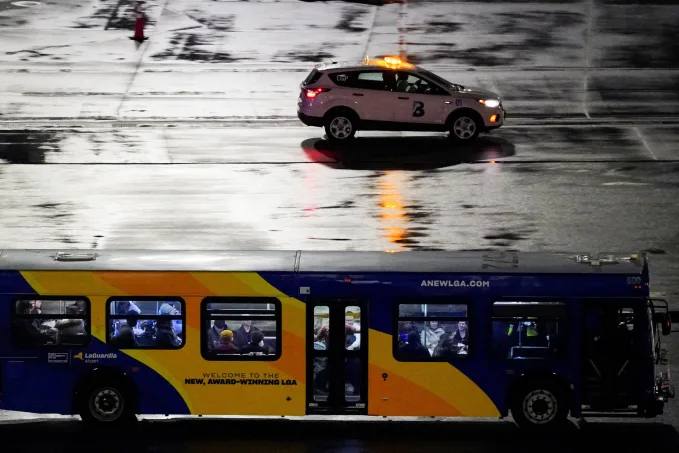
The incident comes at a particularly challenging time for U.S. aviation operations. Airports across the country have already been grappling with staffing shortages linked to an ongoing lapse in funding for the Department of Homeland Security. The funding gap has left many Transportation Security Administration officers working without pay, prompting increased absenteeism and longer security lines at major airports.
While air traffic controllers have not been directly affected by the current funding dispute, the broader strain on airport operations has contributed to mounting pressure on an already complex system.
For passengers at LaGuardia, the aftermath of the crash was marked by confusion, fear, and long hours of waiting. Many described the landing as abrupt and chaotic, followed by a loud impact that sent shockwaves through the cabin.
“I thought we had just hit really hard turbulence,” one passenger told reporters outside the terminal. “Then people started screaming, and you could smell something burning. That’s when we knew something was very wrong.”
Emergency responders worked through the night under difficult conditions, navigating slick runways and low visibility to secure the scene and assist survivors. Rows of emergency vehicles lined the tarmac, their flashing lights reflecting off the wet surface as crews coordinated rescue efforts.
Authorities say weather conditions may have played a role in the incident. Earlier in the evening, LaGuardia had issued advisories warning of light rain and fog in the area, conditions that can reduce visibility and complicate both landing approaches and ground operations.
Still, aviation experts caution against drawing conclusions too early. “Airports are designed with multiple layers of safety to prevent exactly this kind of occurrence,” one analyst said. “When something like this happens, it’s almost always the result of several factors aligning in a very unfortunate way.”
Air Canada and Jazz Aviation both issued statements expressing condolences to the families of the deceased pilots and pledging full cooperation with investigators.
“Our thoughts are with those affected by this tragic incident,” the airline said. “We are working closely with authorities to determine exactly what happened.”
As investigators begin their work, questions remain about how a cleared emergency vehicle and a landing aircraft ended up on the same runway at the same time. The answers will likely take months to fully emerge.
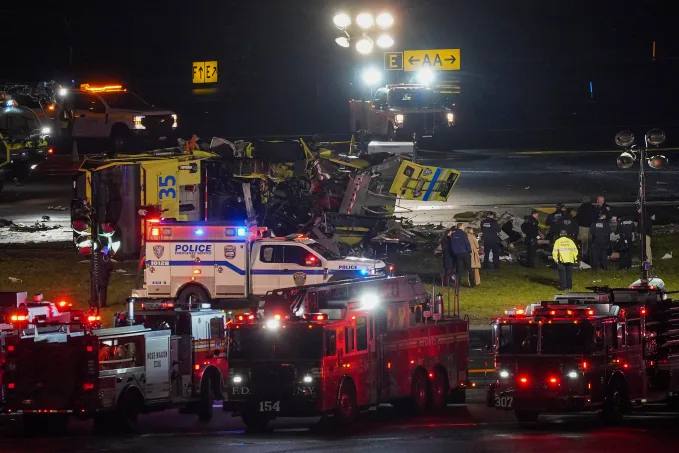 For now, the focus remains on supporting the victims and restoring normal operations at one of the country’s key transportation hubs. Officials say LaGuardia is expected to reopen later Monday, though delays and cancellations could continue to ripple through the system for days.
The crash stands as a stark reminder of the risks inherent in modern air travel, even as it remains one of the safest modes of transportation. In a system that relies on precise timing, clear communication, and coordinated action, even a momentary breakdown can have devastating consequences.