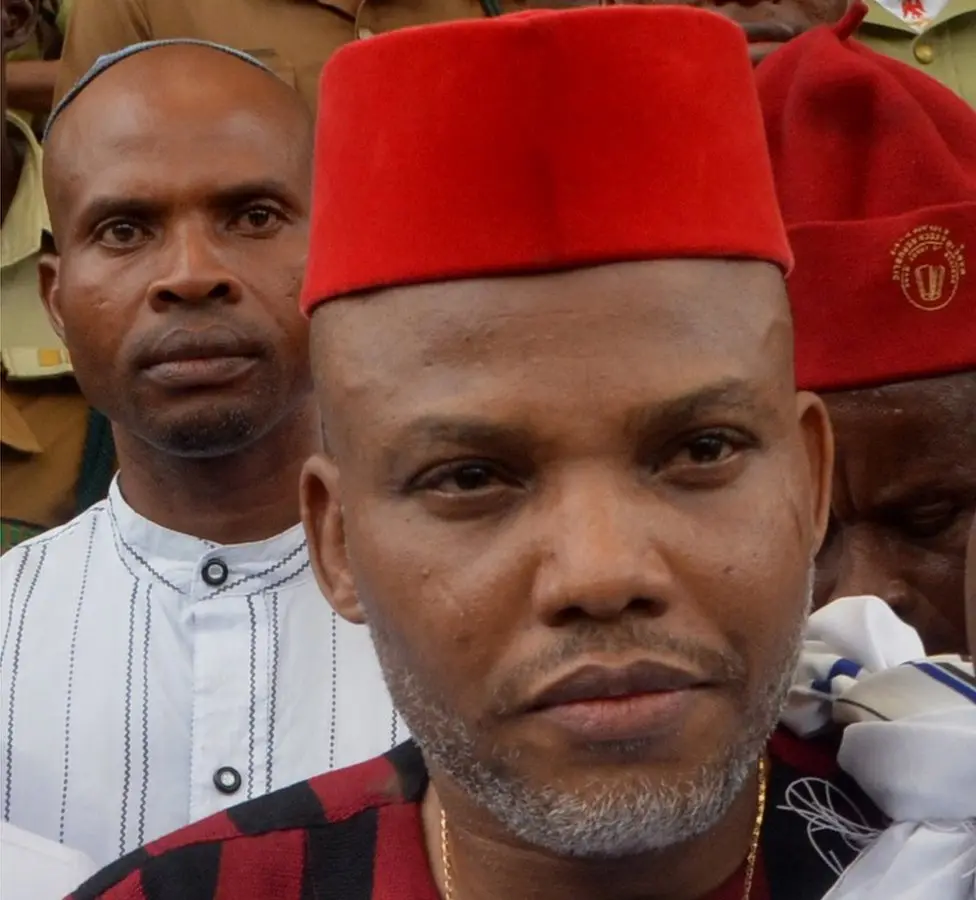
Kanu is the founder of the Indigenous People of Biafra (Ipob), a movement he established in 2014. Its central aim is the secession of a bloc of southeastern states, predominantly inhabited by the Igbo ethnic group, to form an independent country called Biafra.
This ambition is a historical one. A Biafran state was initially declared by Igbo leaders in 1967, sparking a brutal civil war that claimed as many as a million lives before the rebellion was ultimately crushed.
However, the separatist ideal never fully disappeared, and Kanu represents a new generation of activists championing the cause.
He first rose to prominence not in Nigeria, but from London, where he launched Radio Biafra in 2009. The station, which broadcast calls for Igbo independence into Nigeria, elevated him from obscurity.
Although he was raised in Nigeria’s south-east and attended the University of Nsukka, Kanu relocated to the UK before completing his degree.
Following the creation of Ipob, he began addressing large gatherings of the Igbo diaspora, fervently advocating for Biafran independence.
During some of these speeches, he explicitly urged his followers to take up arms against the Nigerian state, with statements such as, “We need guns and we need bullets.” These comments inevitably attracted the scrutiny of Nigerian security services.
Ipob has since reframed these statements. A spokeswoman, Amarachi Chimeremeze, told the BBC that it was “a metaphor, to tell the people we are going to fight for this.” The question of whether it was a literal call to arms is expected to be a central point in his trial, scheduled to begin in July.
Kanu’s legal troubles began in October 2015 when he was arrested in a Lagos hotel shortly after arriving for a visit. He was charged with “criminal conspiracy, intimidation and membership of an illegal organisation”— charges that collectively could constitute treason. His lawyer, Ifeanyi Ejiofor, has dismissed the charges as “frivolous,” alleging they were “concocted to ensure his detention in prison.”
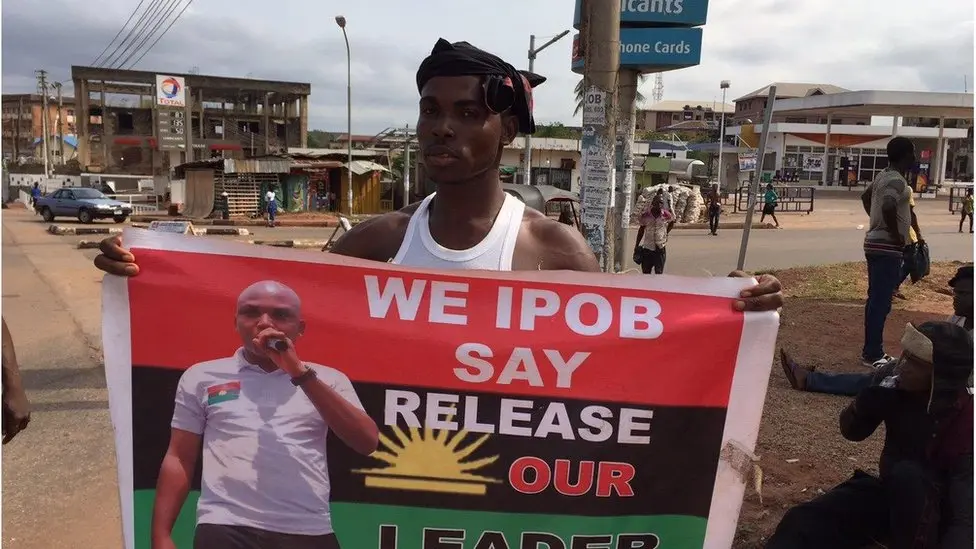
Paradoxically, his imprisonment appears to have energized his movement. Supporters have held protests across Nigeria, and Ipob has gained momentum.
Followers see global events like the Brexit vote and the election of Donald Trump as signs of a growing international trend toward “self-determination,” a principle they champion, sometimes referring to their own goal as “Biafrexit.”
These organized protests are frequently dispersed by police. Ipob alleges that its supporters have been injured and killed during these crackdowns, a claim the authorities strongly deny.
A report from Amnesty International supports claims of violence, stating that Nigerian security forces killed at least 150 pro-Biafra protesters between August 2015 and 2016.
This violence has, in turn, generated more publicity for the cause. Political analyst Cheta Nwanze, who has studied the pro-Biafra movement extensively, believes Kanu’s “arrest was a mistake because it played into his hands.” He suggests that when Kanu’s radio station saw a dip in popularity after the 2015 elections, the activist may have traveled to Nigeria precisely to get arrested.


Nwanze goes further, characterizing Kanu as an opportunist. He points to a video from months before Ipob’s founding that shows Kanu at an anti-Boko Haram rally in London, speaking about the need to preserve Nigeria’s unity.
The Ipob spokeswoman disputes this interpretation, asserting that Kanu returned to Nigeria simply to demonstrate his commitment to the Biafran struggle.
Beyond the debate over his separatist ambitions, Kanu’s prolonged detention without trial drew criticism from human rights groups and senior politicians, who argued it was unlawful.
The Nigerian legal system is often slow, and his case saw little progress. The government initially ignored multiple court orders for his bail before finally acquiescing last week, releasing him “on medical grounds.”
His bail conditions are stringent. He is prohibited from speaking publicly, giving interviews, or gathering in groups larger than ten.
Furthermore, he was required to produce three sureties, a prominent Igbo leader, a wealthy Abuja resident, and a senior Nigerian Jewish leader who each had to pledge 100 million naira to the court.
Kanu identifies as an Igbo Jew, part of a community that believes they are descended from one of the lost tribes of Israel.
It is difficult to gauge the true strength of Ipob and its leader. While the trauma of the Biafran war extinguished the separatist dreams of many, a deep-seated sense of unfair treatment persists among many Igbo people.
Some argue that former President Muhammadu Buhari, a soldier in the war that defeated Biafra, did little to ease this lingering sense of grievance , a sentiment they say has not been meaningfully addressed under President Bola Ahmed Tinubu either. By contrast, Vice-President Yemi Osinbajo has been praised for encouraging open dialogue about the Biafran war.
The future of Nnamdi Kanu and Ipob remains uncertain. The movement could follow the path of an earlier separatist group, Massob, which lost influence after its leader was jailed.
As Nigeria reflects on the legacy of the Biafran war, the ongoing controversy surrounding Kanu underscores the country’s persistent failure to reconcile with its past and lay the idea of Igbo separatism to rest.