The US soldiers killed in Syria over the weekend have now been formally identified, bringing renewed attention to America’s long running military presence in the country and the persistent threat posed by ISIS. The attack, which occurred near the historic city of Palmyra, underscores how dangerous counterterrorism operations remain even years after the group lost most of its territory.
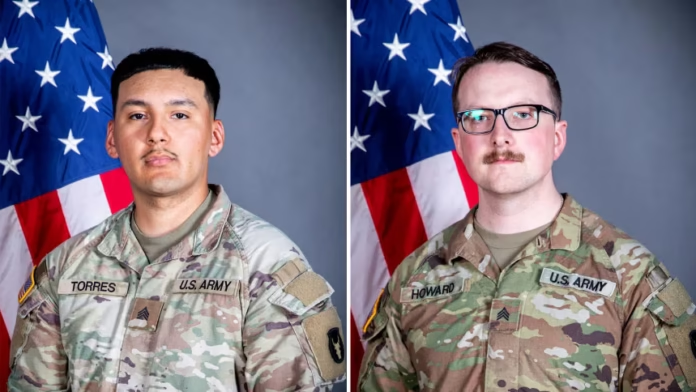
The Army confirmed that Sgt. Edgar Brian Torres Tovar, 25, and Sgt. William Nathaniel Howard, 29, both members of the Iowa National Guard, were killed while engaged with hostile forces. An American civilian interpreter working alongside US troops was also killed in the ambush.
According to the Department of Defense, the incident took place on December 13, 2025, during a mission tied to ongoing counter-ISIS operations. Officials said a single ISIS gunman carried out the attack, opening fire on US personnel during what was described as a routine engagement with local partners.
Three additional Iowa National Guard soldiers were wounded and later evacuated for medical treatment. Syrian security forces said traffic was temporarily halted in the area as US helicopters moved in to evacuate the casualties and secure the scene.
The attack is the deadliest involving US forces in Syria since 2019, when a bombing killed two American service members and two civilians during a patrol.
Both Sgt. Torres Tovar and Sgt. Howard served with the Iowa National Guard and were part of a larger deployment supporting Operation Inherent Resolve, the US led mission aimed at preventing ISIS from regrouping.
Sgt. Howard’s father, Meskwaki Nation Police Chief Jeffrey Bunn, described his son as deeply committed to service and to protecting others. In a public statement, he said his son believed strongly in leaving no one behind and took pride in his role overseas.
Iowa Governor Kim Reynolds confirmed that nearly 1,800 Iowa National Guard troops began deploying to the Middle East earlier this year, reflecting the state’s significant contribution to US military operations abroad.
President Donald Trump reacted strongly to the attack, vowing retaliation against those responsible. Speaking at a White House event, he emphasized that the attackers were members of ISIS and not affiliated with the Syrian government. Trump also noted that Syria’s new leadership, which came to power after the fall of the Assad regime, has cooperated with US forces in the past.
Syrian authorities announced the arrest of five suspects connected to the ambush, saying they were placed under investigation immediately. US officials have not yet confirmed whether those detained were directly involved in the shooting.
The US soldiers killed in Syria were part of a mission that has continued for years with the goal of preventing ISIS from reestablishing safe havens. Although the militant group no longer controls large swaths of territory, US and allied officials warn that ISIS cells remain active, particularly in central and eastern Syria.
American forces work closely with Syrian partner units, providing training, intelligence support, and operational coordination. These missions often involve travel through remote and unstable areas, where the risk of ambush remains high.
The deaths of the US soldiers killed in Syria highlight the ongoing costs of counterterrorism efforts and the challenges facing US policy in the region. While Washington has sought to reduce its footprint in the Middle East, incidents like this demonstrate that the threat environment has not disappeared.
For families, communities in Iowa, and the broader military, the loss is deeply personal. For policymakers, it raises difficult questions about mission scope, force protection, and how long US troops will continue to operate in conflict zones where danger remains constant.
As investigations continue and officials weigh next steps, the attack serves as a stark reminder that even limited deployments can carry profound risks.