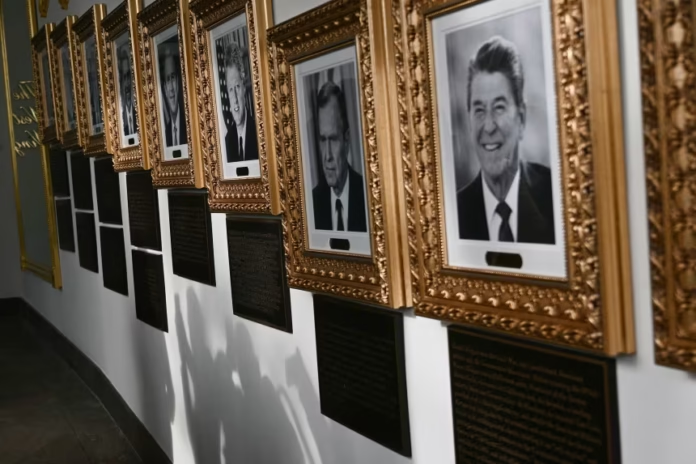
The Presidential Walk of Fame has quietly emerged as one of the most unconventional additions to the White House in modern history. Installed along a walkway outside the West Wing, the exhibit features plaques honoring former US presidents. But instead of traditional, neutral historical summaries, many of the descriptions are written in a tone unmistakably associated with President Donald Trump himself. The result is a display that blends presidential history with political messaging, reigniting debate over how power, memory and legacy are shaped inside the nation’s most symbolic building.
Supporters see the Presidential Walk of Fame as a bold, unfiltered take on American leadership. Critics argue it crosses a line, using government space to amplify partisan attacks and disputed claims.
According to an introductory plaque, the Presidential Walk of Fame was conceived and dedicated by Trump as a tribute to presidents who served the country, described as good, bad and somewhere in the middle. While the framing suggests balance, the execution quickly departs from the restrained tone usually associated with official White House installations.
Rather than carefully vetted language crafted by historians, several plaques mirror Trump’s social media style. Random capitalization, sharp insults and sweeping judgments dominate many descriptions. The exhibit does not merely summarize presidencies but actively interprets them through Trump’s political lens.
Trump’s own plaque stands out as a centerpiece. It highlights his 2024 election victory and frames his return to office as a triumph over what it calls the unprecedented weaponization of law enforcement. It also references two assassination attempts and declares that Trump has already fulfilled his promise to usher in a Golden Age of America.
The claims listed include wars ended, borders secured and criminal gangs deported, echoing familiar talking points from Trump rallies and speeches. Critics note that many of these assertions are disputed or oversimplified, yet the plaque presents them as settled achievements.
Former President Joe Biden receives one of the harshest portrayals. His plaque refers to him as Sleepy Joe Biden and describes his presidency as the worst in American history. It claims he took office through a corrupt election and led the nation to the brink of destruction, before concluding with Trump’s landslide reelection and pledge to save America. Biden is represented not by a traditional portrait but by an image of an autopen, a pointed symbolic jab.
Barack Obama’s plaque follows a similar pattern. While acknowledging his place as the first Black president, it labels him one of the most divisive political figures in American history. His health care law is renamed the Unaffordable Care Act, and the Paris climate agreement is dismissed as one sided.
Bill Clinton’s plaque is more restrained but still political, noting his policy achievements before pivoting to Hillary Clinton’s loss to Trump in 2016. Even historical summaries that might have stood on their own are reframed to center Trump’s political narrative.
The Presidential Walk of Fame raises broader questions about how history is written and who gets to write it. Traditionally, the White House has aimed to present presidential history through a nonpartisan lens, often with input from scholars and archivists. This installation breaks from that norm by openly embracing a single president’s perspective.
White House officials have confirmed that many of the plaques were written directly by Trump, describing them as eloquent reflections of presidential legacies. That acknowledgment alone underscores how personal the project is.
The Presidential Walk of Fame is more than a collection of plaques. It is a statement about authority, memory and the role of politics in public spaces. For supporters, it represents honesty and strength. For critics, it blurs the line between governance and self-promotion. Either way, the Presidential Walk of Fame ensures that debates over Donald Trump’s leadership style now extend into the physical landscape of the White House itself.