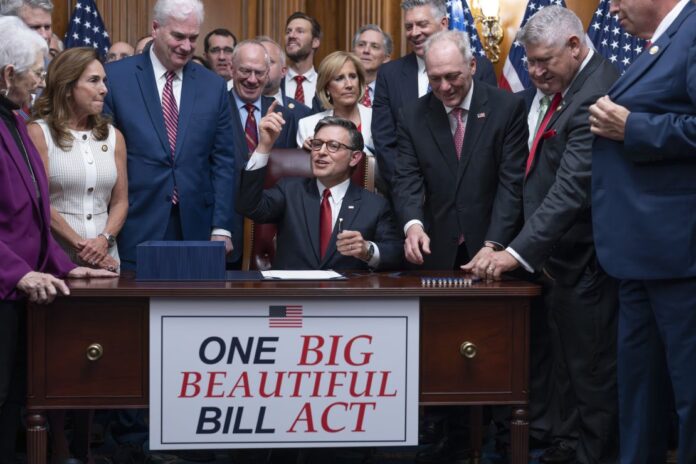
US President Donald Trump is set to sign his sweeping budget mega-bill into law after it passed a final vote in the House of Representatives, ending weeks of Republican infighting over spending levels, healthcare changes and tax policy.
The White House says Trump will sign the legislation at a ceremony on 4 July at 17:00 EDT (22:00 BST). Press secretary Karoline Leavitt marked the bill’s passage with a one-word message on social media: “VICTORY!”
The package advanced only after a turbulent journey through Congress. Earlier this week, the Senate passed the measure with Vice-President JD Vance casting a tie-breaking vote. In the House, internal GOP divisions left the bill’s fate uncertain until a late-night agreement brought dissenting Republicans on board.
The Congressional Budget Office (CBO) estimates the bill could add $3.3tn to federal deficits over the next decade and result in millions losing health coverage, projections disputed by the White House.
Permanent Tax Cuts and Changes to Social Programmes
The bill seeks to extend and expand large portions of Trump’s 2017 Tax Cuts and Jobs Act, which lowered taxes for corporations and most individuals but drew criticism for disproportionately benefiting wealthy Americans.
Key provisions set to expire in December would be made permanent. The legislation also raises the standard deduction by $1,000 for individuals and $2,000 for married couples until 2028.
To offset the tax relief, Republicans included significant changes to Medicaid, the healthcare programme for low-income and disabled Americans. These include:
new work requirements for childless adults without disabilities
recertification every six months instead of annually
tighter income and residency checks
reductions in state provider taxes from 6% to 3.5% by 2032
Concerns from Republicans in states reliant on those provider taxes, especially rural areas prompted the Senate to add a $50bn fund to support rural hospitals.
The Senate version also introduces stricter rules than the House bill, requiring able-bodied adults with children aged 15 and above to work or volunteer at least 80 hours per month. The CBO estimates nearly 12 million people could lose coverage due to the tighter requirements and additional paperwork.
Social Security and State Tax Deductions
On the campaign trail, Trump promised to eliminate taxes on Social Security income. The House bill does not go that far, but it temporarily boosts the standard deduction by up to $4,000 for seniors aged 65 and over between 2025 and 2028.
Senate Republicans approved a more generous deduction up to $6,000 for seniors earning no more than $75,000 annually.
The bill also tackles the long-controversial state and local tax (SALT) deduction cap. The Senate proposal raises the limit from $10,000 to $40,000 for five years before returning it to the current level, a provision that may cause friction with House Republicans from high-tax states.
Changes to Food Assistance and Work Rules
Reforms to the Supplemental Nutrition Assistance Program (SNAP), used by more than 40 million Americans, will require states to shoulder a share of costs starting in 2028.
States with error rates below 6% will continue receiving full federal support, but those with higher error rates will be responsible for 5% to 15% of programme expenses. The legislation also adds work requirements for able-bodied adults without dependents.
Major Boosts to Defence and Immigration Enforcement
Defence spending will rise by $150bn, funding expanded shipbuilding and Trump’s “Golden Dome” missile defence initiative.
Immigration enforcement sees a dramatic increase: $100bn for Immigration and Customs Enforcement (ICE) through 2029. The funding will nearly double migrant detention capacity and allow the agency to hire large numbers of enforcement personnel. ICE’s previous annual budget was roughly $8bn.
The expansion makes ICE the largest federal law enforcement agency, according to the Brennan Center for Justice.
The bill also includes Trump’s “no tax on tips” pledge, allowing certain amounts of tip income and overtime to be deducted. The benefit phases out for individuals earning over $150,000 and expires in 2028.
A permanent child tax credit increase to $2,200 is also included lower than the $2,500 sought by House Republicans with only one parent required to hold a Social Security number.
Energy Tax Credits and Debt Limit Increase
The legislation raises the federal debt ceiling by $5tn, exceeding the $4tn increase previously approved by the House.
One of the sharpest divides between the two chambers involved clean energy subsidies. Both versions end Biden-era renewable energy tax credits, but Senate Republicans backed a slower phase-out.
Under the Senate approach:
projects starting in 2024 get the full credit | those beginning in 2026 receive 60%
those beginning in 2027 get 20% | credits end entirely in 2028
Companies linked to any “foreign entity of concern,” including China, would be barred from receiving the credits. The House bill sought to end them almost immediately.
With the House now approving the Senate’s version, the bill heads to President Trump’s desk. The White House says he will sign the sweeping package into law during a Fourth of July ceremony.