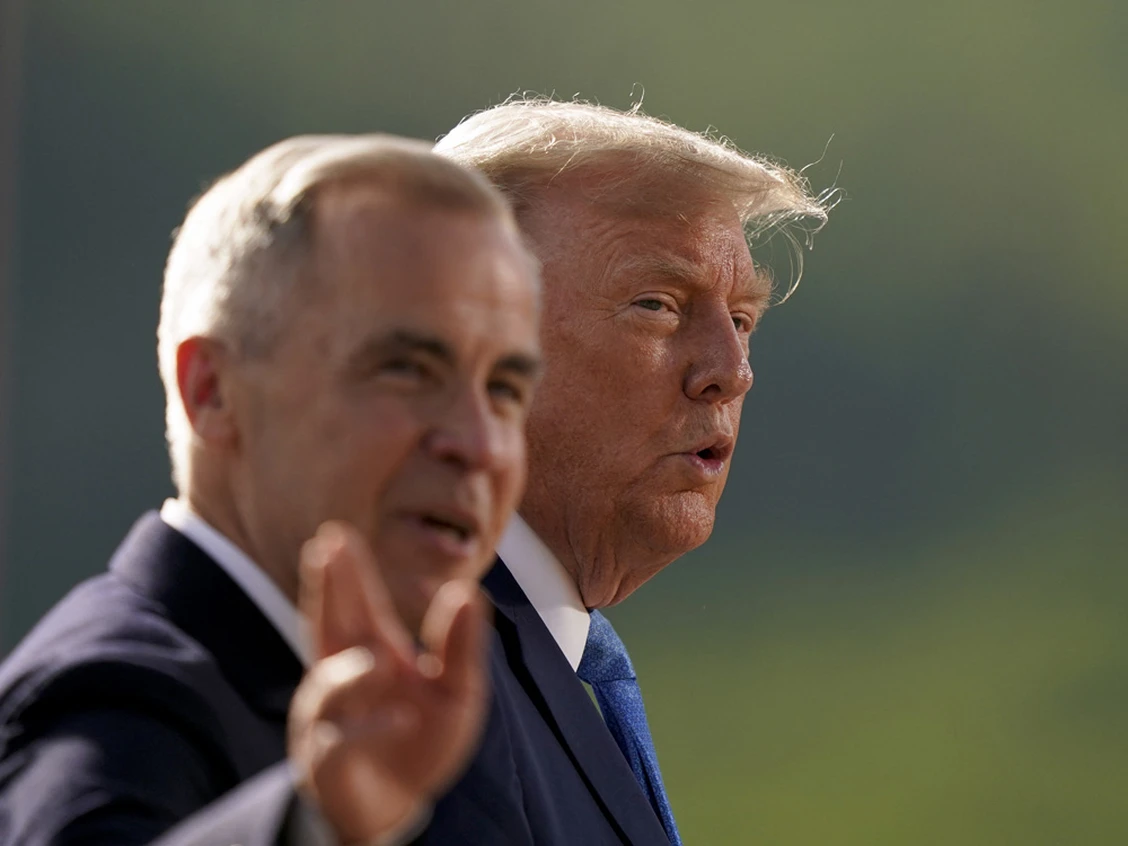
President Donald Trump on Thursday threatened to impose a 35% tariff on imports from Canada, escalating an on-again, off-again trade fight with one of America’s closest allies and its largest export market.
In a separate interview with NBC News, Trump also signaled that blanket tariffs on other U.S. trading partners could rise sharply, underscoring a volatile trade policy that has forced investors, businesses and consumers to adjust plans as economic conditions shift in some cases by the hour.
It remains unclear whether Trump’s threat would apply to all Canadian imports or only to goods currently subject to U.S. duties. One administration official told CNN the expectation was that Canadian products already facing a 25% tariff would see that rate jump to 35%. Goods exempted under the U.S.-Mexico-Canada Agreement (USMCA) would likely remain exempt though no final decision has been made.
“Throughout the current trade negotiations with the United States, the Canadian government has steadfastly defended our workers and businesses,” Canadian Prime Minister Mark Carney said on X. “We will continue to do so as we work towards the revised deadline of August 1.”
Flurry of Tariff Letters to World Leaders
The move came as Trump sent nearly two dozen letters to global leaders in recent days spelling out what tariff rates their goods will face on August 1 unless new trade deals are reached. Canada, the United States’ largest goods export market is by far the most economically significant partner to receive such a letter this week.
The U.S. and Canada are currently negotiating in hopes of reaching an agreement by July 21.
NBC News reported that Trump told “Meet the Press” moderator Kristen Welker he is prepared to raise blanket tariffs on countries not covered by these letters or existing agreements. The U.S. currently applies a 10% tariff on most foreign goods, but Trump indicated that could double.
“We’re just going to say all of the remaining countries are going to pay, whether it’s 20% or 15%. We’ll work that out now,” he said.
High Stakes for Both Economies
Canada imports more U.S. goods than any other country, buying $349 billion worth last year, according to Commerce Department data. Any Canadian retaliation could therefore hit U.S. exporters hard an outcome Trump has threatened to counter with additional tariffs.
Canada shipped $413 billion in goods to the United States last year, making it America’s third-largest source of foreign products.
A Long History of Tariff Threats
Tensions between Trump and Canada stretch back years. In November 2024, shortly after winning the election, Trump vowed to impose 25% tariffs on all Canadian and Mexican goods until illegal migration and fentanyl trafficking stopped. One day before the tariffs were set to begin in February, Trump delayed them for 30 days. They went into effect March 6 but exempted goods compliant with USMCA, significantly limiting the impact.
The next day, Trump threatened additional levies on Canadian lumber and dairy, accusing Ottawa of “ripping us off for years.” He cited Canada’s roughly 250% tariff on U.S. dairy exports and vowed to match it though the administration never implemented those duties.
Last month, Trump again threatened higher tariffs after Canada prepared to enact a retroactive digital services tax that would have heavily affected U.S. tech firms. Canada postponed the tax at the last minute to keep trade talks alive.
Trump has also repeatedly floated the idea of Canada becoming the “51st state,” a suggestion Canadian officials have consistently rejected.
Existing Sector Tariffs Already Bite
Under tariffs imposed earlier in Trump’s term, the U.S. levies a 50% duty on all imported steel and aluminum and a 25% duty on most automobiles and auto parts, key Canadian exports. The tariffs apply to shipments that do not meet USMCA rules.
Canada responded by imposing a 25% tariff on non-compliant U.S. vehicles and retaliated against Trump’s steel and aluminum duties with billions of dollars in tariffs on American products including whiskey, sporting goods and household appliances.
Fentanyl Cited, Despite Low Canadian Role
Trump again mentioned fentanyl in Thursday’s letter, citing it as one of the original justifications for tariffs on Canada. But U.S. federal data shows Canada plays a minimal role in fentanyl trafficking. Of the 21,889 pounds of fentanyl seized by U.S. border authorities in the 2024 fiscal year, just 43 pounds about 0.2% came across the Canadian border.
“If Canada works with me to stop the flow of Fentanyl, we will, perhaps, consider an adjustment,” Trump wrote, adding that tariffs “may be modified, upward or downward, depending on our relationship.”
Carney responded Thursday night, saying Canada had made “vital progress to stop the scourge of fentanyl in North America” and remained committed to cooperating with Washington.
In February, then Prime Minister Justin Trudeau appointed a Fentanyl Czar and launched a new border initiative aimed at intercepting drugs entering or leaving Canada.
Opposition Conservative leader Pierre Poilievre called Trump’s latest move “another unjustified attack on Canada’s economy.”
“Canada has long been a reliable partner and trusted friend to the United States. These tariffs will damage both our countries,” Poilievre wrote on X.
This article was first published on CNN