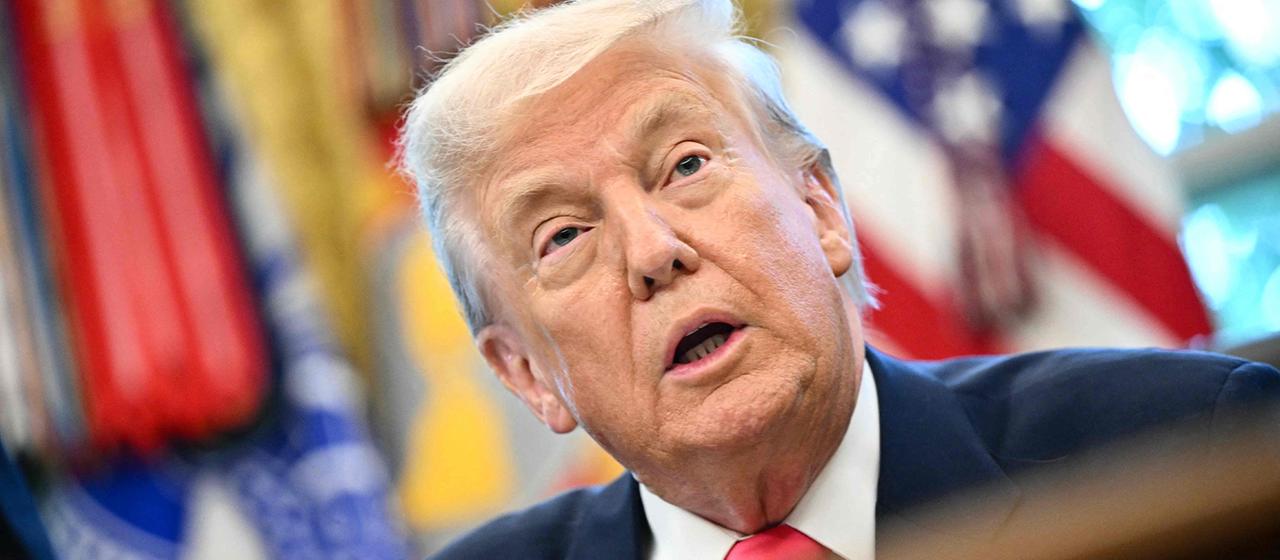
Global equity markets retreated on Friday after U.S. President Donald Trump escalated his trade confrontation with Canada, a move that also raised fears Europe could be the next target and prompted investors to seek relative safety in assets such as gold.
The Canadian dollar weakened after Trump issued a letter late on Thursday announcing that a 35% tariff on all Canadian imports would take effect on August 1. The European Union was also expected to receive formal notification of new tariff measures by the end of the week.
Trump, whose expanding tariff agenda has disrupted global trade and policymaking, has signalled plans to impose across-the-board levies of 15% or 20% on other countries, higher than the current 10% baseline. This week alone, he surprised markets by slapping Brazil, despite its trade surplus with the U.S. with 50% duties, while also targeting copper, pharmaceuticals and semiconductor chips.
Despite sporadic volatility in affected currencies, commodities and equities, financial markets have largely absorbed the steady flow of tariff announcements, leaving the VIX volatility index at its lowest level since late February.
European shares fell, with the STOXX 600 index down 0.8% after gaining about 2% earlier in the week. U.S. equity futures also pointed lower, with S&P 500 and Nasdaq futures down 0.4% to 0.5%, suggesting a pullback from record highs when Wall Street opened later in the day.
“The market is becoming somewhat desensitised to these tariff announcements,” said Fiona Cincotta, a strategist at City Index. “It may take hard economic data showing a clear impact before we see a stronger market reaction.”
She added that while new information has brought some clarity, uncertainty remains high. “There’s still a sense that Trump could be open to negotiations, so nothing feels final yet.”
In currency markets, the U.S. dollar climbed as much as 0.5% against the Canadian dollar before easing to C$1.3697, up about 0.2% on the day. The euro slipped 0.1% to $1.1694 and has lost nearly 1% since the start of July.
Earlier this week, Trump delayed his initial July 9 tariff deadline to August 1 for many trading partners to allow further negotiations. At the same time, he broadened the scope of the trade dispute by setting fresh tariff levels for countries including Japan and South Korea, and imposing a 50% duty on copper.
Joseph Capurso, head of international economics at the Commonwealth Bank of Australia, said the 35% tariff on Canada was less severe than initially feared, as many Canadian exports remain exempt under the United States-Mexico-Canada Agreement.
“The big unknown now is the tariff rate on imports from the EU,” Capurso said. “If that ends up resembling the U.S.-China trade conflict we saw in April, it could be highly destabilising.”
On Wall Street, major indexes closed at record highs on Thursday, buoyed by Nvidia becoming the first company to surpass a $4 trillion market valuation.
Gold extended its rally for a third straight session, rising 0.8% to $3,348 an ounce and lifting its gains for July to 1.2%. U.S. Treasuries, however, saw limited safe-haven demand, as concerns over long-term fiscal sustainability triggered a selloff that pushed yields higher.
The benchmark 10-year Treasury yield rose 3.7 basis points to 4.384%, adding to gains from the previous day after data showed weekly jobless claims unexpectedly declined.
The Japanese yen, another traditional safe-haven currency, continued to weaken as hopes faded for a U.S.-Japan trade deal. The dollar rose 0.45% to 146.93 yen, on track for its biggest weekly gain this year.
Bitcoin surged as much as 4.6% to a record high of $118,832.
Investors are now turning their attention to the upcoming second-quarter earnings season, which begins next week and is expected to shed light on the economic impact of Trump’s tariffs introduced in early April. JPMorgan Chase is scheduled to report results on Tuesday, effectively kicking off the earnings cycle.
Oil prices also edged higher, rising nearly 1% to partially recover from the previous session’s losses, with Brent crude trading at around $69.30 a barrel.