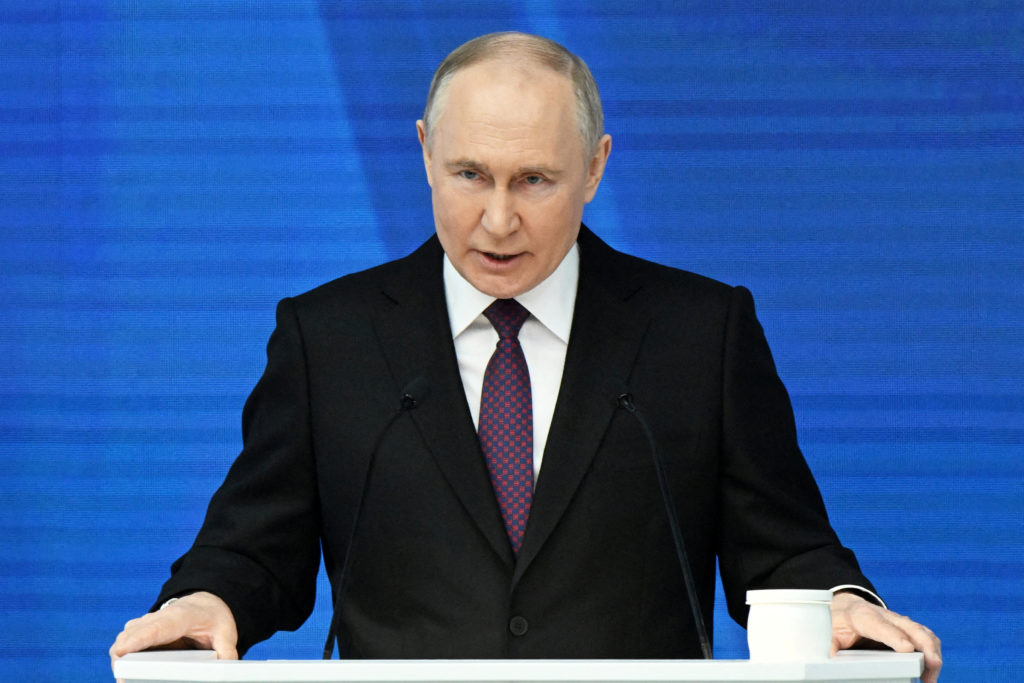
As global diplomacy intensifies around ending the war, Putin rejects compromise on Ukraine, making it clear that Moscow is unwilling to soften its core demands even as US President Donald Trump presses for a negotiated peace. Speaking at a high-profile defense meeting, Russian President Vladimir Putin delivered a blunt message: Russia will pursue its territorial objectives through force if diplomacy fails. His stance complicates already fragile talks and underscores the widening gap between Russia, Ukraine, the United States, and Europe.
At the annual gathering of Russia’s defense leadership, Putin framed Moscow’s position as reasonable but firm. He said Russia preferred diplomacy to end what he called the “root causes” of the conflict, but warned that military action would continue if Ukraine and its backers refused to accept Russia’s conditions.
Those conditions center on territory. Moscow is demanding that Ukraine formally cede regions Russia claims as its own, areas it refers to as “historical lands.” For Kyiv, this remains a red line. Accepting such terms would not only shrink Ukraine’s borders but also legitimize territorial conquest by force, a precedent European leaders fear could destabilize the entire continent.
While Russia has declared several Ukrainian regions annexed, it does not fully control all of them. Military analysts note that Russia’s advances have been slow and costly. At current rates, fully capturing the eastern Donbas region could take years, not months. This reality highlights a key contradiction: Putin is demanding sweeping concessions despite limited progress on the battlefield.
Ukrainian President Volodymyr Zelensky has repeatedly rejected any recognition of occupied territories as Russian, either legally or in practice. In recent remarks, he warned that accepting Russia’s logic of “historical lands” could one day threaten other European countries as well.
President Trump has remained publicly optimistic, suggesting the world is closer to peace than at any previous point. His administration has focused on brokering talks, offering security frameworks, and encouraging compromise. But Putin’s comments show that optimism is not shared in Moscow.
Putin acknowledged dialogue with Washington, signaling that Russia sees the US as the primary negotiating counterpart. Europe, by contrast, was dismissed as politically hostile and unreliable under its current leadership. Putin suggested engagement with Europe would only become possible after a political shift on the continent, a remark that further strains relations.
European leaders are approaching the situation with caution. While supportive of peace efforts, they insist that any agreement must include credible security guarantees for Ukraine. Without them, many fear Russia could simply regroup and attack again in the future.
At a major gathering in Brussels, European officials debated new funding mechanisms for Ukraine, including the possible use of frozen Russian assets or collective borrowing. European Commission President Ursula von der Leyen framed support for Ukraine as central to Europe’s own defense, arguing that the outcome of this war will shape the continent’s security for decades.
The difficulty of reaching a deal lies in fundamentally opposing goals. Ukraine seeks sovereignty, security, and international backing. Europe wants stability and deterrence. The US aims to end a costly conflict without emboldening aggression. Russia, however, is demanding recognition of territorial gains as the price of peace.
When Putin rejects compromise on Ukraine, it signals that Moscow believes time and pressure may still work in its favor, either militarily or politically. This calculation leaves diplomacy stuck, with progress possible only if one side reassesses its core assumptions.
Putin rejects compromise on Ukraine at a moment when international efforts for peace are intensifying, revealing how far apart the negotiating positions remain. While talks continue and proposals circulate, the central issues of territory and security remain unresolved. Until those gaps narrow, the prospect of a lasting peace will remain uncertain, no matter how strong the diplomatic push.