The shocking Bondi Beach attack in Australia has once again drawn international attention to the Philippines Islamist extremism challenge, particularly in the country’s south. As investigators work to understand how a father and son carried out one of Australia’s deadliest mass shootings in decades, their recent travel to the Philippines has become a critical part of the inquiry. The case highlights how long standing militant networks in Southeast Asia still pose risks beyond national borders.
Australian authorities say the suspects, Sajid and Naveed Akram, spent nearly a month in the Philippines before returning home and carrying out the deadly assault. While officials have not confirmed that the trip directly enabled the attack, the connection has revived difficult questions about extremist safe havens, regional cooperation, and how radicalization can cross borders unnoticed.
The Philippines Islamist extremism problem is not new. For decades, militant groups have operated in the southern island of Mindanao, an area with a majority Muslim population in an otherwise largely Catholic country. Groups such as Abu Sayyaf and the Maute network emerged from a mix of ideological extremism, local grievances, and long running separatist conflicts.
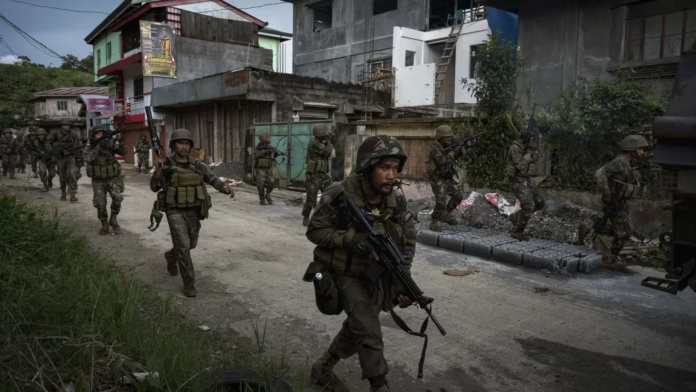
In earlier years, Abu Sayyaf developed links with al Qaeda, later shifting allegiance toward the Islamic State. By the mid 2010s, several factions in the region openly aligned themselves with ISIS, forming what became known as Islamic State East Asia. In 2017, this threat became impossible to ignore when militants seized the city of Marawi, forcing hundreds of thousands of civilians to flee and triggering months of urban warfare.
Experts say Mindanao’s geography and history make it attractive to extremists. Dense forests, remote mountains, and long coastlines provide places to hide, train, and move supplies. At the same time, weak governance in past decades and uneven economic development left some communities feeling marginalized.
These conditions created fertile ground for recruitment and cooperation with foreign extremists. Analysts note that the Philippines has long been viewed as a training ground in Asia, especially during periods when pressure increased on militant groups in the Middle East. Even as global ISIS operations declined, networks in Southeast Asia remained active and adaptable.
Despite this reputation, terrorism in the Philippines has significantly decreased in recent years. The government passed a sweeping anti terrorism law in 2020 that broadened the ability of authorities to disrupt funding, recruitment, and logistical support. Combined with intelligence cooperation, military operations, and community based deradicalization programs, these measures weakened many groups.
Peace agreements with former separatist movements also helped stabilize parts of Mindanao by granting greater autonomy and integrating ex fighters into civilian life. According to global terrorism rankings, the Philippines has fallen sharply from its earlier position among the most affected countries.
Still, experts warn against complacency. Some militant factions remain armed, and splinter groups continue to operate in remote areas and cities alike. These residual networks can still provide inspiration, ideological reinforcement, or limited training to extremists from abroad.
The Bondi investigation underscores how radicalization does not require large scale camps or prolonged training. Authorities in both Australia and the Philippines have stressed that there is no confirmed evidence the attackers trained with militant groups. Even so, the case illustrates how travel, online propaganda, and existing extremist ties can combine into deadly outcomes.
For regional security agencies, the lesson is clear. Counterterrorism efforts must remain cooperative, intelligence driven, and sensitive to local conditions. Labeling entire countries as training hubs risks oversimplifying complex realities and undermining progress made by governments and communities on the ground.
The Bondi attack has pushed Philippines Islamist extremism back into the global conversation, not because the threat is growing, but because it persists in subtle and evolving ways. While the Philippines has made real progress in reducing terrorism, isolated militant networks and unresolved grievances continue to pose risks. Preventing future tragedies will depend on sustained regional cooperation, careful investigation, and addressing the root causes that extremists exploit, both in Southeast Asia and beyond.