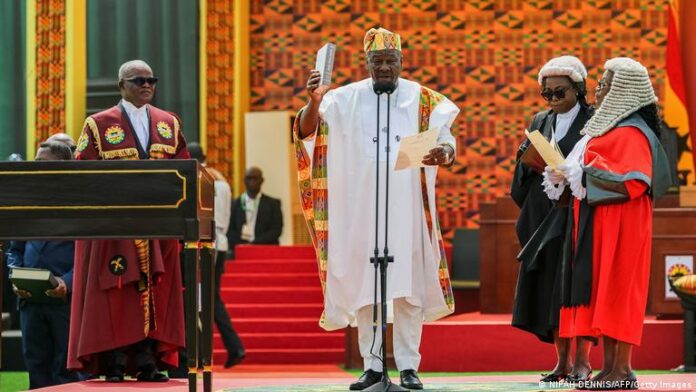
John Dramani Mahama has been sworn in for a second term as Ghana’s president, marking a return to power after eight years in opposition and ushering in a new political chapter for the West African nation.
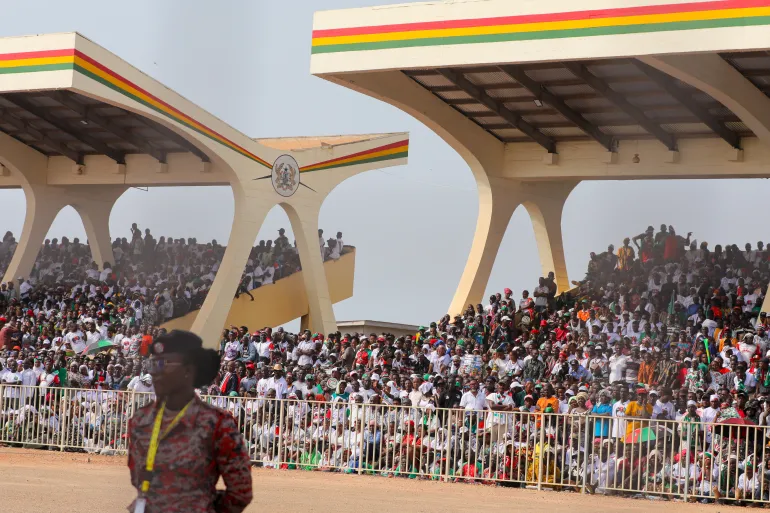
The inauguration ceremony, held at Accra’s Black Star Square, drew around 20 African heads of state and government, underscoring Ghana’s standing as a key political anchor on the continent.
Mahama secured a decisive victory in the December 9 presidential election, winning 56% of the vote to defeat Vice President Mahamudu Bawumia of the ruling New Patriotic Party (NPP), who garnered 41%. He succeeds outgoing President Nana Akufo-Addo, who completed two constitutionally mandated terms in office.
Addressing a jubilant crowd after taking the oath, the 66-year-old president framed his return as a moment of national renewal.
Dressed in traditional Ghanaian attire, Mahama told supporters that his inauguration should serve as “an opportunity to reset our country,” a message that resonated strongly after years of economic strain and political fatigue.
Black Star Square was transformed into a sea of colour as supporters waved Ghanaian flags and those of Mahama’s National Democratic Congress (NDC). Drums echoed across the square as crowds danced, chanted and blew vuvuzelas, creating an atmosphere of celebration and high expectation.
Among the dignitaries in attendance were Nigerian President Bola Ahmed Tinubu, Senegalese President Bassirou Diomaye Faye, Burkina Faso’s leader Ibrahim Traoré, Kenyan President William Ruto, Democratic Republic of the Congo President Félix Tshisekedi and Gabon’s Brice Oligui Nguema.
Mahama was sworn in alongside Jane Naana Opoku-Agyemang, who made history as Ghana’s first female vice president. Her elevation was widely praised as a milestone for gender representation in the country’s political leadership.
Mahama’s return to office brings to an end eight years of NPP rule under Akufo-Addo, whose second term was overshadowed by Ghana’s most severe economic crisis in decades.
That period saw a debt default, soaring inflation and a $3 billion bailout from the International Monetary Fund, factors that played heavily into voter dissatisfaction.
Having previously served as president from 2012 until early 2017, Mahama had twice attempted unsuccessfully to regain power. This time, however, his campaign capitalised on widespread public demand for change, economic relief and renewed social cohesion.
Supporters gathered at the inauguration expressed optimism about the road ahead. “I’ve never been so proud to be Ghanaian,” said Akosua Nyarko, a 28-year-old teacher from Cape Coast, speaking to AFP. “The energy here is amazing. This feels like the dawn of a new era.”
Mohammed Abubakar, a 50-year-old farmer from Tamale in northern Ghana, said he was hopeful Mahama would focus on rural development. “Coming here for this historic moment is a dream come true,” he said, adding that Mahama’s leadership gave him confidence that his children’s future would improve.
Beyond politics, Mahama is also known as a writer and cultural enthusiast. In his memoir, My First Coup d’Etat, And Other True Stories from the Lost Decades of Africa, he reflects on how his childhood was shaped by Ghana’s turbulent political past, including the 1966 military coup that briefly upended his family’s life.
Born in northern Ghana, Mahama grew up in relative privilege; his family home was reportedly the only one in his village with a diesel generator. His father, a junior government minister, was detained and interrogated following the coup but was later released without harm.
Before his presidency, Mahama built a long political career, serving as a member of parliament and later as chairman of the West Africa Caucus at the Pan-African Parliament in Pretoria, roles that helped cement his regional and continental profile.
Ghana’s peaceful transfer of power once again highlights the country’s reputation for political stability. Since the return to multi-party democracy in 1992, the NPP and NDC have alternated in government, reinforcing democratic norms in a region often marked by political upheaval.

As Mahama begins his second term, expectations are high that his administration will stabilise the economy, restore confidence and chart a renewed course for the country’s development.