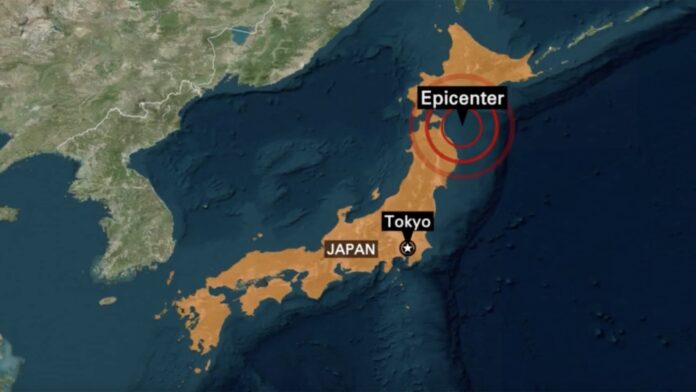
A powerful magnitude 7.6 earthquake struck off the northeastern coast of Japan late Monday, triggering urgent tsunami warnings and evacuation orders for coastal communities.
The temblor shook the region violently, unsettling millions and reviving memories of past disasters. As aftershocks continue and authorities assess the situation, the event stands as another reminder of the constant seismic threat Japan faces.
The late night quake hit around 11:15 p.m. local time, roughly 80 kilometers off the coast of Aomori Prefecture. It registered a magnitude of 7.6 and was centered about 50 kilometers below the seafloor. The shaking reached an upper level on Japans seismic intensity scale, strong enough to damage homes, crack roads and knock heavy items from shelves.
Immediately after the tremor, tsunami warnings were issued for coastal regions in Hokkaido, Aomori and Iwate Prefectures, while surrounding areas were put on alert. Authorities urged residents to leave coastal zones quickly and head for higher ground or sturdy shelters.
Initial observations recorded tsunami waves as high as 70 centimeters in some areas, with smaller surges in others. Although the waves were not large enough to cause widespread destruction, they were strong enough to pose risks for people near the shore. Officials kept warnings active for several hours until the threat level could be fully reassessed.
The earthquake caused rapid disruptions across transportation and power networks. High speed rail lines were temporarily suspended between Fukushima and Aomori as safety checks began. Several expressways were closed and authorities inspected bridges, tunnels and public infrastructure for structural damage.
Power outages were reported in multiple towns across Aomori and Iwate. Emergency crews worked overnight to restore electricity to affected households. Local reports confirmed several injuries, most caused by falling objects or minor structural collapses. One man was seriously hurt when a road caved in beneath his vehicle. In a hotel in Hachinohe, several guests suffered minor injuries when parts of the building were damaged.
The shaking also prompted precautionary inspections at nearby nuclear power facilities. As of early assessments, no irregularities have been detected at major plants. Officials emphasized that more detailed inspections are underway and that residents should stay alert for updated safety guidance.
Local governments issued widespread evacuation orders for low lying coastal regions, with tens of thousands urged to leave their homes. Shelters were opened in schools, community centers and public buildings to host evacuees. Emergency teams assisted elderly residents and families with young children, who often face the greatest difficulty during sudden evacuations.
Japans central government established an emergency task force to coordinate rescue operations, infrastructure inspections and communication efforts. Prime Minister Sanae Takaichi stressed that protecting human life is the highest priority and promised full national support for relief and recovery.
Japan is one of the most earthquake prone countries in the world because it sits on the Ring of Fire, a region of intense tectonic activity. The memory of the 2011 earthquake and tsunami, which killed over 22,000 people and caused a nuclear disaster in Fukushima, still shapes public awareness and emergency planning today.
Monday nights quake highlights how quickly ordinary life can change in coastal regions. Even moderate tsunamis can threaten fishing towns, ports and transportation hubs. Experts warn that aftershocks are likely in the coming days, and residents are urged to remain cautious.
The magnitude 7.6 earthquake serves as a sharp reminder of the ever present seismic dangers along Japans coastline. Overnight, communities faced fear, uncertainty and widespread disruption. Transportation systems halted, homes shook violently and thousands evacuated as officials worked to keep residents safe.
While the immediate tsunami threat has decreased, the quake underscores the importance of preparedness and strong disaster response systems. As authorities continue inspections and provide aid to affected areas, the event will likely reinforce national conversations about coastal resilience, infrastructure safety and future emergency planning.