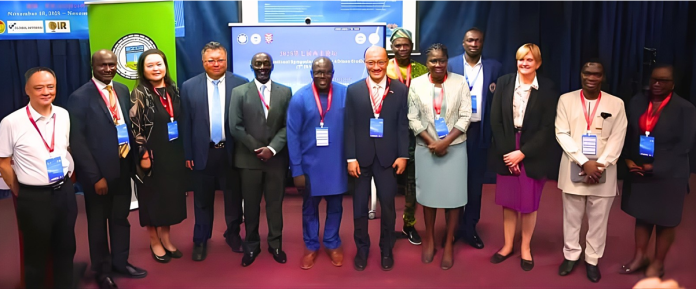
Accra, Ghana — The 7th International Symposium on West African Studies (ISWAS) opened on Wednesday, November 19, 2025, at the Ghana Institute of Management and Public Administration (GIMPA), launching conversations that moved far beyond traditional academic inquiry.
In a series of high-level engagements, diplomats and scholars presented a concrete roadmap outlining how Artificial Intelligence (AI) must evolve from a global buzzword into a catalyst for Equity, Empowerment, and Resilience across the West African sub-region.
The symposium held under the theme Sustainable Economic and Social Development in West Africa: AI Empowerment and Innovation is a tripartite collaboration involving the University of Electronic Science and Technology of China (UESTC), GIMPA, and the University of Cape Coast (UCC).
Delivering a keynote address that bridged diplomacy with practical economics, Tong Defa, the Chinese Ambassador to Ghana, emphasized that the true value of AI lies in its direct application to Ghana’s real economy.
He challenged participants to envision a near future where digital infrastructure fundamentally transforms national productivity. “Let’s imagine: what if AI technology is widely applied in Tema Port, in the cultivation of cassava and cocoa, and in the construction of the Volta Economic Corridor?” Ambassador Tong asked. “I believe it would greatly enhance the production efficiency and economic development of Ghana.”
Ambassador Tong situated his proposals within the broader outcomes of the recent FOCAC Summit in Beijing and the forthcoming China-Africa Year of People-to-People Exchanges. He reaffirmed China’s commitment to supporting developing nations in closing the intelligent divide and ensuring that West Africa secures an influential voice in global AI governance.
Welcoming the delegates, GIMPA Rector Prof. Samuel Kwaku Bonsu reflected on the inaugural ISWAS held at UCC in 2017 and the subsequent Smart City–focused edition at UESTC in China. He noted that the partnership between GIMPA and UESTC has expanded beyond academic exchange to foster deep cultural integration.
“For the West African region, artificial intelligence holds enormous potential and is expected to become a key driving force for achieving sustainable development goals. We also hope that this seminar can further promote capacity building and cooperation, inspire profound reflection and action, and bring greater and more positive impacts to our institutions, countries, and even the entire West African region,” he said.
Representing the Acting Vice-Chancellor of the University of Cape Coast, former Pro-Vice Chancellor Professor Rosemond Boohene cautioned against embracing technology solely for speed.
She stressed that to address challenges such as climate vulnerabilities and education disparities, West Africa must equip its youthful population and its demographic dividend with advanced digital competencies.
“As artificial intelligence reshapes industries, governance, and social systems, West Africa must position itself not only as a participant but as a leader. This symposium offers a unique platform to explore how AI can be leveraged not just as a tool of efficiency, but as a catalyst for equity, empowerment, and resilience,” she added.
Prof. Shurong Zhao, Director of the Center for West African Studies at UESTC, presented the symposium’s comprehensive academic agenda. She noted that the 7th ISWAS will generate a variety of new ideas and innovative technologies that can be adapted to various national contexts depending on political and historical conditions. In her keynote, she also presented findings from a high-impact study identifying risks in E-Business cooperation between China and West Africa, along with strategies to mitigate them.
In another keynote, Prof. Nora Ann Colton, Director of the Global Business School for Health at University College London, discussed how AI is helping address systemic challenges faced by healthcare professionals in the United Kingdom—and how similar applications could help improve healthcare delivery in West Africa.
Addressing the role of AI in public sector transformation, the Head of the Local Government Service, Ingr. Dr. Nana Ato Arthur, called for stronger AI governance and regulation to ensure ethical adoption and application across all areas of public administration.
Professor Rosemond Boohene, in a subsequent presentation, lamented the inadequate integration of Artificial Intelligence within the West African context. She argued that the challenge is not resistance to technology but rather the absence of West African perspectives and data in AI systems. She called for greater regional investment in developing AI ecosystems led by West Africans themselves.
After the plenary sessions, the symposium shifted into six parallel expert seminars featuring over 65 scholars and practitioners.
These sessions translated policy discussions into technical exploration, addressing topics such as big data analytics in public administration, national security, social governance, and strategies for digitally preserving West Africa’s cultural heritage.
The 7th ISWAS is being held with strategic support from the Ghana Chinese Chamber of Commerce and the Center for West Africa Studies (CEWAS).
The Center for West African Studies at UESTC (CWAS-UESTC) was jointly established in April 2017 by UESTC, the University of Ghana (UG), the University of Cape Coast (UCC), GIMPA, Akenten Appiah-Menka University of Skills Training and Entrepreneurial Development (AAMUSTED-UEW), and the University for Development Studies (UDS).
The symposium is also co-hosted by Global Afrisino, underscoring the vital role of private sector investment in strengthening digital capacity across the region. Organizers indicate that the 8th ISWAS will be even larger, as it will form part of the 2026 China-Africa Year of People-to-People Exchange.