When a gunman killed 35 people at Port Arthur in Tasmania in 1996, Australia’s political leaders moved swiftly and in unison to enact some of the toughest gun laws in the Western world.
A Fractured Response to Tragedy
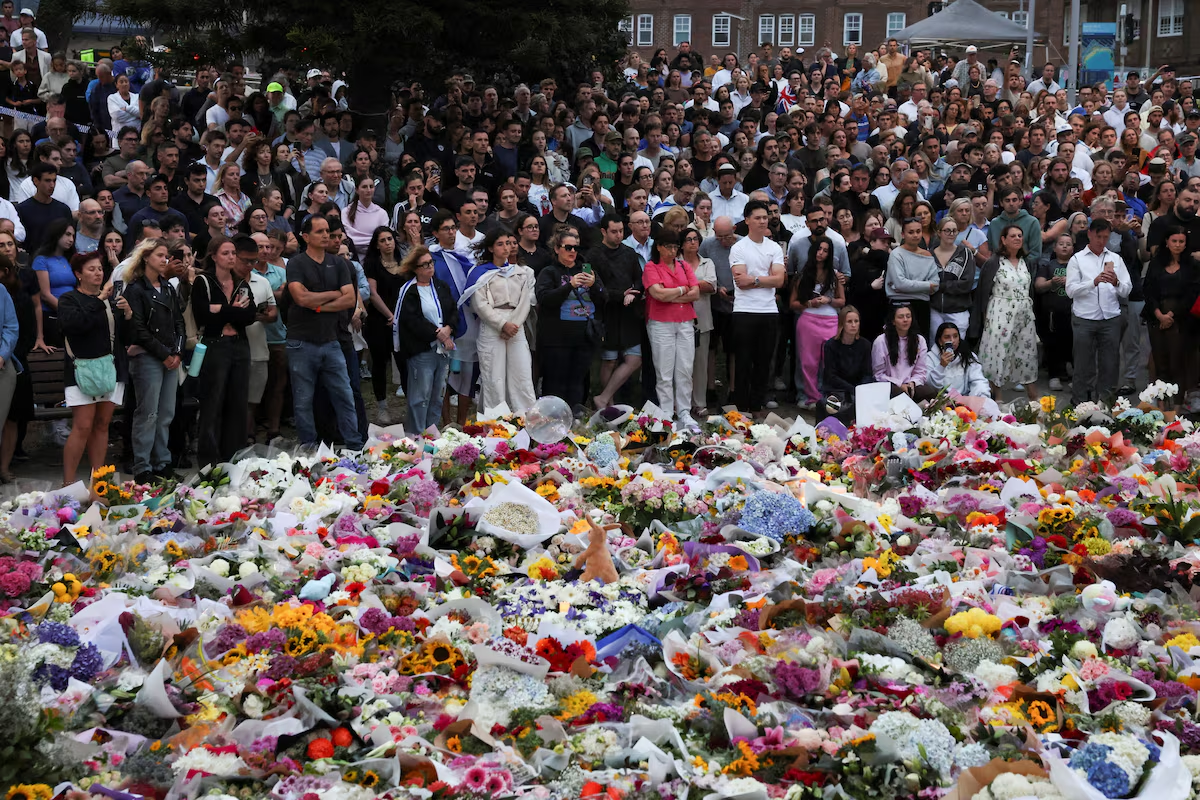
That moment became a defining example of national consensus forged in the aftermath of mass violence. Nearly three decades later, following the killing of 15 people at a Jewish festival at Sydney’s Bondi Beach, that unity is nowhere to be found.
Prime Minister Anthony Albanese’s renewed push for tighter gun controls has instead exposed deep political divisions. His calls for reform are encountering resistance not only from rising right-wing populists but also from parts of the conservative mainstream, underscoring a far more polarized political environment than the one that prevailed after Port Arthur.
“This is not a rally-around-the-flag moment of national unity,” said Simon Jackman, a political scientist at the University of Sydney. “Instead, Albanese is confronting distrust and unhappiness.”
Antisemitism and a Leadership Test
In the days since Sunday’s attack, Albanese has faced criticism from conservative politicians and some Jewish leaders, who argue he has not done enough to confront rising antisemitism in Australia. The criticism has turned the aftermath of the shooting into a defining test of his leadership.
Albanese, whose center-left Labor Party holds a strong majority in parliament, has rejected claims that his government has been complacent. He has defended Labor’s record on antisemitism while announcing new measures aimed at curbing hate speech and protecting targeted communities.
Still, the political fallout has been compounded by the broader context in which the attack occurred: a period marked by the rise of right-wing populism, fueled by public anxieties over immigration, crime and national identity.
The Attack and the Gun Law Gaps
Authorities have said the Bondi attack, which took place during a Hanukkah celebration, was inspired by Islamic State ideology. One of the attackers, Sajid Akram, was shot dead by police. Officials later confirmed that Akram legally owned six firearms and had obtained his gun license in 2023.
The case raised troubling questions. Akram’s son and alleged accomplice, Naveed Akram, had been scrutinized by intelligence agencies in 2019 for alleged links to individuals convicted of terrorism-related offenses. Despite that history, Sajid Akram was able to acquire multiple weapons.
 The revelations have highlighted shortcomings in Australia’s firearms licensing system, particularly in the sharing of intelligence between agencies—gaps that policymakers now say must be closed.
Albanese’s Reform Agenda
On Friday, Albanese outlined a sweeping package of proposed reforms aimed at tightening Australia’s already strict gun laws. The measures include limiting both the number and types of firearms an individual can own, establishing a national firearms register, expanding background checks to incorporate intelligence data, and requiring regular reviews of gun licenses.
Under the plan, gun ownership would also be restricted to Australian citizens. The government would introduce a buyback program for surplus and newly banned firearms, a move Albanese said could remove hundreds of thousands of weapons from circulation.
The proposals mark the opening salvo in what is shaping up to be a contentious political battle, one complicated by the antisemitic dimension of the Bondi attack, which was absent from the Port Arthur massacre.
A Debate Watched Abroad
The debate is being closely monitored in the United States, where Australia’s gun laws are often cited by gun-control advocates as proof that strict regulation can reduce mass shootings. At the same time, American gun lobby groups have long argued that such measures are ineffective.
“In Australia, there has never really been that bedrock idea of gun ownership as a right of citizenship,” Jackman said. “It’s never been there legally or culturally. There is much greater acceptance of the government’s right—indeed its obligation to regulate gun ownership.”
But Jackman noted a shift in tone among Australian conservatives, who are increasingly adopting arguments long familiar in the U.S. gun debate, a stark contrast with the bipartisan consensus of 1996.
Populist Pushback
The populist One Nation party has flatly ruled out supporting tougher firearms laws. Party founder Pauline Hanson visited Bondi this week alongside Barnaby Joyce, a former deputy prime minister who recently defected from the rural-based National Party.
“It is not about the guns. It’s the person behind the guns,” Hanson said.
One Nation, which holds four seats in the Senate, has surged in recent opinion polls, largely at the expense of the conservative Liberal–National coalition.
Conservatives Divided
Liberal leader Sussan Ley has said that tighter gun laws “should be on the table” and that she is open to “sensible” proposals, though she has stopped short of committing to a firm position. Instead, Ley has placed greater emphasis on combating antisemitism.
Her coalition partners in the National Party have been far less receptive. Nationals Senate leader Bridget McKenzie dismissed calls for new restrictions, arguing the focus should remain on terrorism rather than firearms policy.
“This was an act of evil by Islamic terrorists,” she told Reuters, “and that is who the investigation needs to be focused on, not law-abiding gun owners.”
Andrew Willcox, a conservative lawmaker from Queensland, echoed that sentiment, warning against penalizing farmers and sporting shooters. “This is not a gun control issue; it is a leadership and security failure,” he said.
Rural Anxiety and Cultural Fault Lines
Concerns have been particularly acute in rural Australia, where firearms are commonly used for pest control and farming. On the national broadcaster ABC’s “Country Hour,” farmers and hunters voiced fears about how sweeping the proposed changes might be.
Grant Roberts, who runs a 186,000-acre cattle property in outback New South Wales, said feral animals pose a constant threat. He owns three firearms, all kept locked away.
“We need our guns, no question,” Roberts said. “Will the government listen? How dramatic will the change be?”
Liberal lawmaker Andrew Hastie, a gun-club member and former soldier, declined to say whether he supports tighter gun control, calling the debate “a massive deflection from the prime minister.”
The Shadow of 1996
John Howard, the former prime minister who spearheaded Australia’s landmark gun reforms after Port Arthur, including bans on semiautomatic weapons and a nationwide buyback said this week that gun control should not become a distraction from confronting antisemitism.
Albanese, however, insisted the government must address both the motive and the means behind the Bondi attack.
“There’s something wrong with the licensing laws when this guy can have six high-powered rifles,” Albanese said, referring to Sajid Akram.
A Global and Political Shift
The divisions now playing out reflect a broader global trend, in which populist movements are increasingly challenging long-standing policy consensus on issues ranging from immigration to gun control.
Arthur Sinodinos, a former Australian ambassador to the United States and adviser to Howard, said he doubts bipartisan agreement on firearms reform will be achievable in 2025.
“What is different today is that One Nation is there, it is much stronger, and it will capitalize on this issue,” Sinodinos said. “They see a constituency in the bush.”
For the Liberal Party, outright opposition to tighter gun laws carries risks of its own, particularly in major cities like Sydney and Melbourne, where the party has already lost traditional strongholds to centrist independents.
Public Opinion and International Voices
Polling suggests most Australians support stronger gun laws. A January survey by the Australia Institute found that 64% favored tougher restrictions, while about a quarter wanted no change and only 6% supported rolling regulations back. Support for stricter laws was weakest among One Nation voters.
In the United States, reactions split along familiar lines. President Donald Trump said the Bondi attack underscored the need for the world to “stand together against the evil forces of radical Islamic terrorism.” Former Republican presidential contender Nikki Haley argued Australia did not need to tighten its gun laws further.
What Comes Next
Australia traditionally slows its political pace during the southern hemisphere summer, a pause that could offer Albanese some breathing room, Jackman said. But he cautioned that pressure could soon mount on Ley from right-wing challengers within the Liberal Party. Hastie, among others, is widely viewed as a potential contender.
As the debate unfolds, the contrast with 1996 looms large. Where once tragedy forged unity, today it is revealing the depth of Australia’s political and cultural divides.