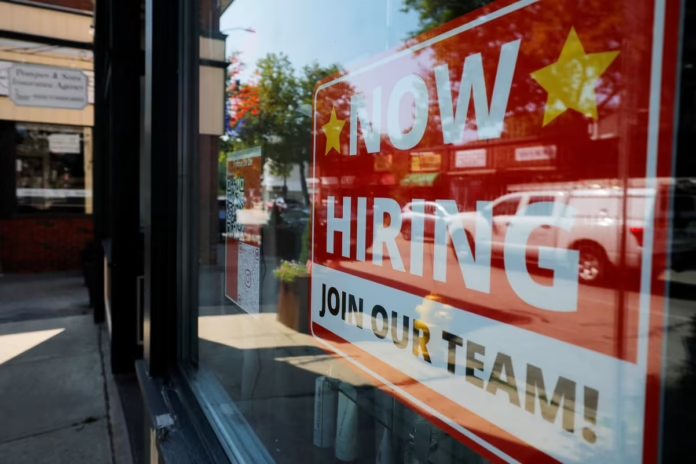
For years, Americans worried about layoffs and sudden job losses. Now, a different fear is taking hold: a stuck US job market that feels frozen in place. Jobs still exist, paychecks are still coming in for many workers, but opportunities to move up, switch roles, or reenter the workforce are becoming harder to find. The latest employment data reinforces what many households already feel. The economy is moving, but the labor market is barely shifting.
This stuck US job market has created a strange sense of limbo. People with jobs are reluctant to leave them, while those searching for work are facing longer waits, fewer callbacks, and rising frustration.
Recent jobs reports show that employers are still adding workers, but at one of the slowest rates seen outside of recessions over the past two decades. Hiring has cooled without collapsing, producing what economists call a “low-hire, low-fire” environment. Companies are not aggressively expanding, but they are also hesitant to cut staff after the painful labor shortages of recent years.
Unemployment has edged higher in part because more Americans are looking for work and not finding it. Long-term unemployment is rising, discouraged workers are quietly stepping back from job searches, and the gap between high-income and low-income households continues to widen.
In practical terms, this means fewer chances to negotiate higher pay, fewer promotions, and limited mobility for workers who feel stuck in roles they may have outgrown.
One reason the stuck US job market may persist is demographics. As baby boomers retire, the labor force is shrinking. At the same time, tighter immigration policies have reduced the flow of new workers. That combination lowers the number of jobs the economy needs to create each month just to stay balanced.
Some economists estimate that roughly 50,000 new jobs per month may now be enough to keep conditions stable. From a macroeconomic perspective, that can support modest growth, manageable inflation, and steady financial markets. For individual workers, however, stability does not always feel like progress.
This environment tends to favor people who already have assets, in-demand skills, or secure positions. Lower-income households and younger workers are more likely to feel left behind, reinforcing what analysts describe as a K-shaped economy.
There are also forces that could push the labor market from stagnation into deeper trouble. Artificial intelligence is one of the biggest unknowns. In the short term, uncertainty about automation is making companies cautious about hiring. In the longer term, AI could reshape entire industries, changing which skills are valued and which jobs disappear.
Policy uncertainty adds another layer of risk. Shifting trade rules, immigration enforcement, and unclear regulatory paths make long-term planning difficult for businesses. When executives are unsure about future costs or demand, they often delay hiring decisions.
Some economists warn that the most likely way out of a prolonged K-shaped slowdown is a recession that resets the system. That outcome, however, would come with real pain, especially for workers already struggling.
There are paths toward improvement. Interest rate cuts by the Federal Reserve could gradually stimulate hiring, though monetary policy often takes a year or more to show results. Clearer policy direction from Washington could also ease uncertainty and encourage companies to invest and expand payrolls.
Tax changes expected in the coming years may influence business decisions as well, depending on how firms adjust their long-term strategies. Even small improvements in confidence can matter, because the labor market often moves slowly, like a large ship that takes time to change course.
The stuck US job market is not a crisis in the traditional sense, but it is a growing source of anxiety for millions of Americans. Jobs feel harder to get, harder to change, and harder to improve. Without clearer policy signals or a strong economic catalyst, this period of stagnation could linger. For workers, patience and adaptability may be essential, but so is honest recognition that stability alone is no longer enough to feel secure.