The US Senate has passed the Trump defense policy bill, clearing the way for President Donald Trump to sign one of the most significant pieces of legislation shaping America’s military priorities for the coming year. While the bill sailed through Congress with strong bipartisan backing, it did so without changes that some lawmakers say are urgently needed to protect aircraft safety and address unresolved military family concerns.
The legislation, formally known as the National Defense Authorization Act, or NDAA, outlines defense spending, military policy, and strategic priorities at a time of heightened global tension. Yet its passage also highlights how political urgency can sometimes outweigh lingering bipartisan worries.
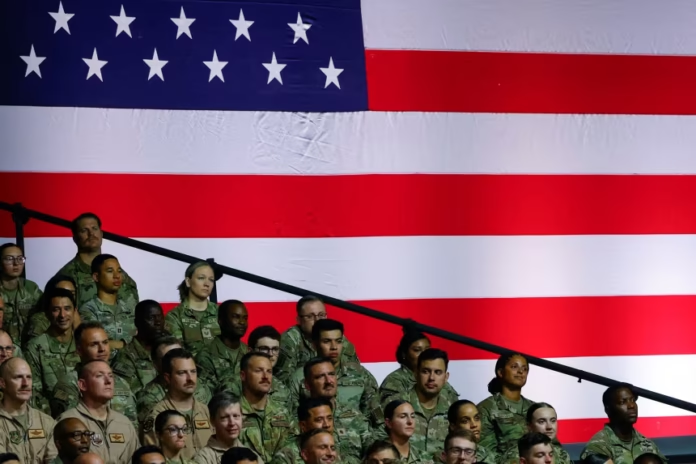
The Trump defense policy bill authorizes nearly 900 billion dollars in funding for military programs and operations. Among its most notable provisions is a 3.8 percent pay raise for US service members, a move widely welcomed by lawmakers from both parties as a necessary response to rising living costs for military families.
The bill also sets the overall direction of US defense policy, covering troop deployments, weapons programs, and oversight of Pentagon operations. It follows the traditional pattern of the NDAA, which Congress has passed annually for more than six decades, often describing it as a must-pass bill to keep the military functioning smoothly.
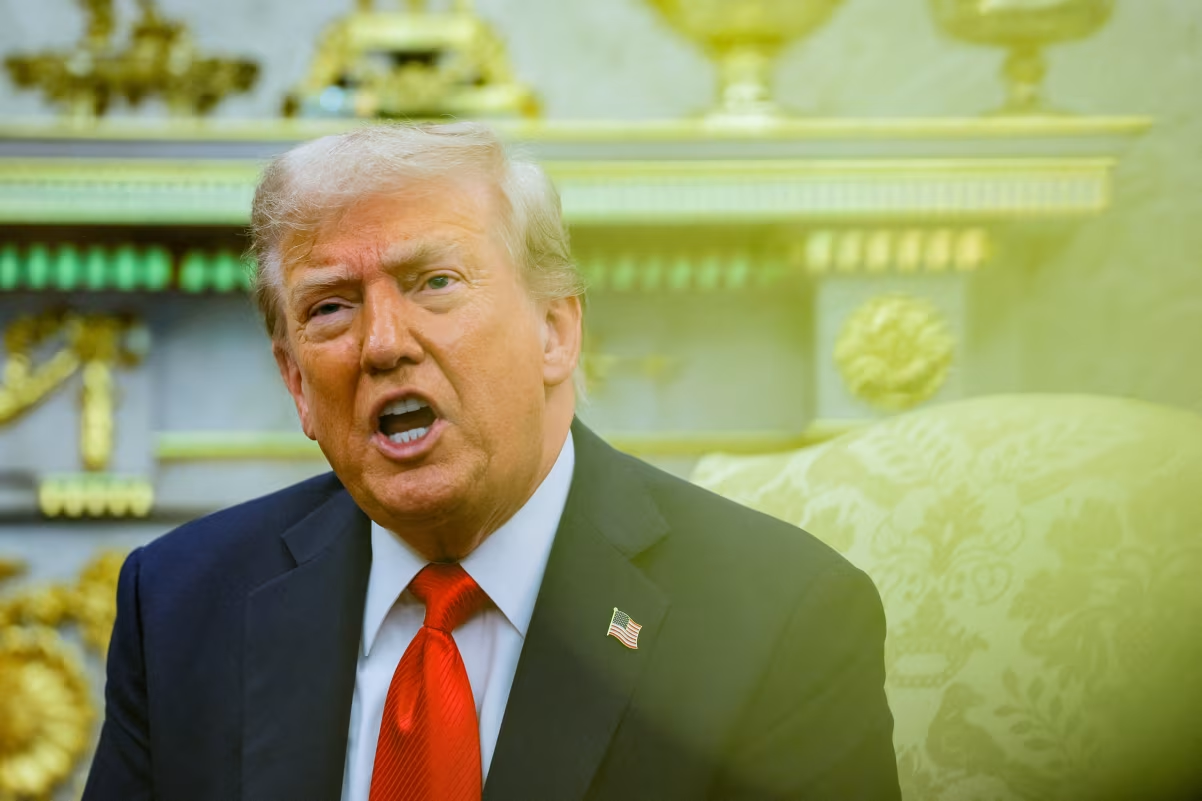
The House of Representatives approved the package last week, and President Trump had already urged Congress to move quickly on it, signaling that he is expected to sign it into law.
Despite broad support, the Trump defense policy bill includes provisions that have drawn criticism and debate. One of the most controversial sections pressures the Pentagon to provide more transparency around US military strikes on suspected drug trafficking boats in the Caribbean.
This provision was added after lawmakers learned of a follow-up strike conducted in early September. Under the bill, Defense Secretary Pete Hegseth’s travel budget would be cut by 25 percent until unedited videos of those strikes are shared with the House and Senate Armed Services Committees. While classified briefings have already been held, Hegseth has made clear that the full footage will not be released publicly.
The bill also repeals outdated authorizations for the use of military force related to Iraq from 1991 and 2002, rolls back certain sanctions on Syria, and seeks to limit the administration’s ability to significantly reduce US troop levels in Europe without congressional input.
Another section restores US support for efforts to locate and return Ukrainian children abducted by Russia, reversing an earlier funding cut that had alarmed human rights advocates and lawmakers.
One of the most contentious issues surrounding the Trump defense policy bill involves aircraft safety. Senators from both parties warned that language in the bill could weaken safeguards put in place after a deadly plane crash near Ronald Reagan Washington National Airport last year.
That crash involved a military helicopter and a commercial airliner, prompting new rules requiring military aircraft to use a more precise tracking system. Lawmakers including Senators Ted Cruz, Maria Cantwell, and Mark Warner pushed for an amendment to ensure those stricter requirements remain in effect.
They argued that the NDAA creates a loophole allowing some military aircraft to revert to less precise systems similar to those used during the fatal collision. Despite these warnings, the amendment was not included in the final bill.
The Senate later passed a separate bipartisan measure to close the loophole, but that legislation still needs approval from the House, leaving safety advocates uneasy.
Beyond aircraft safety, senators raised concerns about what the bill leaves out. Several lawmakers expressed disappointment that language expanding fertility treatment coverage, including in vitro fertilization, for service members under TRICARE was dropped during final negotiations.
Senator Tammy Duckworth and others said the omission was particularly troubling given that both the House and Senate versions initially included the provision. For military families struggling with fertility challenges, the absence feels like a missed opportunity.
With Senate approval secured, the Trump defense policy bill now heads to the White House, where President Trump is expected to sign it into law. While it ensures funding stability for the military and advances several bipartisan priorities, the unresolved safety and family support issues suggest the debate is far from over.
As separate legislation moves through Congress to address aircraft tracking and other concerns, lawmakers will continue balancing the urgency of national defense with the responsibility to protect service members and civilians alike. The passage of this bill may be decisive, but it is not the final word.