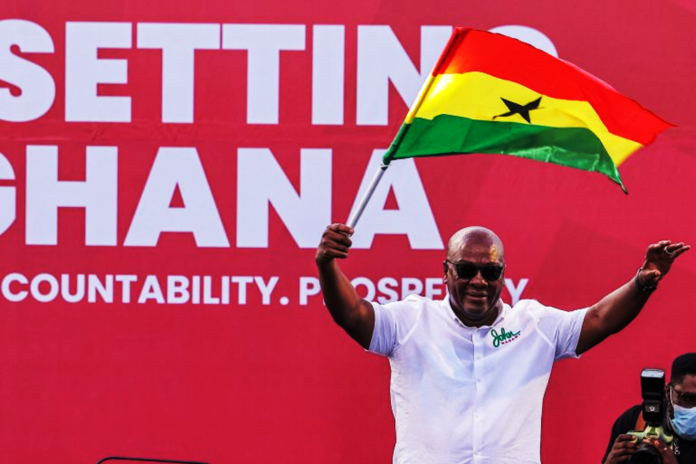
Ghana’s former president John Dramani Mahama has won the country’s presidential election, securing a return to power after his main rival, Vice President Mahamudu Bawumia, conceded defeat and acknowledged the opposition’s victory.
Speaking at a news conference on Sunday, Bawumia said the outcome reflected the will of the electorate. “The people of Ghana have spoken, the people have voted for change at this time and we respect it with all humility,” he said, confirming that he had called Mahama to congratulate him.
The result brings to an end eight years in office for the governing New Patriotic Party (NPP) under President Nana Akufo-Addo. The party’s tenure was dominated by Ghana’s most severe economic crisis in decades, marked by soaring inflation, sharp currency depreciation and a historic debt default that culminated in a $3bn bailout from the International Monetary Fund.
Although the electoral commission had yet to formally declare final results, both parties indicated the outcome was clear.
Sammy Gyamfi, a spokesperson for Mahama’s National Democratic Congress (NDC), said the party’s internal collation showed Mahama winning 56.3% of the vote, compared with 41.3% for Bawumia. “It is very clear the people of this country have voted for change,” Gyamfi told reporters.
Bawumia also described the result as a decisive victory for Mahama, while adding that the NDC had also won control of parliament, according to the NPP’s own internal tally of votes.
Mahama, who served as president from July 2012 to January 2017, confirmed on social media platform X that he had received a congratulatory call from Bawumia following what he described as an “emphatic victory.”
As news of the concession spread, supporters of the 65-year-old opposition leader poured into the streets of the capital, Accra, sounding car horns, waving party flags and celebrating outside the NDC’s campaign headquarters.
During the campaign, Mahama positioned himself as an agent of renewal, promising to “reset” the country after years of economic hardship. He focused much of his message on young voters, who have been particularly affected by unemployment, rising living costs and shrinking economic opportunities.
His victory is historically significant. Mahama becomes the first president in the three decades of Ghana’s Fourth Republic which began with the return to multi-party democracy in 1992 to reclaim the presidency after having previously been voted out of office.
Economic issues loomed large throughout the campaign. Ghana, Africa’s leading gold exporter and one of the world’s top cocoa producers, has struggled with high debt levels, inflation and a weakened currency in recent years.
These challenges were widely seen as central to voter dissatisfaction with the incumbent administration.
On governance and corruption, Mahama pledged during the campaign to establish a new public office to scrutinise government procurement contracts above $5m, arguing that weak oversight of procurement processes has been a major driver of corruption and wasteful spending.
At the same time, he adopted socially conservative positions on some issues, including voicing support for a controversial anti-LGBTQ bill passed by parliament in February. The legislation, which has yet to be signed into law, has drawn sharp criticism from international human rights groups and some of Ghana’s development partners.
The electoral commission had earlier indicated that official results were expected by Tuesday, but the concession by Bawumia effectively settles the contest and paves the way for a smooth transition of power.
Ghana is widely regarded as one of Africa’s most stable democracies. Since the restoration of multi-party politics in 1992, the country’s two dominant parties, the NPP and the NDC have alternated power through largely peaceful and credible elections, reinforcing its reputation as a democratic stronghold in the region.