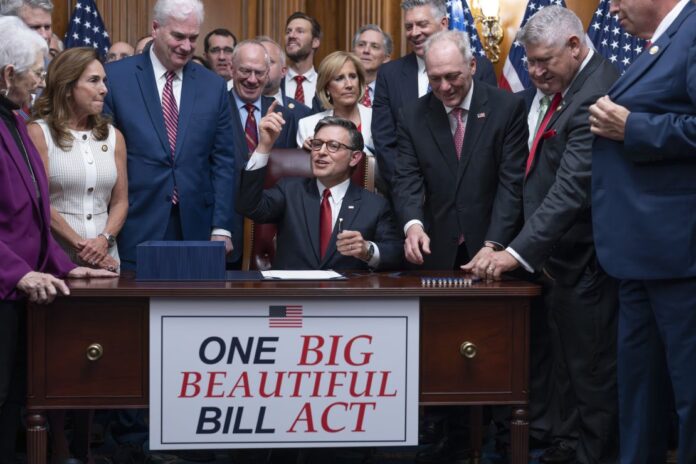
President Donald Trump has hailed the sweeping budget legislation passed by Congress as a “big, beautiful bill,” promising it will rank among the most successful laws in U.S. history. Whether it lives up to that description will depend largely on who benefits and who bears the costs.
The legislation delivers major wins for corporations, higher earners and several industries, while cutting deeply into social safety net programmes relied upon by millions of low-income Americans.
Winners: Corporations, High Earners and Manufacturers
Big business groups, including the U.S. Chamber of Commerce and the Business Roundtable, welcomed the Senate’s passage of the bill this week. At its core, the legislation makes permanent many of the tax breaks introduced under the 2017 Tax Cuts and Jobs Act.
Companies would once again be able to fully write off the cost of equipment in the year it is purchased, restoring a provision that has been phasing out since 2023. The bill also revives immediate deductions for research and development expenses, reversing a rule that forced firms to spread those costs over five years.
Manufacturers stand to gain substantially. The legislation allows businesses to fully and immediately deduct the cost of constructing new manufacturing facilities, a temporary incentive retroactive to January 19, 2025, and available for projects started before January 1, 2029.
Semiconductor firms would receive enhanced tax credits to encourage domestic chip production, a key pillar of U.S. industrial policy.
Small business owners also benefit. The bill preserves a special deduction for pass-through businesses, such as partnerships and sole proprietorships. While the House version sought to raise the deduction from 20% to 23%, the Senate retained the current rate.
Income Gains Tilt Heavily Upward
According to the Penn Wharton Budget Model, the top 20% of earners would see their after-tax income rise by nearly $13,000 a year about a 3% increase. For the wealthiest 0.1%, average annual gains would exceed $290,000.
Residents of high-tax states would also benefit from a temporary expansion of the state and local tax (SALT) deduction cap. The bill raises the limit from $10,000 to $40,000 for households earning up to $500,000, though only for five years.
Workers in tipped and overtime-heavy jobs would receive temporary relief through 2028. Tip earners could deduct up to $25,000 in tip income, while overtime workers could deduct up to $12,500, though income limits apply.
Losers: Low-Income Americans and Safety Net Recipients
At the same time, the bill enacts some of the most significant cuts to the social safety net in decades.
For the first time in Medicaid’s 60-year history, the legislation imposes federal work requirements. It also expands work mandates under the Supplemental Nutrition Assistance Program (SNAP), requiring some parents of children aged 14 and older to work, volunteer or participate in training to maintain benefits.
Analysts expect millions to lose coverage as a result. The Congressional Budget Office (CBO) has warned that few of those dropped from Medicaid would gain employer-sponsored insurance.
Those earning less than $18,000 annually would see their after-tax income fall by $165 — a 1.1% decrease once benefit cuts are accounted for, according to Penn Wharton. Lower-middle earners would see negligible gains, while middle-income households would average a $1,430 increase, or 1.8%.
Healthcare impacts extend beyond the poorest Americans. The Senate also tightened verification rules for Affordable Care Act subsidies, potentially leaving some middle-income families uninsured. Overall, more than 10 million additional people could be without health insurance by 2034, according to CNN’s analysis of CBO forecasts.
Hospitals have strongly opposed the healthcare provisions, warning of rising uncompensated care costs. While the bill includes a $50 billion fund for rural hospitals, industry leaders say it falls far short.
“The real-life consequences of these nearly $1 trillion in Medicaid cuts will result in irreparable harm to our health care system,” said American Hospital Association CEO Rick Pollack.
Energy and Climate Setbacks
The Senate removed a proposed excise tax on wind and solar projects that industry groups had warned would be devastating. However, the bill still phases out renewable energy tax credits by 2027 and adds stricter eligibility requirements.
The American Clean Power Association called the legislation a “step backward” that will raise electricity prices and eliminate jobs.
Electric vehicle makers also lose out. The bill ends EV tax credits of up to $7,500 this September, years earlier than previously scheduled.
Debt and Deficits
The bill would add roughly $3.4 trillion to the federal deficit over the next decade, according to the CBO.
Rising debt is expected to push interest rates higher, making it more expensive for households to buy homes and cars and for businesses to borrow. Federal interest payments are projected to exceed $1 trillion annually already more than triple their 2017 level and higher than the entire U.S. defense budget.
As Trump prepares to sign the bill into law, its legacy appears clear: a major reshaping of the U.S. economy that delivers sizable gains to businesses and higher earners, while shifting costs onto the nation’s most vulnerable and onto future taxpayers.