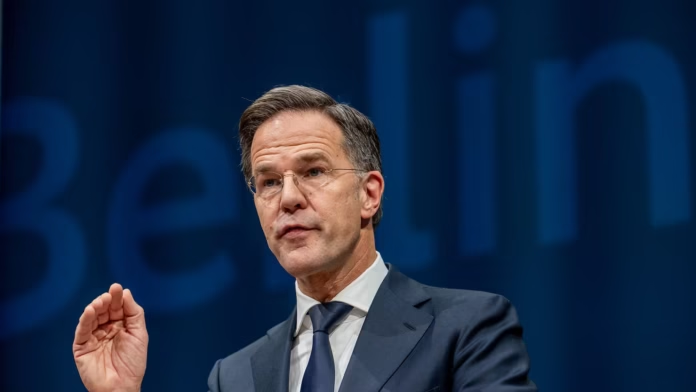
In a stark and urgent message, NATO Secretary General Mark Rutte warned that Europe could be Russia’s next target if Western nations do not take the growing threat from Moscow seriously. Speaking in Berlin to European leaders and defense officials, Rutte underscored the immediate need for stronger deterrence, higher defense budgets, and clearer strategic planning to protect the continent from escalating Russian aggression. His remarks have injected a sense of urgency into discussions on security, alliances, and preparedness across the North Atlantic Treaty Organization.
In his address, Rutte left little room for complacency. He said too many NATO members were failing to grasp the seriousness of the current geopolitical climate and warned that Russia’s actions in Ukraine and elsewhere demonstrate a willingness to challenge European security directly. According to Rutte, the scale of potential conflict could be comparable to major wars of the past, and European allies need to prepare accordingly.
One of the most sobering parts of his message was the suggestion that Russia might be ready to use military force against NATO within the next five years if defenses are not strengthened rapidly. That projection has sent chills through capitals from Lisbon to Tallinn, where leaders are now reassessing their defense postures.
Rutte’s warning comes amid a backdrop of continued Russian military operations in Ukraine and what many Western analysts describe as creeping hybrid warfare tactics elsewhere in Europe. These include cyberattacks, misinformation campaigns, and near incursions into allied airspace. The cumulative effect, Rutte argued, is a landscape where conflict is no longer a distant possibility but something “at our door.”
The Secretary General also highlighted that recent Russian violations of allied airspace and increased activities by intelligence services have underscored the need for vigilance. European nations that believed they were safely removed from frontline tensions are now being reminded that modern missile and drone capabilities can reach deep into allied territory within minutes.
Alongside his warning, Rutte called for a dramatic increase in defense spending among NATO members. In response to the threat, alliance members agreed earlier this year to raise their defense budgets to 5 percent of gross domestic product by 2035, a significant step up from the longstanding 2 percent benchmark. The rationale is simple: better-funded militaries are more capable of deterring aggression and responding swiftly if deterrence fails.
Many European capitals have already begun to boost spending and accelerate weapons production, but Rutte said more needs to be done and done faster if Europe hopes to avoid a full-scale conflict. His call for ramped up defense ties directly to his warning that Europe could be Russia’s next target and that allies must not assume time is on their side.
While Rutte’s comments are sobering, they also came with a reminder that NATO wants to prevent war, not fight it. Strengthening deterrence through military readiness, diplomatic engagement, and solid alliances remains the alliance’s preferred path. Rutte stressed that conflict at Europe’s doorstep does not have to be inevitable if allies commit fully to collective defense and strategic coordination.
This message of urgency has resonated amid broader debates about how much Europe can and should rely on the United States for security, especially as Washington pursues its own evolving foreign policy priorities. Rutte emphasized that a secure Atlantic requires strong European and American contributions, reinforcing the idea that alliances must adapt to emerging threats together.
As tensions persist and global actors recalibrate their strategies, the warning that Europe could be Russia’s next target serves as a clarion call for European and NATO leaders. Whether through increased military investment, enhanced cooperation, or strategic deterrence, the message from NATO leadership is clear: the threat from Russia is real, and the time for decisive action is now. Only through united effort can Europe hope to safeguard its future and uphold the stability that has defined the continent for decades.