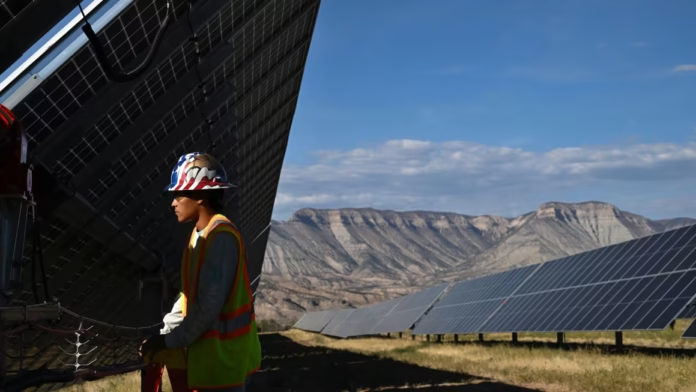
In May, more than a dozen solar company executives gathered at the Capitol Hill Club, a favored meeting spot for Republican lawmakers and lobbyists to make what they believed was a compelling case for preserving clean-energy tax credits.
Wearing pins bearing the slogan “support energy dominance” alongside a gleaming solar panel, they hoped to appeal directly to Republicans who pride themselves on pro-business credentials.
The CEOs arrived with what they thought was an ironclad argument: wind and solar were now cheaper than fossil fuels, utilities were struggling to build them fast enough to meet soaring power demand from AI and data centers, and new factories producing panels, batteries and electric vehicles were creating tens of thousands of jobs in red districts. Eliminating the subsidies, they warned, would raise energy prices nationwide.
“This industry supports the president’s full agenda,” said Costa Nicolaou, CEO of solar mounting firm PanelClaw. “We’re part of their American energy dominance solution.”
But the pitch fell flat. The first draft of President Donald Trump’s sweeping tax and spending bill had already proposed steep cuts to renewable tax credits, and Republican lawmakers under pressure from Trump and his allies ultimately brushed aside industry concerns.
Republicans Unmoved
“They all cried chicken little,” said Sen. Bernie Moreno of Ohio, who helped craft the phaseout language. “Everybody who has any government handout comes here and says the apocalypse will occur if we don’t get this money. None of that’s true.”
For many in the GOP, the tax credits had become inseparable from the Biden administration’s climate agenda what Trump and his allies frequently derided as the “Green New Scam.” Even Republicans representing districts with new energy factories and clean-tech jobs saw little choice but to align with the former president, who had campaigned aggressively on ending the subsidies.
The law, as CNN has reported, is expected to raise electricity prices in every continental U.S. state over the next decade because fewer wind and solar projects will be built, forcing utilities to rely more heavily on costlier gas and coal.
Retiring Sen. Thom Tillis of North Carolina, who opposed the bill, said he was “absolutely” concerned about potential job losses. “It’s not very business-like in its approach,” he said.
Trump’s Opposition Proves Decisive
Interviews with lawmakers, lobbyists and executives suggest the industry underestimated Trump’s commitment to killing the subsidies.
Asked whether clean-energy companies misread the political moment, Rep. Dan Newhouse of Washington replied: “They shouldn’t have. He was signaling pretty strongly.”
Renewables have historically enjoyed bipartisan backing. Republican Sen. Chuck Grassley of Iowa, who authored the original wind tax credit in 1993, once called himself its “father.” But the political landscape shifted after Biden and Democrats extended the credits for ten years in 2022.
For Trump’s allies including the House Freedom Caucus, former administration officials and pro-fossil-fuel author Alex Epstein eliminating the subsidies became a defining ideological fight. Epstein addressed Senate Republicans in June, urging them to “zero out” support for solar and wind, which he labeled “grid-destroying.”
In an email, Epstein said he acted as a “trusted independent advisor” and made “a lot of effort to educate anyone who would listen.”
The Final Bill
When Trump’s bill passed, a decade of technology-neutral tax credits for large-scale wind and solar was pared down to just one more year before a rapid phaseout. Newer technologies such as geothermal and advanced nuclear received more time.
At several stages, the situation worsened for renewables. In the final days before passage, the Senate released bill text including a surprise excise tax on wind and solar, a provision that one source said emerged from the Trump administration and reflected its “hatred on all things Biden.” The tax was ultimately removed after lobbying from Republican Sens. Lisa Murkowski and Joni Ernst.
Jason Grumet, CEO of the American Clean Power Association, said the last-minute changes merely extended the status quo for a single year. “All they did was continue the actual law as it’s existed for the last decade, one more year,” he said.
But opponents of the credits were also dissatisfied. “It did not come close to the President’s stated objective to ‘terminate the Green New Scam,’” Epstein said.
Some Republicans sought a middle path. Sen. Bill Cassidy of Louisiana emphasized that the party should consider investments made under previous rules. “If somebody has made significant investment because of a certain business environment, you don’t pull the rug beneath them,” he said.
Industry Self-Critique
With the dust settling, some in the clean-energy sector acknowledged strategic failures of their own. “We’re zero for every policy fight we have attempted to contest since Trump was elected,” said Steve McBee, CEO of investment firm Huck Capital. He argued the industry should have more forcefully connected the debate to energy costs and reliability.
“We’re not organized for power,” McBee said. “The American Petroleum Institute is stealing our lunch money every morning.”
The oil and gas industry “actively engaged for more than a year” on the bill, said API senior vice president Dustin Meyer, praising the final legislation for encouraging fossil-fuel investment.
Tech giants driving the surge in electricity demand were only lightly involved until late in the process, according to multiple sources, partly to avoid antagonizing Trump.
Grumet acknowledged that the clean-energy sector struggled to unify its message. “The industry is a broad expression of big utilities, oil and gas companies, renewable developers, banks and manufacturers,” he said. “You did have a dilution of advocacy.”
Some lobbyists argued the final outcome could have been worse. Rich Powell, CEO of the Clean Energy Buyers Association, said the bill still provides “a four-to-five-year runway” for some projects.
Economic Consequences Loom
Still, many executives fear the long-term implications: higher electricity prices, lost jobs and uncertainty over whether the U.S. can meet skyrocketing demand from AI and manufacturing.
Powell warned that companies may shift operations abroad if they cannot secure cheap, abundant power in the U.S. “They would prefer to build in the U.S.,” he said. “But if that’s not possible, they will have to look to other places.”
Democrats Prepare the Political Fallout
Democrats say Republicans will have to answer for the consequences.
“Any time a facility closes in one of these members’ districts, there’s going to be accountability,” said Adrian Deveny, founder of Climate Vision and a former senior Democratic Senate aide. “Any time there’s a blackout, they’re going to own that they voted to kill cheap energy investments.”
This article was first published on CNN