Russia is approaching a grim milestone of one million soldiers killed or wounded since launching its full-scale invasion of Ukraine, according to a new analysis that underscores the immense human cost of President Vladimir Putin’s war.
The estimate, published Tuesday by the Center for Strategic and International Studies (CSIS) in Washington, suggests Russia will likely surpass the one-million casualty mark this summer. The think tank called the “stunning” figures evidence of Putin’s “blatant disregard for his soldiers” as the conflict enters its fourth year.
CSIS estimates that of the roughly 950,000 Russian troops killed or injured so far, between 200,000 and 250,000 have died making the war the deadliest conflict for Russia or the former Soviet Union since the Second World War. Ukraine, it said, has sustained nearly 400,000 casualties, including 60,000 to 100,000 fatalities.
Neither country publishes comprehensive casualty data, and both figures from Kyiv and Moscow are widely considered unreliable. However, the CSIS assessment aligns with recent British and U.S. intelligence estimates. In March, the UK defence ministry said Russia had suffered around 900,000 casualties, and has for months assessed that Moscow is losing roughly 1,000 soldiers per day, killed or wounded.
“Meat-grinder” tactics and minimal gains
While Russia continues to claim battlefield momentum, the study challenges assertions by some Western lawmakers that Moscow “holds all the cards.” It argues that Russia’s performance has been “relatively poor,” citing the staggering casualty rate, heavy equipment losses, and minimal advances.
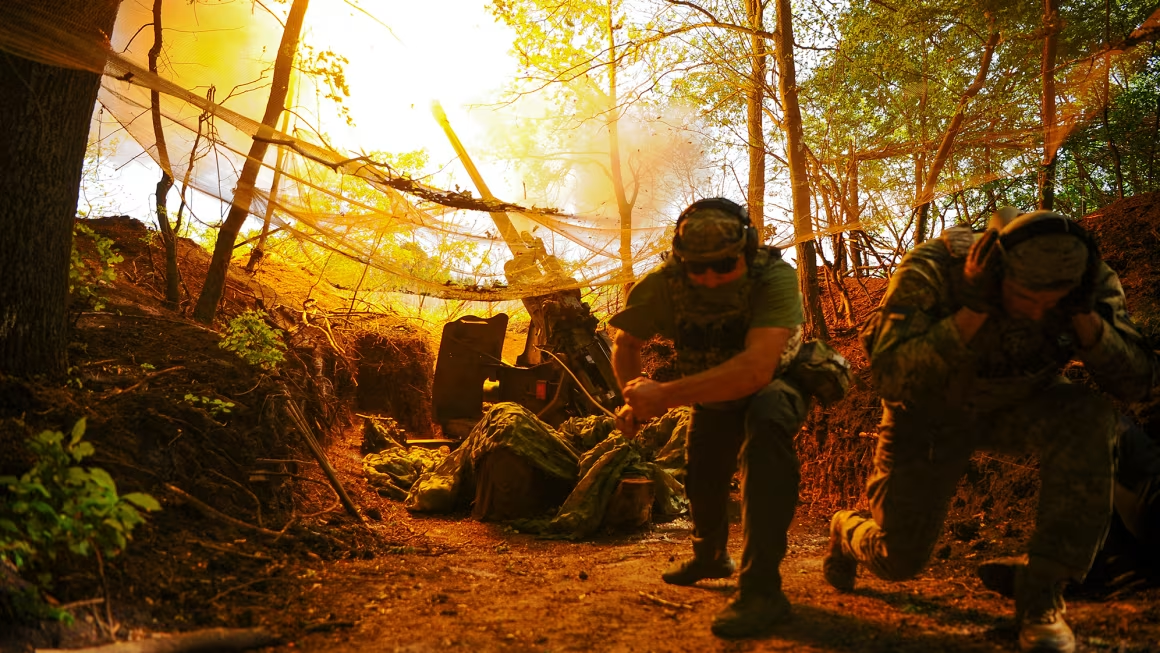
After Ukraine repelled Russia’s initial assault in early 2022, the conflict hardened into an attritional war of trenches, artillery, and minefields. Moscow has increasingly relied on massed infantry assaults described by the report as “meat-grinder” tactics to achieve limited objectives.
In the northeastern Kharkiv region, Russian troops have advanced an average of only 50 metres per day, according to CSIS, slower than the British and French advances during the First World War Battle of the Somme.
Since January 2024, Russia has captured only 1% of additional Ukrainian territory, the report says, calling the gains “paltry.” Moscow currently occupies about 20% of Ukraine, including Crimea, which it annexed in 2014.
Mobilising convicts and foreign troops
To sustain its manpower levels, the Kremlin has enlisted tens of thousands of convicts from Russian prisons and welcomed more than 10,000 North Korean soldiers, the report claims. Yet the burden of mobilisation has fallen unevenly.
The children of Moscow and St. Petersburg’s elite remain largely untouched, while recruitment has focused heavily on poorer regions in Russia’s far north and far east, where the financial incentives are more attractive. These recruits, the authors argue, are viewed by the Kremlin as more “expendable” and less likely to threaten domestic stability.
Ukraine, with a population about one-quarter the size of Russia’s, has faced internal resistance to further mobilisation. But in Russia where open criticism of the war is illegal, there has been little public dissent despite the soaring casualties.
A long war with few breakthroughs
Although Russia has held the initiative since early 2024, the report says the grinding, attritional nature of the conflict leaves “few opportunities for decisive breakthroughs.” Instead, it warns that Russia’s best chance of forcing a victory may lie not on the battlefield, but in Washington.
The authors say Moscow’s most plausible path to winning the war is if the United States cuts off military support to Ukraine, as happened briefly earlier this year under President Donald Trump, and “walks away from the conflict” entirely.
For now, the study concludes, the war continues to exact a “devastating blood cost”, one that could become a growing vulnerability for the Kremlin as the conflict drags on.
This article was first published on CNN