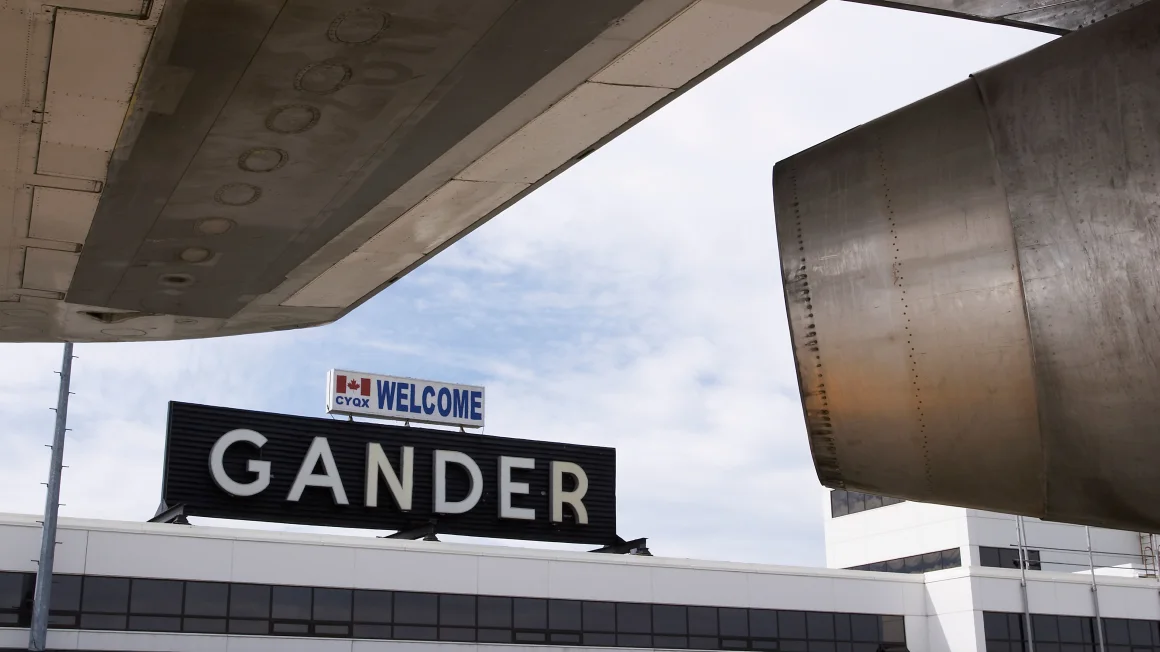
Gander International Airport history is one of the most fascinating in global aviation. Nestled in Newfoundland, Canada, this small airport has played an outsized role in transatlantic travel, military operations, and even Broadway. From being a lifeline during World War II to welcoming thousands of stranded passengers during 9/11, Gander has earned a place in both aviation and cultural history.
A Gateway to the Skies
Gander became a landmark in aviation history when early pioneers like Alcock and Brown and Amelia Earhart used the area as a launching point for record-breaking flights. Recognizing its strategic location between North America and Europe, the Canadian government opened Gander International Airport in 1938.
By the 1940s, during World War II, the airport was a vital hub for Allied aircraft ferrying supplies and troops across the Atlantic.

The Perfect Refueling Stop
In the mid-20th century, long before jet engines eliminated the need for mid-Atlantic fuel stops, Gander was one of the busiest airports in the world. Airlines such as Pan Am and BOAC (later British Airways) relied on the airport as a critical refueling point.
By the 1950s, Gander was handling 13,000 aircraft annually and over 250,000 passengers. Soon after, the town of Gander itself grew around the airport, its very streets named after aviation legends like Charles Lindbergh.
A Mid-Century Marvel
The Canadian government invested in a strikingly modern terminal to leave a strong impression on international travelers. Opened by Queen Elizabeth II, the terminal became a mid-century icon, featuring furniture by Charles and Ray Eames and artwork by Canadian artist Kenneth Lochhead.
During the Cold War, Gander played an unexpected role as a gateway for airlines from Eastern Europe and the Soviet Union, many of which were barred from US airports. Flights from East Germany, Czechoslovakia, and Cuba regularly touched down in Newfoundland.
Even celebrities and world leaders—including The Beatles, Marilyn Monroe, and Fidel Castro—passed through Gander’s iconic terminal.

Operation Yellow Ribbon
On September 11, 2001, when US airspace shut down, 38 aircraft carrying nearly 7,000 passengers were diverted to Gander. The town, with fewer than 12,000 residents, nearly doubled in size overnight.

Despite the crisis, residents welcomed passengers into their homes, providing food, shelter, and care. This extraordinary show of compassion became known as Operation Yellow Ribbon.
Broadway and Global Fame
The story was immortalized in the award-winning musical “Come From Away”, which became a global phenomenon on Broadway, London’s West End, and beyond. The production highlighted how a small Canadian town became a beacon of hope and humanity during one of the darkest days in modern history.

Aviation Tourism Hotspot
Although no longer a major international hub, Gander International Airport has reinvented itself as a destination for aviation tourism. Fans of “Come From Away” flock to see the mid-century terminal, historic murals, and the airport that became a symbol of resilience.

Economic Struggles and Renovation
The airport still employs one in five local workers, but passenger traffic has declined sharply in recent decades. The Covid-19 pandemic hit especially hard, cutting traffic by 70% in 2020. However, renovations—including a $1.5 million restoration of the famous lounge—are helping keep Gander relevant.
A Legacy Unlike Any Other
From its strategic role in World War II to its iconic place in 9/11 history, Gander International Airport’s story is one of resilience, compassion, and community spirit. While many airports are remembered for their scale, Gander is remembered for its humanity.
As former residents and visitors often say: “There aren’t many airports in the world that became a Broadway play.”