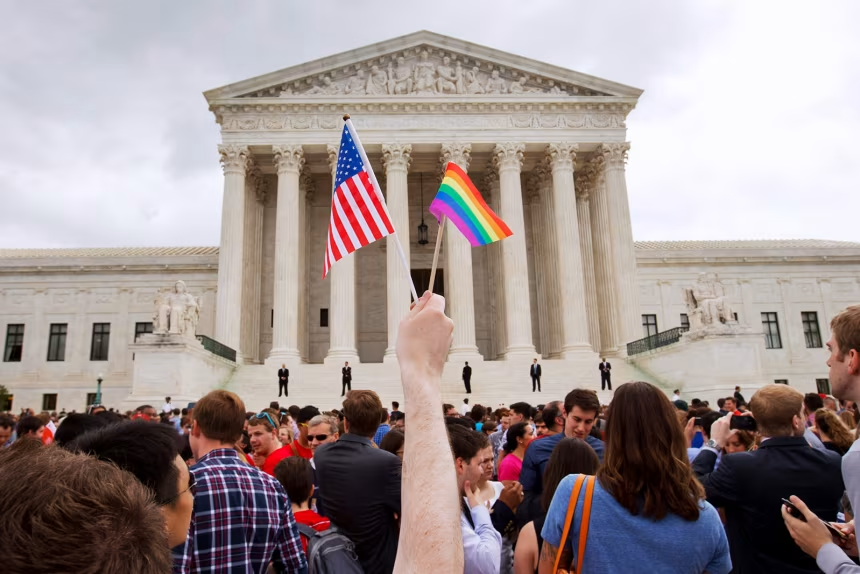
The Supreme Court to weigh longshot bid to overturn same-sex marriage precedent has reignited debate over LGBTQ rights and the stability of landmark rulings in the United States.
As justices prepare to meet behind closed doors, advocates and legal experts are closely watching whether the court will entertain a challenge to its 2015 decision in Obergefell v. Hodges, which legalized same-sex marriage nationwide.
Although most analysts see this as a longshot, the case’s mere appearance on the docket has raised questions about how far the current conservative-majority court might go in revisiting once-settled rights.
At the center of this renewed controversy is Kim Davis, a former Kentucky county clerk who became a national figure in 2015 when she refused to issue marriage licenses to same-sex couples, citing her religious beliefs. Davis’s defiance led to lawsuits, a brief jail sentence, and a protracted legal battle that has now reached the Supreme Court.
Davis’s appeal argues that the justices should overturn Obergefell v. Hodges, calling it a “course correction” necessary to defend religious liberty. Her legal team contends that forcing public officials to recognize same-sex marriage violates the First Amendment’s protection of religious freedom.
The case will be discussed in the court’s private conference this Friday, where justices will decide whether to hear it or let lower court rulings stand.
The Supreme Court to weigh longshot bid to overturn same-sex marriage precedent comes at a politically and culturally sensitive moment. The court’s composition has changed dramatically since 2015, shifting from a moderate-liberal majority to a firmly conservative one.
Justice Anthony Kennedy, who wrote the Obergefell opinion, retired in 2018 and was replaced by Justice Brett Kavanaugh. Justice Ruth Bader Ginsburg’s death in 2020 also shifted the balance further right with the appointment of Justice Amy Coney Barrett.
These changes have fueled skepticism among LGBTQ advocates. “At this point, I do not trust the Supreme Court,” said James Obergefell, the original plaintiff whose name became synonymous with marriage equality.
While a few conservative justices have openly criticized Obergefell, most have shown caution in calling for its reversal. Justice Clarence Thomas previously urged the court to “reconsider” the decision, while Justice Samuel Alito has described it as inconsistent with originalist constitutional interpretation.
However, both Alito and Barrett have acknowledged that overturning a precedent with such deep social and legal roots could have serious consequences. Millions of Americans have since built their families, property rights, and financial plans on the assumption that same-sex marriage is protected by law.
Barrett recently noted the “reliance interests” tied to Obergefell, referring to the principle that courts should hesitate to undo rulings people have come to depend on.
Many legal scholars are comparing this moment to the years leading up to the reversal of Roe v. Wade. That decision, which was overturned in 2022, demonstrated how gradual challenges and cultural shifts can eventually dismantle long-standing precedents.
Some worry that this could be the beginning of a similar campaign. Religious advocacy groups such as Liberty Counsel, which represents Davis, believe the court will eventually revisit Obergefell. “It’s not a matter of if but when it will be overturned,” said Liberty Counsel founder Mathew Staver.
Yet others point to the widespread acceptance of same-sex marriage as a reason for optimism. Polls show that nearly 70% of Americans now support marriage equality, and Congress passed bipartisan legislation in 2022 codifying protections for same-sex and interracial marriages.
It takes four votes for the Supreme Court to agree to hear a case, but five to form a majority. Even if some justices are interested in reconsidering Obergefell, they may hesitate unless they are confident in the outcome.
There’s also the possibility that the court could take up only the narrower issue in Davis’s case—whether public officials can claim religious immunity from damages—without reopening the broader constitutional question.
If the court denies Davis’s petition, it would effectively affirm the lower court’s ruling against her and leave Obergefell untouched. But if it accepts the case, even to discuss procedural questions, it could reignite national debate about LGBTQ rights and judicial stability.
The Supreme Court to weigh longshot bid to overturn same-sex marriage precedent underscores the fragility of even landmark rulings in a shifting political and judicial landscape. For many Americans, Obergefell v. Hodges represents not just a legal victory but a personal milestone marking equality, dignity, and family recognition.
While it remains unlikely that the court will reopen the case this term, the appeal serves as a reminder that cultural and legal progress can never be taken for granted.
The real test may not be whether the court hears Kim Davis’s case, but whether the nation is prepared to defend the principles of equality it fought so hard to achieve.