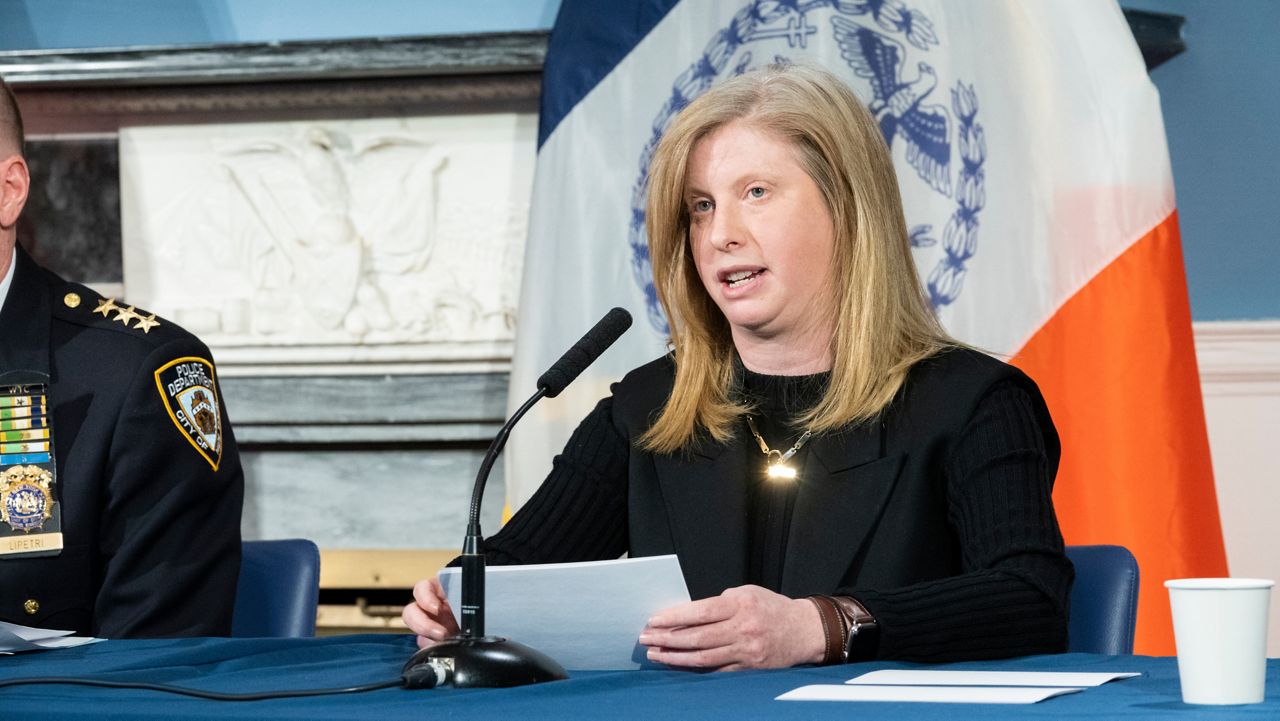
New York City Mayor-elect Zohran Mamdani announced Wednesday that Police Commissioner Jessica Tisch has agreed to remain at the helm of the New York Police Department, cementing the most consequential personnel decision of his incoming administration just weeks before he is set to take office in January.
The move secures continuity at the top of the nation’s largest police force and signals a deliberate effort by Mamdani to balance his progressive political roots with the demands of governing a city where public safety remains a dominant concern.
The decision was far from a foregone conclusion. For weeks after Mamdani’s election victory, uncertainty surrounded whether Tisch, who was appointed by outgoing Mayor Eric Adams would stay on under a mayor whose past rhetoric had often been sharply critical of the NYPD.
Mamdani’s confirmation that Tisch accepted his offer removes a major question mark hanging over the transition and provides an early indication of how he intends to govern: through compromise, coalition-building and institutional stability rather than abrupt ideological shifts.
A compromise forged in politics and pragmatism
Keeping Tisch in place will require concessions on both sides.
Mamdani, a former state lawmaker and longtime critic of aggressive policing practices, once supported defunding the NYPD and has accused the department of systemic failures.
During his successful mayoral run, however, he publicly apologized to police officers for past statements, acknowledging that his words had alienated many in law enforcement and among voters concerned about crime.
Tisch, by contrast, is widely viewed as a technocratic manager with a firm belief in traditional policing tools.
Since taking office, she has advocated rolling back certain criminal justice reforms she argues went too far and expanding so-called quality-of-life policing, an approach that emphasizes enforcement of low-level offenses to maintain public order.
Her philosophy has drawn praise from business groups and police unions, and criticism from civil liberties advocates who see echoes of “broken windows” policing.
In a letter sent to NYPD employees and obtained by CNN, Tisch addressed the ideological gap head-on. “Leading this department is the greatest privilege of my life, and I am proud to continue doing it,” she wrote. “Now, do the Mayor-elect and I agree on everything? No, we don’t. But in speaking with him, it’s clear that we share broad and crucial priorities: the importance of public safety, the need to continue driving down crime, and the need to maintain stability and order across the department. We also agree that you deserve the city’s respect and support.”
Those words underscore the transactional nature of the agreement. Mamdani gains credibility with moderate voters, business leaders and law enforcement officials wary of sweeping change. Tisch, meanwhile, retains her position and the ability to continue shaping policy inside a department that has experienced years of leadership churn and scandal.
A strategic moment in the transition
The announcement marks Mamdani’s highest-profile appointment to date and comes at a critical juncture in his transition. During the final mayoral debate, Mamdani publicly committed to keeping Tisch if elected, a move widely seen as a last-minute attempt to reassure undecided voters particularly older and more moderate Democrats that he would not pursue radical changes to public safety policy.
At the time, Tisch did not publicly respond, and she carefully avoided commenting on the mayoral race or Mamdani’s politics throughout the campaign. Behind the scenes, however, pressure mounted from powerful figures urging continuity. New York Gov. Kathy Hochul, a key ally of law enforcement and a supporter of Tisch, said last week that she was confident the commissioner would remain.
Mamdani and Tisch met privately in the days following the election, but even then it was unclear whether a firm commitment had been reached. The uncertainty reflected both the political sensitivity of the decision and the genuine policy differences between the two. Wednesday’s announcement put an end to the speculation.
Tisch’s record
Jessica Tisch brings to the role a résumé unusual even by New York City standards. An heiress to the Loews family fortune, she has spent much of her career in public service rather than the private sector.
Before becoming police commissioner, she served as the city’s sanitation commissioner and earlier as chief technology officer, earning a reputation as a data-driven manager capable of running large, complex bureaucracies.
She was appointed police commissioner in the wake of a series of high-profile corruption scandals that engulfed the NYPD under Mayor Adams, including investigations into senior leadership and allegations of misconduct that eroded public trust. Tisch’s arrival was widely interpreted as an attempt to stabilize the department and restore credibility after years of turbulence.
Over the past year, the NYPD has reported a sharp drop in overall crime, including reductions in shootings and homicides, alongside aggressive efforts to seize illegal firearms. City officials have touted those figures as evidence that the department has regained its footing, though critics caution that crime trends fluctuate and that some categories such as sexual violence remain stubbornly high.
Still, Tisch’s tenure has been credited with restoring internal discipline, halting questionable promotions and transfers, and re-establishing clearer lines of authority within the department. Those achievements have earned her support from police unions and many rank-and-file officers who were unsettled by years of instability.
A symbolic joint appearance
Shortly after the announcement, Mamdani and Tisch made their first public appearance together at the Fallen Heroes Memorial in Lower Manhattan, a site honoring NYPD officers who have died in the line of duty. The choice of location was heavy with symbolism, signaling respect for the department’s sacrifices and an effort to reset Mamdani’s relationship with law enforcement.
The two walked the memorial grounds as Tisch pointed out the names of recently fallen officers. A small group of uniformed officers accompanied them, shaking Mamdani’s hand as he asked about their careers and experiences on the force.
“I appreciate the moments I just shared with Commissioner Tisch and a number of officers here with us to pay our respects to NYPD officers who lost their lives in the line of duty and to learn a little bit more about the names that so many New Yorkers have come to know, the heroism and the families they left behind,” Mamdani told reporters afterward.
Tisch declined to answer substantive questions, emphasizing that she wanted to keep “politics out” of the moment. “I’m sure there will be plenty of time to discuss all of that,” she said, adding that Mamdani’s decision to begin their public partnership at the memorial was meaningful. “To me it is very meaningful that he asked to come here as our first public venture to visit the memorial.”
The debate over a Department of Community Safety
One of the most significant policy questions looming over the new administration is Mamdani’s proposal to create a Department of Community Safety.
The envisioned civilian agency would handle certain emergency and non-emergency calls particularly those involving mental health crises, homelessness and some domestic disputes—functions that currently fall largely on the NYPD.
Mamdani has argued that police officers are routinely asked to respond to situations for which they are not adequately trained and that doing so diverts resources away from combating serious and violent crime. Under his proposal, police would still be involved when necessary, but specialized teams would take the lead in appropriate cases.
Following the memorial visit, Mamdani suggested that Tisch shared his view. “It’s untenable for officers to be asked to respond to the 200,000 mental health calls they receive every year, to be tasked with the responsibility to deal with the mental health crisis, the homelessness crisis,” he said. “The commissioner and I share a belief in the fact that in order for police officers to be able to do their jobs we also need to create a Department of Community Safety to be tasked with those responsibilities.”
The proposal has drawn mixed reactions. Advocates say it would reduce unnecessary police encounters and improve outcomes for vulnerable populations.
Critics worry it could fragment emergency response systems or leave officers sidelined in dangerous situations. Tisch has not publicly detailed her position, but her willingness to stay suggests she is at least open to discussing how such a department might operate alongside the NYPD.
A test of governing style
Mamdani’s decision to retain Tisch reflects a broader test of his governing philosophy. Elected on a platform that energized younger and more progressive voters, he now faces the challenge of leading a city with deep institutional interests and a diverse electorate that includes many who remain wary of dramatic change to public safety policy.
By keeping Tisch, Mamdani signals that reform, in his view, does not require wholesale disruption. Instead, it may come through incremental change, negotiation and the coexistence of differing perspectives within the same administration. For Tisch, the decision represents an opportunity and a risk to work with a mayor whose political base includes some of the department’s fiercest critics.
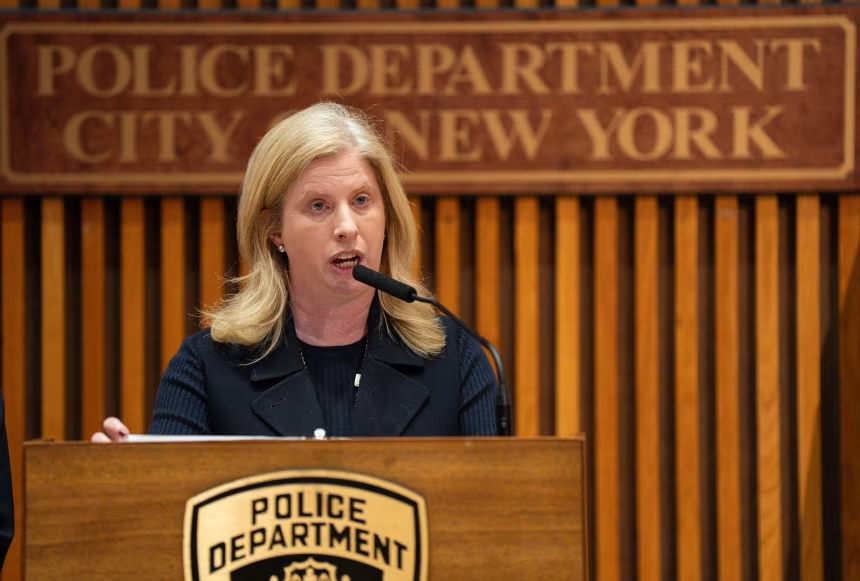 As January approaches, both will be under scrutiny. Supporters will look for signs that crime reductions can be sustained and that trust between police and communities can be rebuilt. Critics will watch closely to see whether Mamdani’s campaign promises translate into policy or are blunted by compromise.
For now, the agreement offers a measure of certainty in a city accustomed to political and institutional upheaval. Whether it marks the beginning of a durable partnership or merely a temporary truce will become clear as New York City’s next chapter in policing and public safety unfolds.
This article was first published on CNN