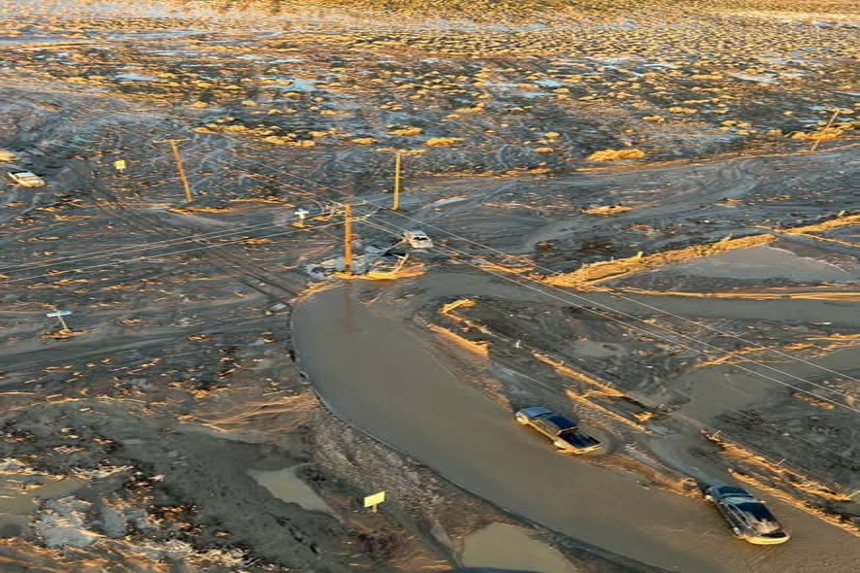
An intense winter storm swept across Southern California on Wednesday, unleashing torrential rain that triggered flash flooding, mudslides, and debris flows, forced evacuations in mountain and coastal communities, and snarled transportation across the Los Angeles region as the holiday season approached.
The storm is part of a larger and unusually persistent weather system expected to bring heavy rainfall to California through the holidays, raising concerns about record precipitation totals and life-threatening conditions in areas already vulnerable from past wildfires and prolonged drought.
For much of Wednesday, wide swaths of Southern California—including Santa Barbara, Ventura, and Los Angeles counties—were under flash flood warnings issued by the National Weather Service. Forecasters later downgraded those warnings to flash flood advisories for parts of southwestern California, but cautioned that risks remained elevated through early Thursday morning as runoff continued to overwhelm creeks, storm drains, and roadways.
Widespread Disruptions and Emergency Rescues
The powerful storm quickly tested the region’s emergency response systems. Fire crews in San Bernardino County went door to door evacuating residents as rushing debris flows overwhelmed mountain roads and neighborhoods. Portions of Highway 2, a key route through the San Gabriel Mountains east of Los Angeles, were shut down after mud, rocks, and fallen trees made travel impossible.
In Los Angeles itself, heavy rain flooded stretches of Interstate 5 in the San Fernando Valley, prompting officials to close northbound lanes during the morning commute. Water rescues were reported in at least Los Angeles and San Bernardino counties, as fast-moving floodwaters trapped drivers and residents in low-lying areas. Authorities also reported multiple mudslides and rockslides across hillside neighborhoods in the Los Angeles Basin.
Emergency officials repeatedly urged residents to stay off the roads unless absolutely necessary, warning that even experienced drivers could be caught off guard by rapidly changing conditions.
Wrightwood Overwhelmed as Debris Flows Surge
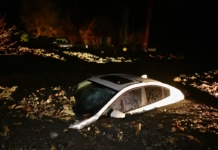
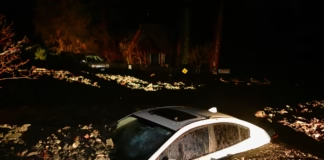
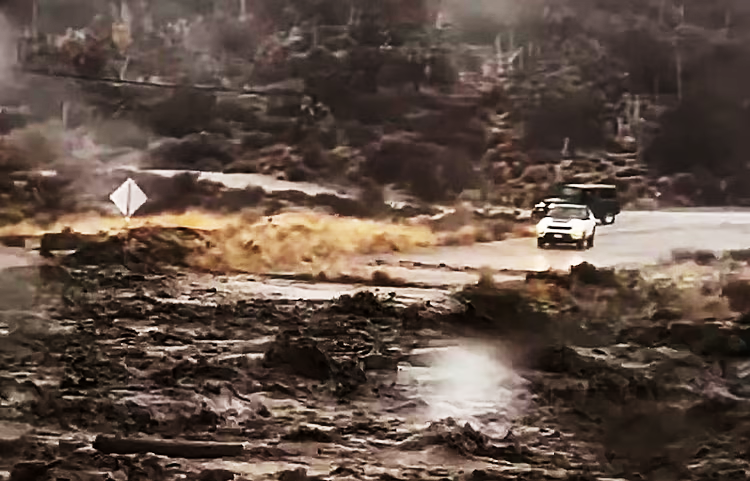
Among the hardest-hit communities was Wrightwood, a ski resort town of about 5,000 people nestled in the San Bernardino Mountains. There, intense rainfall combined with steep terrain to create dangerous debris flows that engulfed roads, vehicles, and homes.
By midmorning, the entire town was under a shelter-in-place warning as rescue crews responded to dozens of emergency calls. Firefighters and sheriff’s deputies moved door to door, urging residents to evacuate from homes and vehicles threatened by flooding and mud.
“Our primary function right now is life safety,” said Christopher Prater, a spokesman for the San Bernardino County Fire Department. “We are focused on getting people out of harm’s way.”
Residents described scenes of chaos as mud and water surged through normally quiet mountain streets, transforming them into rivers of debris.
Officials said the storm posed particular risks in areas still scarred by wildfires that burned across Southern California earlier in the year. Vegetation that once stabilized hillsides has been stripped away, leaving soil loose and prone to collapse when saturated with rain.
“I am urging all Angelenos to stay safe and be extremely careful on the roads if you absolutely must travel,” Los Angeles Mayor Karen Bass said in a statement. “Please do not take this storm lightly.”
California Governor Gavin Newsom declared a state of emergency in six counties, including Los Angeles, Orange, and San Diego, enabling the state to mobilize resources more quickly and request federal assistance if needed.
In San Diego County, the National Weather Service reported between six and eight inches of rain and widespread flash flooding by Wednesday afternoon, with more precipitation forecast overnight.
A Rare “High Risk” Rainfall Alert
The severity of the storm prompted the National Weather Service to issue a rare “high risk” alert for excessive rainfall covering Los Angeles and surrounding areas. Over the past decade, some of the deadliest and most destructive flood events in the United States have occurred under this warning level.
“This is the type of storm system that affects the area approximately every five to ten years,” Ariel Cohen, a meteorologist with the National Weather Service, said during a Tuesday briefing. “There will almost certainly be numerous rockslides and mudslides, along with areas of severe flooding in urban locations and along freeways.”
Cohen warned that driving during the storm would be “exceptionally dangerous,” especially at night when flooding and debris are harder to see.
Mandatory evacuation orders were issued for several vulnerable areas, including neighborhoods in Orange County burned by last year’s Airport Fire, a recreational vehicle resort in Ventura County, and parts of Los Angeles County such as the Pacific Palisades burn zone.
In Trabuco Canyon in Orange County, the U.S. Postal Service halted mail delivery due to unsafe conditions.
However, the timing of the storm just days before Christmas complicated evacuation efforts. Los Angeles Police Chief Jim McDonnell said many residents resisted orders to leave their homes, despite repeated warnings.
Officers visited 126 properties in the Palisades burn zone to distribute evacuation notices, McDonnell said.
“Many of the people probably most of the people in the evacuation area have thanked us for the notification but chosen not to leave,” he said. “I would ask you to seriously reconsider that.”
Economic Toll on Mountain Communities
Beyond the immediate danger, the storm has also dealt a heavy economic blow to communities dependent on tourism, particularly mountain towns like Wrightwood.
Sarah Bailey, who has lived in the area for more than 20 years and operates vacation rental cabins, said the flooding was the worst she had ever seen.
“This is the worst flooding I’ve seen,” Bailey said, adding that she spent the morning fielding calls from guests canceling holiday reservations.
“It’s an economic nightmare,” she said. “Christmas and New Year’s are the biggest two weeks for Wrightwood. That’s where the majority of people in this town make their money.”
Some visitors already in town were unable to leave because roads were closed, while others were stranded as conditions deteriorated.
The storm deepened the misery for Southern California’s thousands of unhoused residents, many of whom had few safe places to seek shelter from the rain.
In downtown Los Angeles’ Little Tokyo neighborhood, Matthew Alexander Consolato brushed his teeth under the awning of a bus stop Wednesday afternoon, trying to stay dry. It was his birthday.
“Pretty horrendous,” Consolato said. “It kind of caught me by surprise. I didn’t think it would be this bad.”
Nearby in Skid Row, Christavis Tillman said he planned to take refuge under an overpass.
“I’m going to go under the bridge and hope I’ll stay dry,” he said.
Advocates have long warned that extreme weather events disproportionately affect people experiencing homelessness, a problem likely to worsen as storms become more intense and frequent.
Meteorologists said the deluge was driven by a series of atmospheric rivers—long, narrow plumes of moisture originating over the Pacific Ocean that can deliver enormous amounts of rain when they make landfall.
While atmospheric rivers are a natural part of California’s climate, scientists say climate change is intensifying them. Warmer air holds more moisture, increasing the likelihood of heavier rainfall and more destructive flooding.
As a result, California has experienced increasingly dramatic swings between prolonged drought and intense storms, challenging infrastructure designed for a more stable climate.
By Wednesday evening, rainfall had eased in some areas, including parts of Los Angeles. Under clearing skies in Santa Monica, residents cautiously emerged from apartments and hotels. On the beach, one young boy even ventured into the ocean for a swim.
But forecasters warned the break would be short-lived.
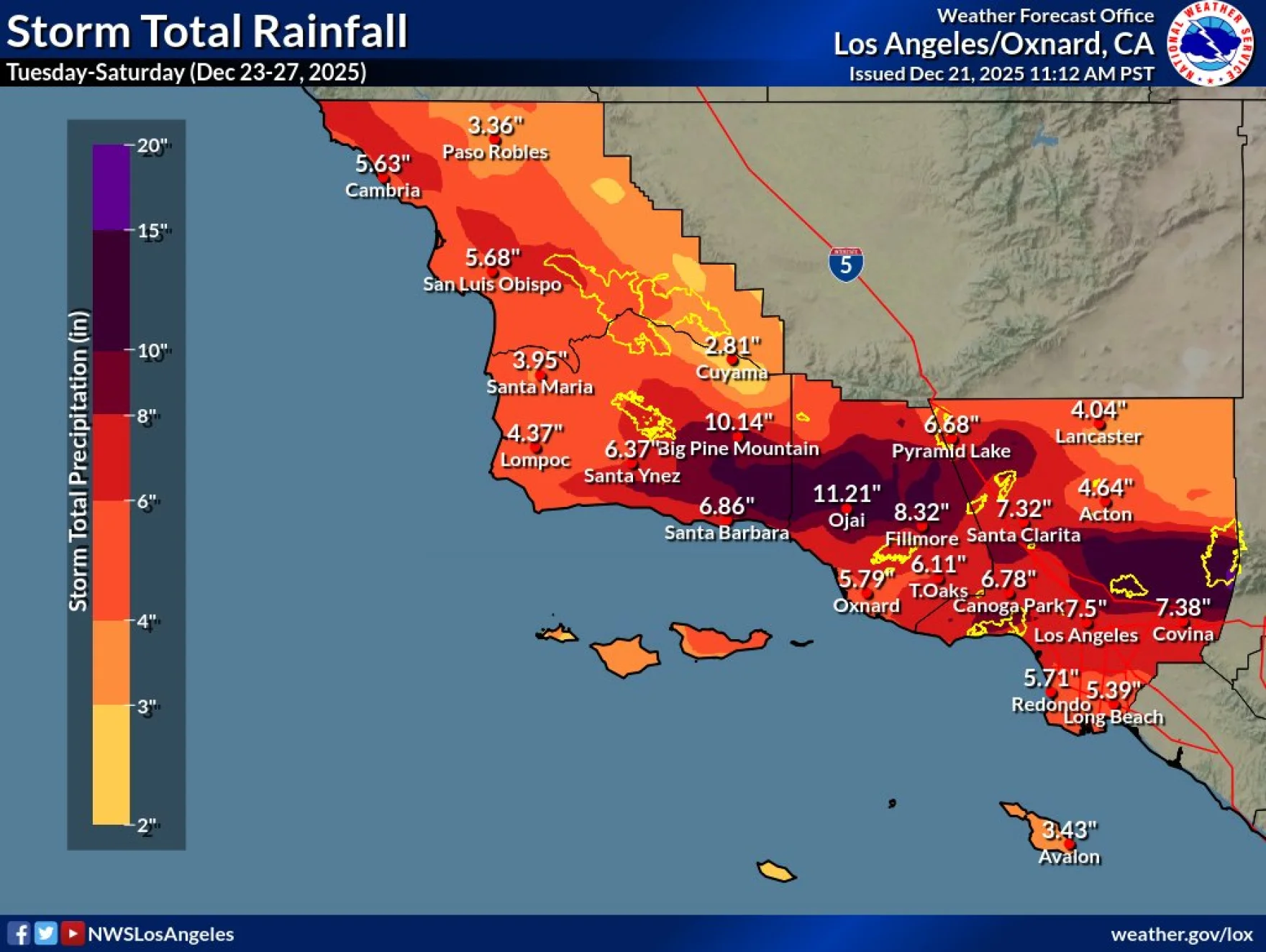
Wednesday’s downpour marked the first of two major waves of rain. Joe Sirard, a meteorologist with the National Weather Service, said precipitation was expected to intensify again Thursday night, bringing another round of heavy rainfall and a few more inches in some locations.
The broader storm system has already soaked Northern and Central California and is expected to dump significant snowfall across the Sierra Nevada, raising avalanche concerns and impacting travel through mountain passes.
Storm’s Reach Extends North
The storm system has already claimed at least one life in Northern California. In Redding, a 74-year-old man died Sunday after driving his pickup truck onto a flooded roadway, according to local police.
Officials statewide urged residents to heed warnings, avoid flooded roads, and prepare for rapidly changing conditions as the storms continue.
As Californians brace for another round of rain, authorities emphasized that vigilance, preparation, and cooperation could mean the difference between safety and tragedy during one of the most dangerous weather events of the season.