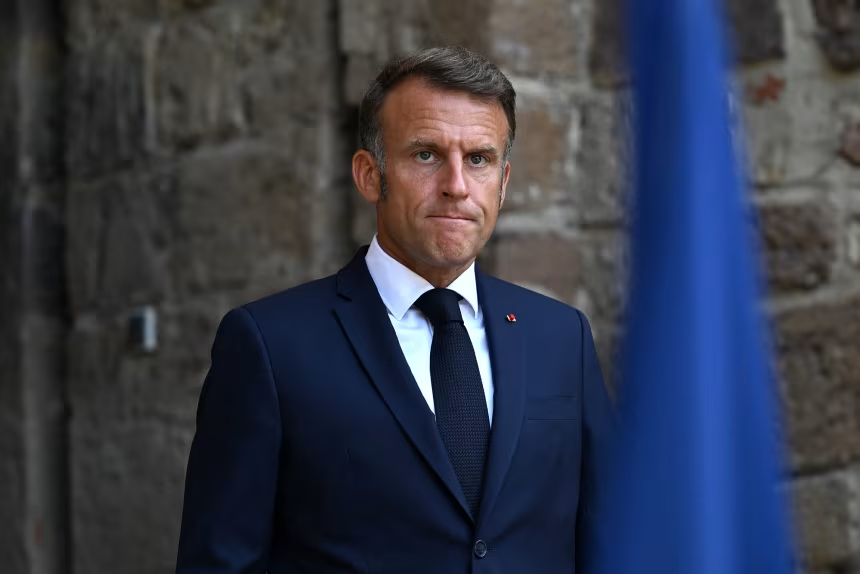
France political crisis 2024 has thrown the country into unprecedented turmoil, with President Emmanuel Macron facing mounting instability and a fractured parliament. The resignation threats against Prime Minister François Bayrou, combined with rising debt concerns and growing influence of far-right and far-left parties, mark one of the most volatile moments in the Fifth Republic’s history.
The current turmoil reflects a deeper political instability that has left France increasingly ungovernable. Bayrou, less than a year in office, is struggling to push through a €44 billion savings plan that includes scrapping two public holidays and freezing government spending. He warns the measures are a matter of “national survival,” pointing to spiraling debt that grows by €12 million every hour.
His predecessors have already fallen victim to similar reforms, with Michel Barnier lasting only three months as prime minister after failing to implement austerity measures.
The political instability has spilled into financial markets. France’s ten-year bond yields have now risen above those of Spain, Portugal, and Greece, and are approaching Italian levels. This is a troubling sign for the Eurozone’s second-largest economy, undermining the image of strength President Emmanuel Macron has sought to project in Europe.
The roots of this crisis can be traced to Macron’s dramatic decision to call a snap election in 2024 after the far-right National Rally scored historic gains in European elections. His centrist party lost ground, leaving parliament deeply divided between the far left and far right.
Unlike Germany or Italy, France lacks a tradition of coalition-building. The Fifth Republic, established by Charles de Gaulle in 1958, was designed to bring stability by granting strong powers to the presidency. But Macron’s disruption of the traditional left-right order in 2017 has now left France in uncharted territory.
For decades, French politics was dominated by two mainstream parties, alternately holding power and ensuring continuity. Macron broke this system, winning the presidency without support from the traditional political blocs.
Re-elected in 2022, he soon lost his parliamentary majority, leaving him dependent on Article 49.3 of the constitution — a controversial mechanism that allows laws to pass without a vote. Opposition anger grew, fueling further instability.
The Future of Bayrou and Macron
If Bayrou loses the confidence vote, Macron will face intense pressure to resign, though he has vowed to serve out his term. Far-right leader Marine Le Pen is demanding fresh elections, which could strengthen her National Rally and further fracture parliament.
Macron’s alternatives are limited to:
Appointing a caretaker government | Selecting a successor from within his cabinet, such as Armed Forces Minister Sébastien Lecornu or Justice Minister Gérald Darmanin | Attempting an alliance with another political family, though both the far left and far right have promised to block such moves
Polls suggest the National Rally would top the vote in any snap election, with the left coming second and Macron’s centrist bloc trailing far behind. Many now believe the far right will eventually take power, if not immediately, then by the 2027 presidential election.
Public anger is also boiling over. Nationwide protests under the slogan Bloquons tout (“block everything”) are planned for September 10, with unions and activist groups calling for mass demonstrations against austerity and political gridlock.
France’s internal crisis comes at a time of international turmoil, with wars in Ukraine and the Middle East. Instability in Paris plays directly into the hands of global rivals, including Russia and the United States, both eager to portray Europe as divided and weak.
Is the Fifth Republic Ending?
Charles de Gaulle founded the Fifth Republic in 1958 to end decades of short-lived governments and chronic instability. For more than 60 years, the system delivered relative stability. Today, however, France stands at a crossroads.
The question is no longer whether Emmanuel Macron can govern effectively, but whether he will be remembered as the president who ended the Fifth Republic’s era of stability.