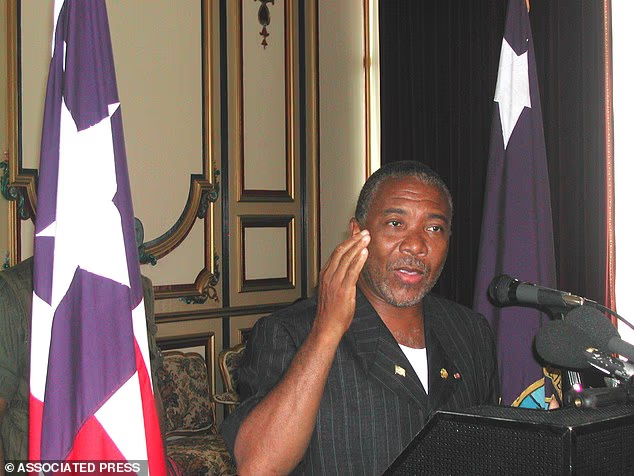
In public appearances, Charles Taylor cultivated the image of a composed and assured statesman. He wore tailored suits, spoke deliberately, and promised peace, stability, and national renewal to a country exhausted by chaos.
To many Liberians and foreign observers unfamiliar with his past, he appeared as a leader capable of restoring order after years of upheaval. But behind that carefully maintained persona stood a man whose influence became inseparable from some of the most extreme violence recorded in modern African history.
Under Taylor’s rise and eventual rule, armed groups in Liberia and neighboring Sierra Leone committed atrocities on a scale that shocked the world. Killings, mutilations, mass rapes, forced recruitment of children, and systematic terror became tools of war.
Human rights organizations have described the period linked to Taylor’s ascent and presidency as among the darkest chapters of the late twentieth century.
By the time the violence subsided, an estimated 250,000 Liberians had been killed across two civil wars. Hundreds of thousands more were raped, maimed, displaced, or permanently traumatized. Entire generations were shaped by brutality.
From Political Collapse to Civil War
Liberia’s descent into catastrophe did not begin with Taylor. Long before his name became synonymous with war, the country was already unraveling.
In 1980, Master Sergeant Samuel Doe seized power in a violent coup that overthrew Liberia’s long-standing political elite.
For more than a century, national power had been dominated by Americo-Liberians, descendants of freed American slaves who controlled government and commerce while most indigenous communities remained excluded. Doe’s coup was initially welcomed by many who hoped it would end decades of inequality.
That hope quickly faded. Doe’s regime became notorious for torture, ethnic targeting, political assassinations, and executions.
He filled senior military and government positions with members of his own Krahn ethnic group, fueling resentment among other communities, particularly the Gio and Mano peoples of northern Liberia.
Corruption flourished, the economy collapsed, and political opposition was crushed. Doe’s own forces committed widespread atrocities, deepening ethnic divisions and leaving the country fractured and fearful. By the late 1980s, Liberia was teetering on the edge of total collapse.
It was into this volatile environment that Charles Taylor emerged. Educated in the United States, Taylor had worked within the Liberian government before being accused of embezzling public funds.
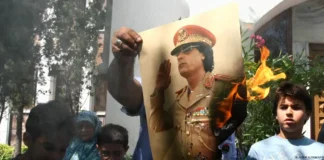
He was arrested in Massachusetts but escaped from jail under circumstances that remain murky. From there, he traveled to Libya, where he received military training alongside other insurgents supported by Muammar Gaddafi.
In December 1989, Taylor crossed into Liberia from Côte d’Ivoire with a small armed group. That incursion marked the beginning of a conflict that would engulf the region.
Taylor’s fighters quickly seized towns, drawing support from communities that had suffered under Doe’s rule. But they were soon joined by rival factions, some opposed to Doe, others opposed to Taylor himself.
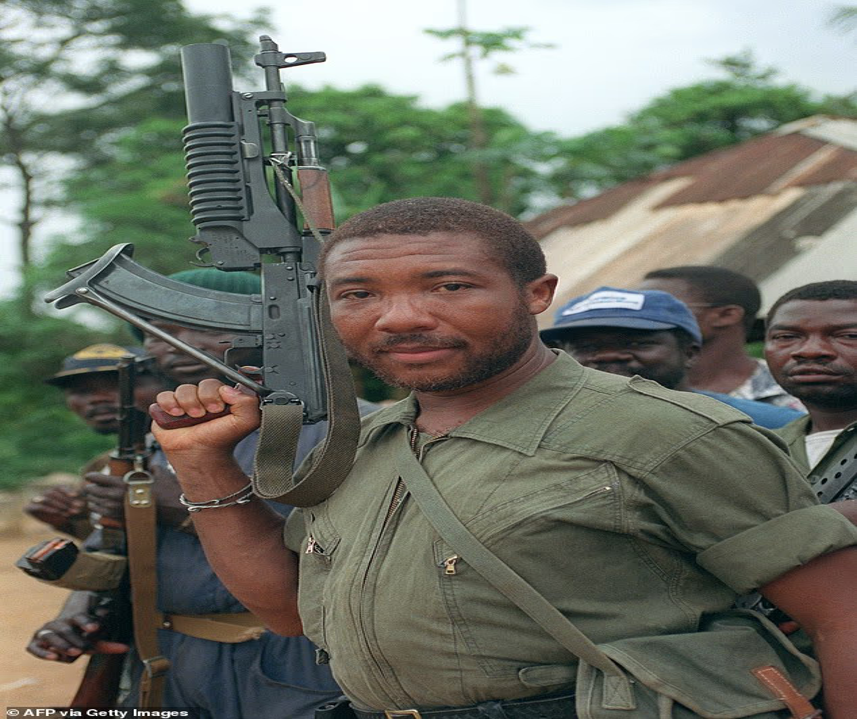
What followed was not a clean rebellion but a chaotic, multi-sided war. Markets were burned, schools destroyed, and villages emptied. Monrovia, the capital, was fought over repeatedly and reduced to ruins more than once. By the mid-1990s, much of Liberia resembled a battlefield without front lines, where civilians bore the brunt of the violence.
Children Turned into Weapons of War
Children were among the earliest and most devastatingly affected victims. Human Rights Watch documented the recruitment of boys as young as ten. Some were seized from villages, others abducted at checkpoints.
One boy later told Liberia’s Truth and Reconciliation Commission that fighters dragged him from hiding, placed a rifle in his hands, and ordered him to shoot a captive. When he hesitated, they threatened to kill him.
Terrified, he pulled the trigger, believing he had no alternative. Other boys described witnessing executions and being told that refusal to fight would result in their own deaths.
One of the most harrowing practices involved forcing children to kill family members as a form of initiation. Investigators recorded testimony describing boys ordered to murder their parents, with refusal often leading to execution.
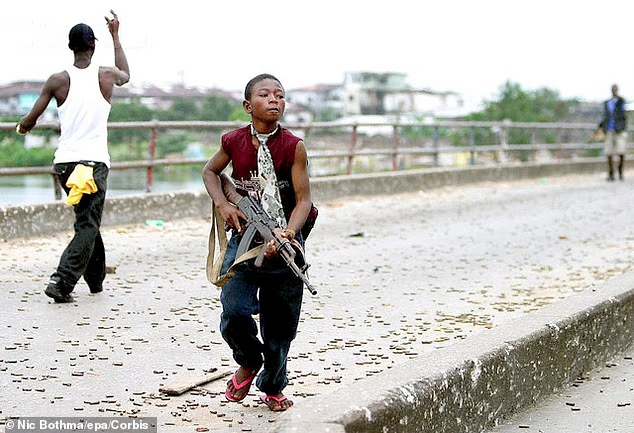
Once recruited, many children were drugged. Survivors described being given “brown brown,” a mixture of cocaine and gunpowder rubbed into cuts on their skin. The drug left them dizzy, disoriented, and hyper-aggressive. Some said their hands shook so violently they fired weapons uncontrollably.
Commanders sometimes tied ropes around the waists of the smallest boys so they could be pulled forward during attacks. Children were also forced to watch beheadings, burnings, and torture inflicted on people they knew, under threat of death if they screamed or reacted.
This exposure was deliberate. It was intended to sever emotional ties to their communities and reshape them into compliant fighters.
Units known as the Small Boys Unit included children as young as eight, serving as combatants, porters, and bodyguards. Many were killed in ambushes or sent into reckless assaults.
The pattern extended beyond Liberia. In Sierra Leone, UNICEF reported similar formations, including Small Boys Units and Small Girls Units, used by the Revolutionary United Front, or RUF, a rebel group backed by Taylor. Boys acted as scouts and messengers, while girls were often subjected to sexual slavery. Punishments for disobedience were severe and sometimes fatal.
Former child soldiers have since described the psychological grip of war. Prince “Small Soldier” Kamara told the Independent in 2012 about battles he was forced into as a child.
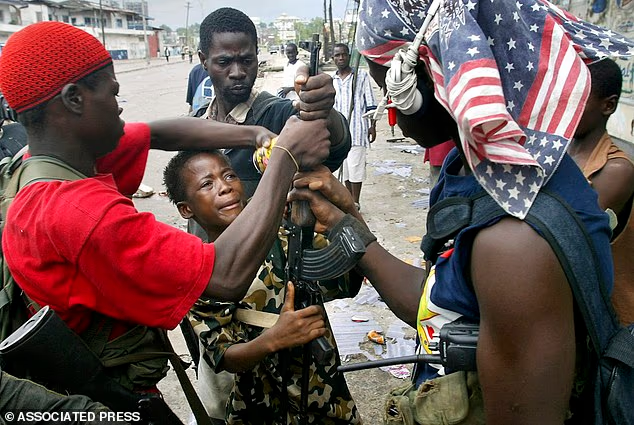
He recalled the smell of gunpowder, the sting of smoke in his eyes, and the sound of friends crying. He said he missed his mother desperately, but moments of perceived power followed acts of violence. After capturing Nigerian peacekeepers, he said, people called him a “big man,” and he felt pride despite the horror.
Girls suffered in ways that were often even more hidden. Amnesty International and the Special Court for Sierra Leone documented widespread abduction and sexual slavery. Fighters took girls as so-called “bush wives,” raping them repeatedly and forcing them to cook, clean, and carry supplies.
Resistance was met with beatings or death threats. Diana Korgbaye, who was abducted as a minor, later said that in wartime there was no real love. She was raped before she even understood what sex was, forced into a “marriage” with a man who had dozens of other captive women.
Another girl testified that she was taken from church with four others and dragged to the front lines. She described cooking and carrying ammunition while enduring constant abuse. If she refused sex, she was threatened with death.
She told investigators she wanted to return to school and go home to her people, dreams that felt unreachable. Médecins Sans Frontières treated women with injuries so severe they could barely walk. Some fainted after repeated assaults.
Many were forced to give birth in the bush without medical care. Others died attempting to deliver children.
By 2004, studies suggested that between 60 and 70 percent of Liberia’s civilian population had experienced rape or sexual abuse. Women were often gang-raped in front of their children or husbands. The trauma left deep scars that persist today.
A Campaign of Terror Across Borders
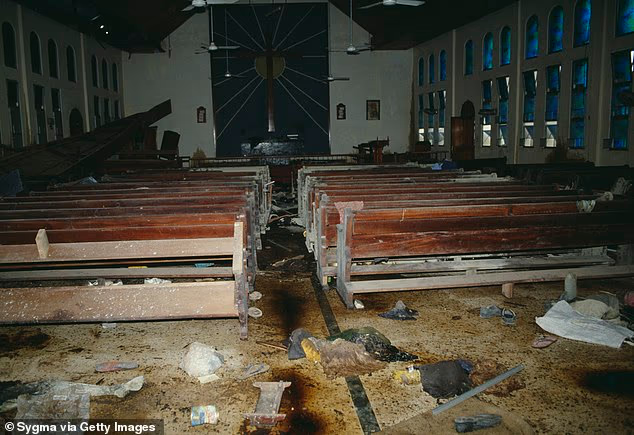
Entire communities were erased. One of the worst massacres occurred in July 1990 at St. Peter’s Lutheran Church in Monrovia. More than 600 civilians, mostly women, children, and elderly people, had sought shelter there.
Soldiers loyal to Doe, believing the civilians supported rebels, surrounded the church and opened fire through doors and windows. Survivors said bodies piled up as people tried to hide. Those still alive were stabbed or shot when fighters entered the building. UN investigators later described the scene as overwhelming devastation.
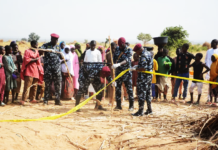
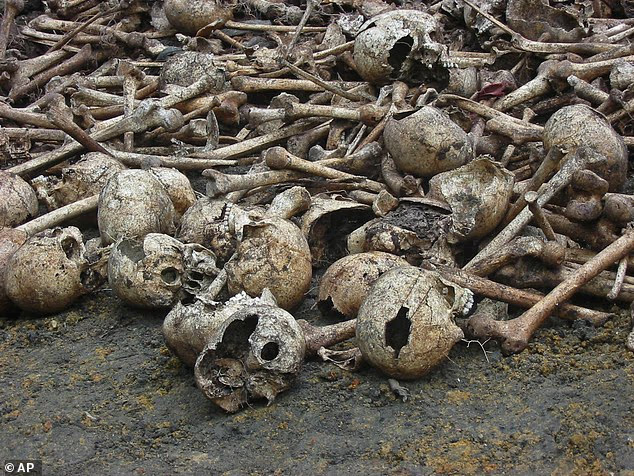
Elsewhere, UN teams found villages reduced to ash. In Lofa County, huts were burned, bones scattered across the ground. Médecins Sans Frontières reported burned bodies inside homes in towns like Buchanan and Totota.
People returning after the fighting found belongings but no survivors. Liberia’s Truth and Reconciliation Commission recorded countless testimonies of relatives taken and never seen again.
Torture was routine. Survivors described being beaten with rifle butts, nailed to trees through their hands or feet, or buried up to their necks and left under the sun. Insects crawled over their faces as guards laughed.
A BBC correspondent detained during the war said he heard screams throughout the night from nearby buildings.
In Sierra Leone, the brutality escalated further. The RUF carried out mutilations that became infamous worldwide.
Civilians were forced to choose between “short sleeve” or “long sleeve” — having their hands cut off at the wrist or their arms severed above the elbow. Mariatu Kamara was just 12 when rebels amputated her hands. She later said she did not understand the choice they demanded, so they made it for her.
Mass executions were common. In Liberia, the Maher Bridge massacre in 2002 saw government forces round up about 175 civilians in Bomi County, shoot them, and dump their bodies into a river.
In Sierra Leone, the 1999 assault on Freetown, known as Operation No Living Thing, left more than 7,000 dead. Homes were burned with families inside. Civilians were used as human shields. Even wells became dumping grounds for bodies, contaminating water sources survivors relied on.
Taylor’s rise culminated in the 1997 elections, which many hoped would end the war. Some voters admitted they supported him out of fear, believing that rejecting him would mean renewed violence.
Once in power, Taylor consolidated control and, according to UN reports, continued backing the RUF with weapons and support. He denied the allegations, but international investigations linked diamonds mined under brutal conditions to networks connected to his presidency.
Justice, Exile and an Unfinished Legacy
In 2003, the Special Court for Sierra Leone indicted Taylor. Under regional pressure, he resigned and went into exile in Nigeria, granted asylum by President Olusegun Obasanjo.
Three years later, Taylor was arrested while attempting to flee and transferred to The Hague. His trial lasted nearly six years. Victims testified alongside former fighters, UN experts, and insiders. Many witnesses appeared without limbs or bearing visible scars.
In 2012, judges found Taylor guilty on all counts, ruling that he aided and abetted war crimes and crimes against humanity. He was sentenced to 50 years in prison and transferred to a high-security facility in the United Kingdom.
Samuel Doe met his own violent end much earlier. In September 1990, he was captured by forces loyal to Prince Johnson. He was tortured for hours, mutilated on camera, and eventually killed. His body was displayed publicly, symbolizing the collapse of Liberia’s state.
Today, Liberia and Sierra Leone still bear the wounds. Former child soldiers struggle with trauma and addiction. Women face stigma. Amputees rely on aid. Mass graves remain scattered across the land.
Charles Taylor sits in a British prison, far from the countries his decisions devastated. To many, he is not remembered as a president, but as the man whose wars scarred a generation and left suffering that will endure for decades.