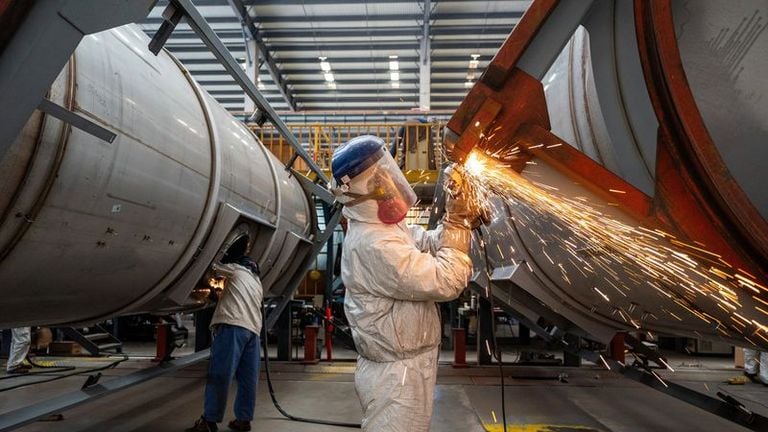
Asian factories struggle amid weak China, U.S. demand, a trend that has deepened in recent months and now threatens regional growth prospects. Purchasing Managers’ Index (PMI) data from Japan, Taiwan, South Korea, and other export-driven economies show contraction, signaling falling orders and reduced output. A PMI reading below 50 typically means industrial activity is shrinking. September’s surveys indicated this was the case for most major Asian markets.
Japan, Asia’s second-largest economy, saw factory orders slip to their weakest level in nearly a year. Electronics and auto exports slowed sharply, reflecting lower overseas demand and supply chain uncertainty. Taiwan and South Korea, two critical hubs for semiconductors and advanced manufacturing, also reported a steep decline in orders from both the U.S. and China. With semiconductors forming a backbone of global trade, these downturns raise concerns about a prolonged slump.
The softness in demand from China, the world’s largest importer of raw materials and industrial goods, stands out as a key driver. Beijing’s sluggish property sector and weaker consumer spending have hurt imports. At the same time, U.S. demand has weakened under the pressure of higher interest rates and ongoing tariff disputes. For economies tied to both markets, this dual slowdown is squeezing profits and leading to job concerns.
Another reason Asian factories struggle amid weak China, U.S. demand is the heightened trade friction. The United States has imposed tariffs on a wide range of products, particularly in technology and heavy industry, while China has adjusted its import policies in response. These shifts add to the challenges faced by manufacturers who rely on stable trade channels.
In South Korea, export volumes fell for the seventh straight month, driven by weaker chip demand. In Taiwan, officials warned that prolonged declines could hit employment levels if global demand does not stabilize. Southeast Asia, once a beneficiary of supply chain diversification, is also beginning to feel the slowdown, especially in Vietnam and Thailand, where electronics and textiles dominate exports.


Governments across the region are considering policy responses to cushion the impact. Central banks in South Korea and Taiwan have hinted at rate cuts to stimulate domestic spending. Japan is reviewing industrial support measures, while China is expected to roll out further stimulus to prop up growth. However, analysts caution that without a rebound in external demand, these measures may provide only limited relief.
The global implications of this slowdown are significant. As Asia represents a central link in global supply chains, reduced output impacts both developed and developing economies. Lower exports of electronics, cars, and consumer goods ripple into Europe and North America, raising costs and delaying deliveries. Investors, meanwhile, are closely watching the trend, as weaker Asian factory activity can weigh on corporate earnings worldwide.
The current challenges also underscore structural vulnerabilities. Many Asian economies depend heavily on exports, leaving them exposed to external shocks. Experts argue that diversifying trade partners, investing in domestic markets, and strengthening regional trade blocs could help reduce reliance on the U.S. and China.