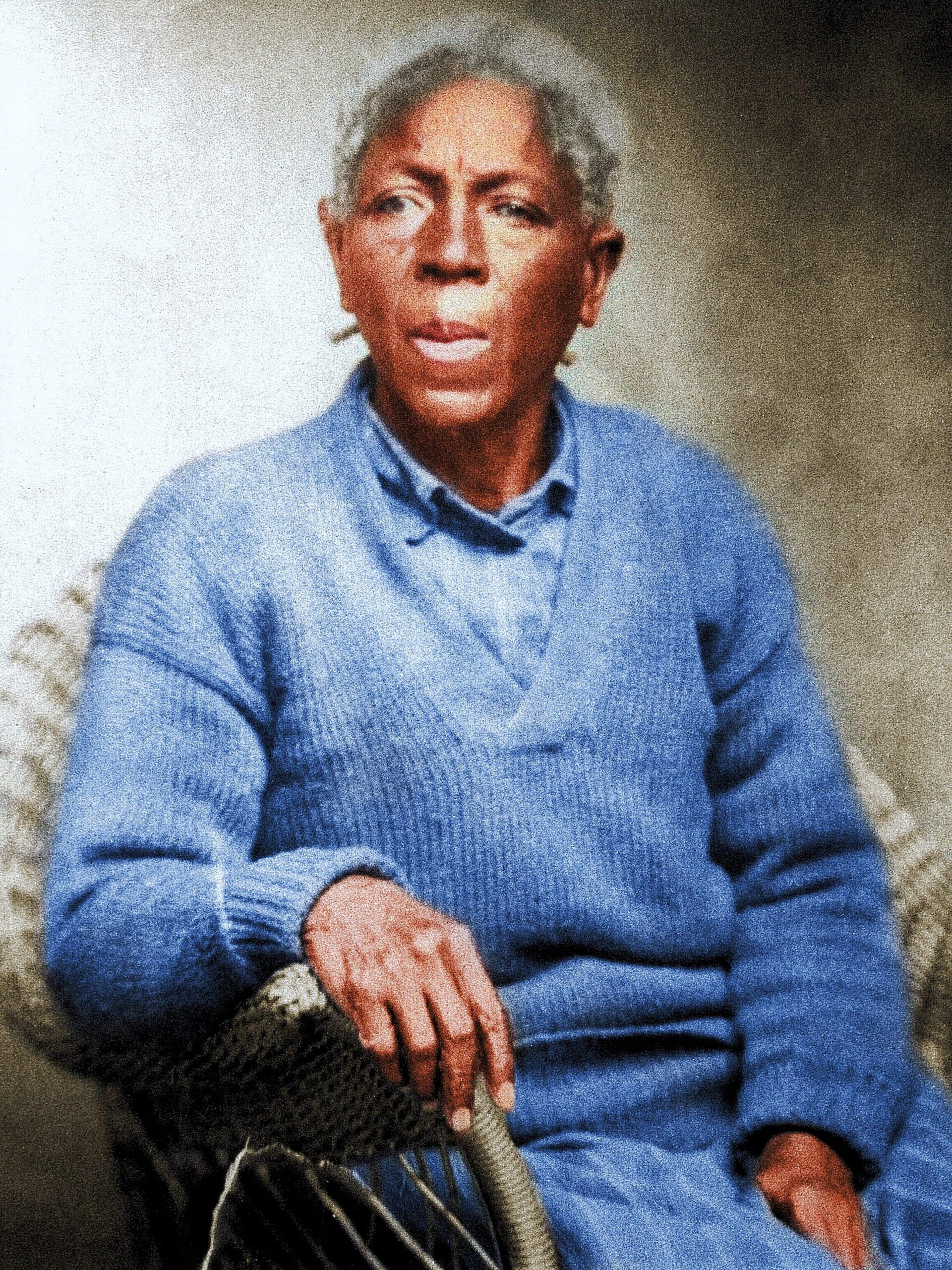
January 13 marks the 85th anniversary of Matilda’s death, born Abake—a name meaning “born to be loved by all” among the Tarkar people of West Africa.
On a frigid December morning in 1931, a short, elderly Black woman set out on a daunting 24-kilometer (15-mile) journey from her Alabama homestead, driven by a relentless quest for justice. For someone in her mid-70s, the trek to the courthouse in Selma was no small feat.
Yet Matilda McCrear remained resolute, determined to file a legal claim for compensation and seek recognition for the horrors her family had endured.
Until her passing on January 13, 1940, Matilda stood as the last surviving passenger of the final slave ship to sail from the West African coast to North America, a voyage that took place in late 1859. Her story began decades earlier and thousands of miles away from that sharecropping homestead.
Originally named Abake, she was born around 1857 among the Tarkar people of West Africa. In 1859, at just two years old, Abake was captured alongside her mother, Grace, and her three older sisters by troops from the Kingdom of Dahomey, now part of present-day Benin.
Torn from their family, they became victims of long-standing regional conflict that fueled a brutal slave trade stretching across North and East Africa, the Ottoman Empire, and ultimately into the Americas.
Though the precise details of her capture remain unknown, it is likely that Abake and her fellow captives were bound together and forced to march hundreds of miles to the coastal port of Ouidah, in present-day southern Benin. This harrowing journey marked the beginning of a relentless ordeal.
Upon reaching Ouidah, enslaved individuals were confined in “barracoons”, enclosed pens where they awaited inspection and sale to European traders. It was here that many were branded with the dehumanizing mark of their new owners.
Abake and her family were sold to Captain William Foster, a Canadian trader. In his journal, he recounted his dealings with the King of Dahomey, describing the grim sight of four thousand captives held in squalor. He selected 125 individuals for his cargo, forbidding the branding that was common practice.
Foster’s ship, the Clotilda, a two-masted schooner measuring 26 meters (86 feet), is now notorious as the last vessel known to have transported enslaved people across the Atlantic to North America.
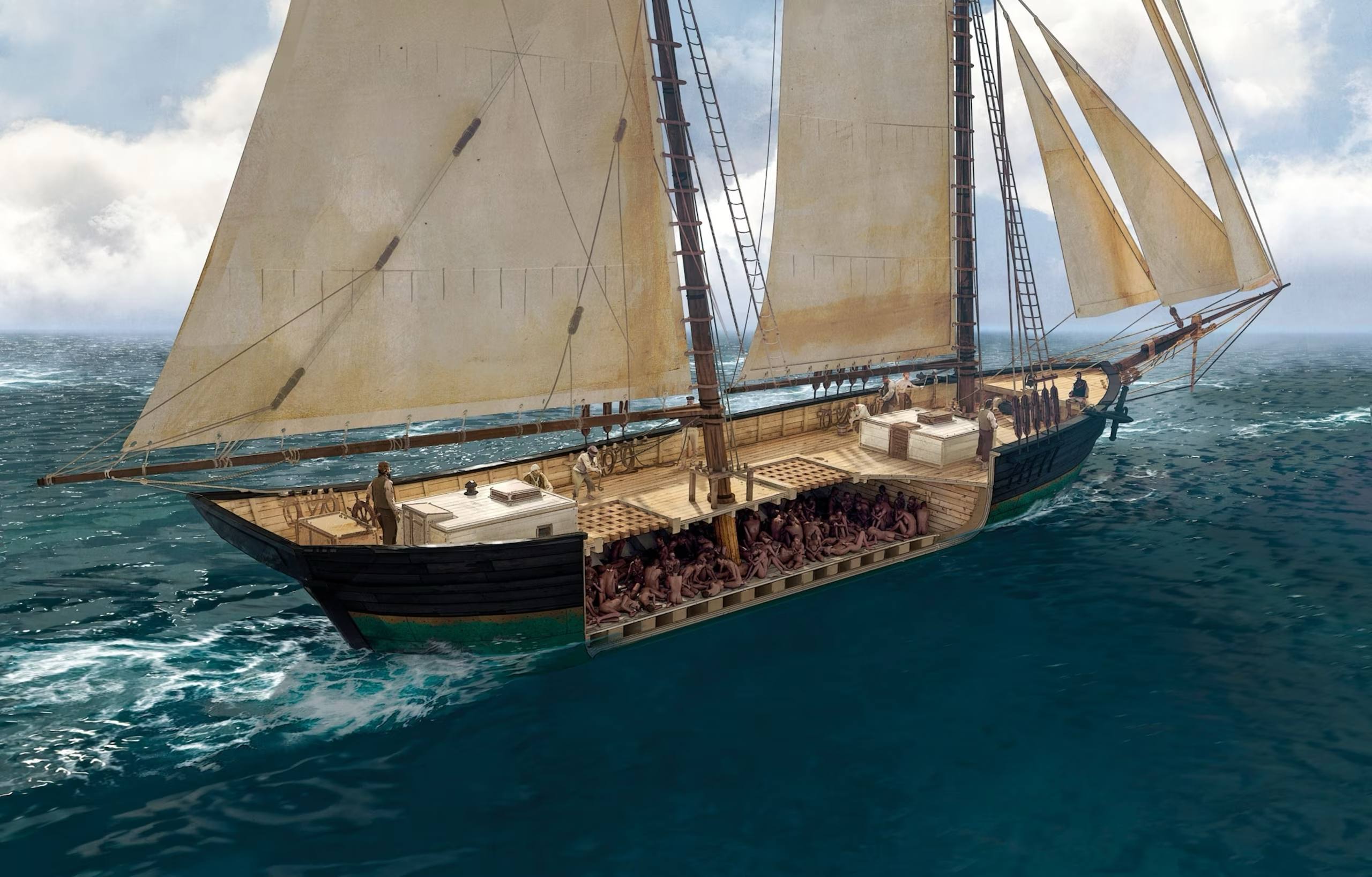
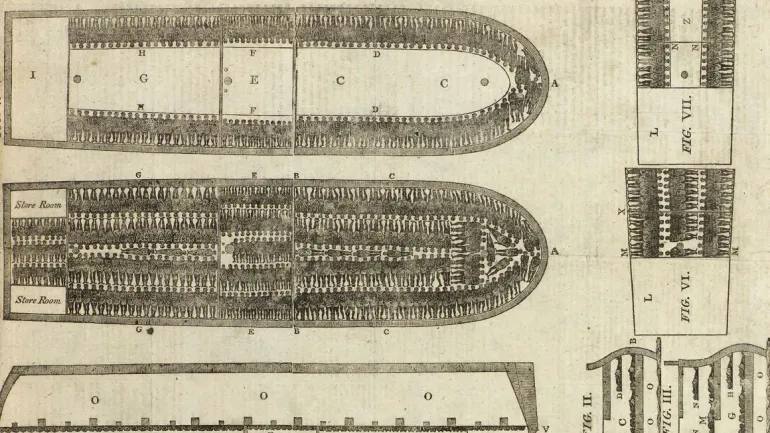
Their route across the Atlantic, known as the “Middle Passage,” formed the second leg of a triangular trade route linking Europe, Africa, and the Americas. Ships carried weapons and manufactured goods from Europe to the “slave coast” of West Africa; in exchange, they acquired enslaved Africans for sale in the United States and South America, typically through auctions. On the final leg, these vessels returned to Europe, often laden with cotton, tobacco, and sugarcane.
Shackled and Sold
Of the approximately 12.5 million enslaved Africans transported to the Americas over nearly 350 years, it is estimated that at least two million perished during the harrowing journey across the Atlantic. Grace would later recount to her daughters the heartbreaking sight of her nephew, along with others from her Tarkar village, being thrown overboard when they fell ill, a grim decision made to prevent contagion.
In early 1860, Captain William Foster steered the Clotilda, now carrying 108 enslaved individuals, into the port of Mobile, Alabama, under the cover of darkness. He towed the ship up the Mobile River to Twelvemile Island, where the captive Africans were transferred to a river steamboat. To erase any trace of his illegal actions, Foster recorded in his journal that he ordered the Clotilda burned.
Foster faced prosecution in 1861 for illegally importing enslaved people, but the case was dismissed due to a lack of evidence from the ship or its manifest. It was not until 2019 that researchers located the remains of the *Clotilda* in the Mobile River, confirming its long-contested existence and final resting place.
At Twelvemile Island, Abake, her mother, and her ten-year-old sister were handed over to Memorable Creagh, a wealthy plantation owner and one of the financial backers of the Clotilda. Tragically, Abake’s two other sisters whose names remain unknown were sold elsewhere, lost to their family forever. This separation reflected the brutal fate of countless individuals reduced to mere commodities.
Soon after, Abake, her mother, and her sister were taken to Creagh’s plantation near Montgomery, Alabama. There, Abake was given the name Matilda, her mother became Grace, and her sister was renamed Sally. Grace was forcibly married to another Clotilda survivor, a man renamed Guy.
Their union, treated in law as property rather than partnership, existed solely to produce more enslaved children. Even the most intimate aspects of their lives were controlled by their enslavers. Grace and Guy took their owner’s surname and labored in his cotton fields.
Matilda’s family likely lived in the most rudimentary conditions, crowded into crude wooden cabins that leaked in the rain and offered little warmth in winter. Under the constant surveillance of overseers, they were forced to work seven days a week.
Although Matilda retained only faint memories of her earliest years, she later recalled a harrowing moment when, at just three years old, she and Sally attempted to escape to a nearby swamp. They were quickly tracked down by the overseer’s dogs and returned to their quarters.
Still a child when the Civil War erupted in April 1861, Matilda witnessed Alabama’s secession from the United States, joining Virginia, North and South Carolina, Mississippi, Florida, Georgia, Louisiana, Texas, Arkansas, and Tennessee to form the Confederate States of America. This decision was rooted in the belief that slavery, the foundation of the southern economy was under threat from the federal government.
On January 1, 1863, President Abraham Lincoln issued the Emancipation Proclamation, declaring all enslaved people in Confederate states to be free. Yet the decree brought no immediate change for Matilda and her family as the Civil War continued. It was not until June 19, 1865, after the Confederacy’s defeat, that they were finally liberated.
By then, Matilda was about seven years old. Her family moved north and settled in Athens. The details of how they made a living remain unclear, but Matilda later recalled how quickly she learned English as a young child, often serving as an interpreter for her mother and stepfather as they struggled with the unfamiliar language.
They were free but what would that so-called freedom truly mean?
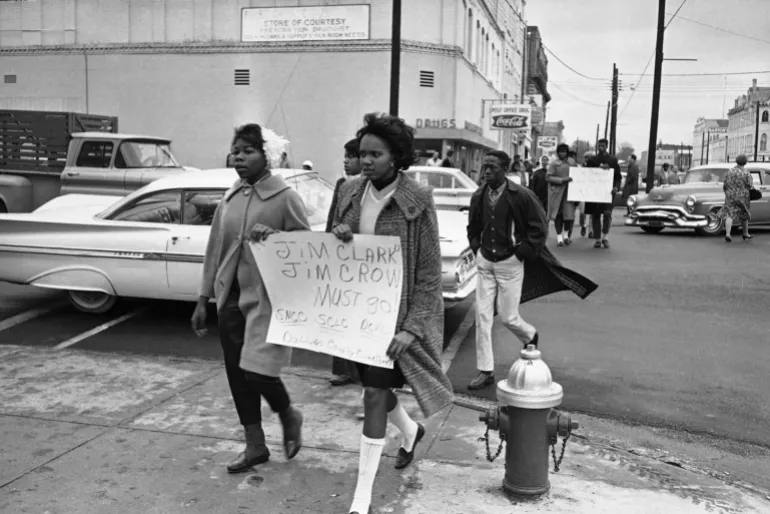
After 1865, however, freed Black Americans faced a hostile and unwelcoming world. Many white citizens reacted with outrage to the idea of racial equality. For uneducated ex-slaves, options were limited, and many remained on plantations as “sharecroppers.” This system allowed tenants to farm a portion of land in exchange for a share of the crop, but contracts often trapped them in perpetual debt and poverty conditions scarcely different from slavery itself.
Upon emancipation, Matilda and her family became legally free, but as Martin Luther King Jr. observed in a 1968 sermon: “Emancipation for the Negro was only a proclamation. It was not a fact. The Negro still lives in chains: the chains of economic slavery, the chains of social segregation, the chains of political disenfranchisement.”
During Reconstruction, federal laws promoting racial equality were swiftly undermined by local measures designed to maintain white supremacy. The 13th, 14th, and 15th Amendments exemplify this struggle.
The 13th Amendment of 1865 formally abolished slavery in all U.S. states and territories, granting legal freedom to formerly enslaved individuals. The Freedmen’s Bureau was established to provide essential aid, including food, housing, medical care, education, and legal support.
In response, southern states including Alabama, Matilda’s home—enacted “Black Codes,” which restricted African Americans’ rights to own property, conduct business, buy or lease land, and move freely in public spaces. These laws forced many Black individuals into exploitative labor arrangements like sharecropping.
A particularly insidious element of the Black Codes was the “vagrancy” law. Through “convict leasing,” African-American men and boys could be arrested for minor offenses such as vagrancy, imprisoned, and then leased to private businesses. This created a new system of forced labor strikingly similar to slavery, legally justified by the 13th Amendment’s “exception clause”: “Neither slavery nor involuntary servitude, except as a punishment for crime whereof the party shall have been duly convicted, shall exist within the United States.”
Convict leasing persists in the U.S. today, disproportionately affecting Black and Hispanic prisoners, who earn only a few cents per hour. Even after release, ex-convicts face enormous obstacles to employment, credit, and property ownership due to their criminal records.
The 14th Amendment of 1868 granted African Americans full U.S. citizenship and mandated equal protection under the law. Yet, the Supreme Court’s 1896 ruling in Plessy v. Ferguson undermined this promise.
Homer Plessy, who was one-eighth Black, refused to sit in a segregated train car and claimed his 14th Amendment rights had been violated. The Court ruled that racial segregation did not violate the Constitution as long as facilities were “separate but equal,” opening the door to Jim Crow laws.
These laws enforced segregation across schools, transportation, public spaces, and even places of worship. They effectively disenfranchised African Americans, prohibited interracial marriage, and imposed “Whites Only” signage to maintain racial hierarchy.
The 15th Amendment of 1869 aimed to protect voting rights regardless of race, but manipulative tactics literacy tests, poll taxes, and “grandfather clauses” restricted access to the ballot for Black Americans.
Even beyond legal barriers, systemic racism permeated daily life: exclusion from institutions and clubs, discriminatory urban planning, and “redlining” by banks denied African Americans housing and financial opportunity. Novelist James Baldwin noted in 1968 that nearly a century after the 15th Amendment, “…we have a Christian church which is white and a Christian church which is black… [and] the most segregated hour in American life is high noon on Sunday.”
Enforcement of these laws and social norms was often violent, carried out by white supremacist groups like the Ku Klux Klan, frequently with the complicity or direct involvement of local authorities.
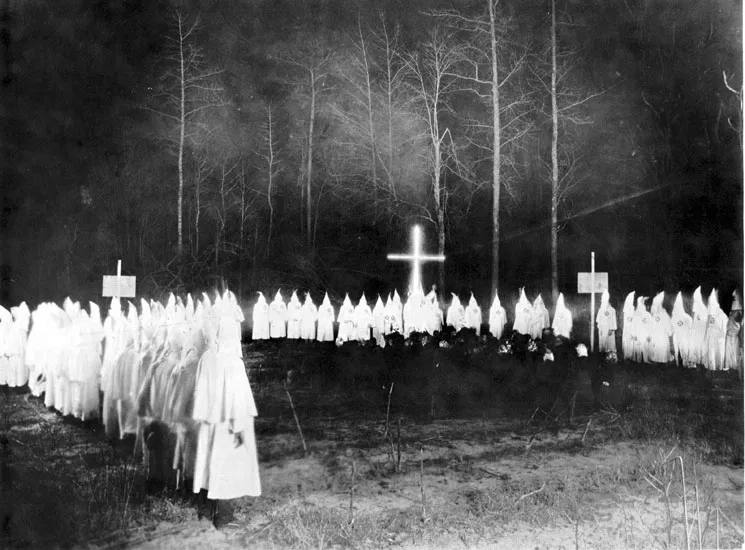
Later, Matilda entered a common-law partnership with a German-born man named Jacob Schuler, together raising 14 children, 10 of whom survived into adulthood.
The fates of the other four remain unknown. It is unclear whether interracial marriage bans prevented their formal union or if she chose to remain in a common-law arrangement. Regardless, Matilda continued living as a sharecropper near Selma for most of her life.
She eventually changed her surname from Creagh to McCrear, perhaps to assert her own identity and distance herself from her former enslaver. Over generations, the family name has appeared in various forms, including Crear, Creah, Creagher, and McCreer.
Justice that Never Came
In 1931, Matilda heard a rumor that people like her were receiving compensation for being illegally smuggled as slaves into the United States. Motivated by this, she embarked on a 24-kilometer (15-mile) journey on foot to the courthouse in Selma, Alabama, to make her claim.

The newspaper provided a vivid portrait of Matilda: “She walks with a vigorous stride. Her kinky hair is almost white and is plaited in small tufts and with bright-coloured string … Her voice is low and husky, but clear. Age shows most in her eyes … yet her … skin is firm and smooth.” It went on to note, “Tildy has vigor and spirit in spite of her years … endurance and a natural aptitude for agriculture inherited from the Tarkar tribe, made [her] a thrifty farmer.”
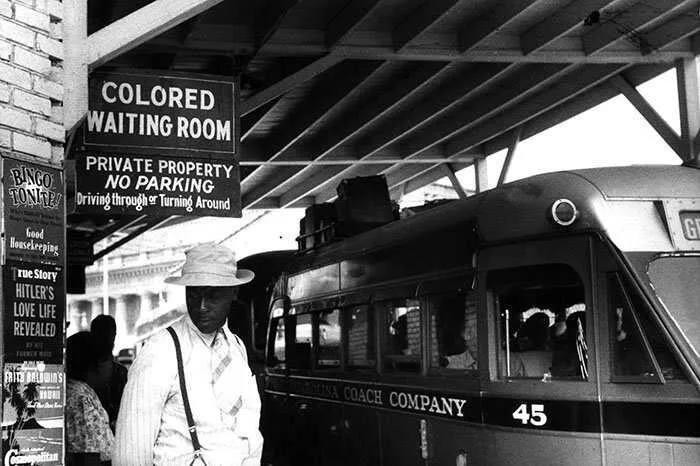
Matilda fell ill following a stroke and died at age 83 on January 13, 1940.
Among the mourners was her young grandson, John Crear. “I was about three years old and I got away from my parents and almost fell in the grave,” he recalled to National Geographic in 2020. John, a retired hospital administrator and community leader in his late 80s, was born in Matilda’s home, and her funeral remains one of his earliest memories. “I was told she was quite rambunctious,” he said, recounting his grandmother’s formidable character.
Later, John and his wife researched their family history. “I had no idea she’d been on the Clotilda,” he said. “It came as a real surprise. Her story gives me mixed emotions because if she hadn’t been brought here, I wouldn’t be here. But it’s hard to read about what she experienced.”
Matilda waited her entire life for justice, yet it would be another 14 years before the civil rights movement began to challenge the systemic racism she endured. Iconic leaders such as Martin Luther King Jr. and Malcolm X highlighted the gap between the ideals of the 13th, 14th, and 15th Amendments and the lived reality of African Americans.
In a 1964 speech, Malcolm X demanded: “… our right on this earth … to be respected as a human being, to be given the rights of a human being in this society … which we intend to bring into existence by any means necessary.”
Although Matilda did not live to see these changes, her grandson was actively involved in the civil rights movement. “You can read about slavery and be detached from it,” he reflected.
“But when it’s your family that is involved, it becomes up close and very real.” He was once arrested for stopping a white man from attempting to stuff a live snake down his throat, a stark reminder of the risks faced by civil rights activists.
Many campaigners endured violence, imprisonment, or even death, including both Martin Luther King Jr. and Malcolm X.
Yet their sacrifices were not in vain. By the mid-1960s, Jim Crow laws had been dismantled: public school segregation was ruled unconstitutional in Brown v. Board of Education (1954); discriminatory voting practices were banned under the Voting Rights Act (1965); and the Civil Rights Act (1964) outlawed segregation and employment discrimination.
While these measures addressed legal inequities, deeper societal racism persists. “As long as people can be judged by the colour of their skin, the problem is not solved,” said Oprah Winfrey in 2021.
Nearly a century earlier, Matilda seemed to recognize this when the Selma court denied her claim. “I don’t expect I need anything more than I got,” she said, expressing gratitude despite the injustice.
This article was first published on Aljazeera