President Donald Trump announced Thursday that he had ordered a deadly U.S. military strike against Islamic State-linked militants in Nigeria, describing the operation as a decisive response to what he called the persecution and killing of Christians in Africa’s most populous country.
The strikes, carried out in coordination with Nigerian authorities, mark a significant escalation of U.S. military involvement in northwestern Nigeria, a region increasingly affected by a complex mix of jihadist violence, criminal banditry, and regional instability spilling over from the Sahel.
Christmas-Timed Attack Highlights Terrorism, Religion, and Geopolitical Tensions in West Africa
In a series of posts on social media, Trump said he had directed a “powerful and deadly strike against ISIS Terrorist Scum in Northwest Nigeria,” accusing the group of targeting innocent Christians. The president later told Politico that he deliberately delayed the operation so it would coincide with Christmas, framing the timing as both symbolic and strategic.
“They were going to do it earlier,” Trump said. “And I said, ‘nope, let’s give a Christmas present.’ … They didn’t think that was coming, but we hit them hard. Every camp got decimated.”
The Strike and U.S. Military Involvement
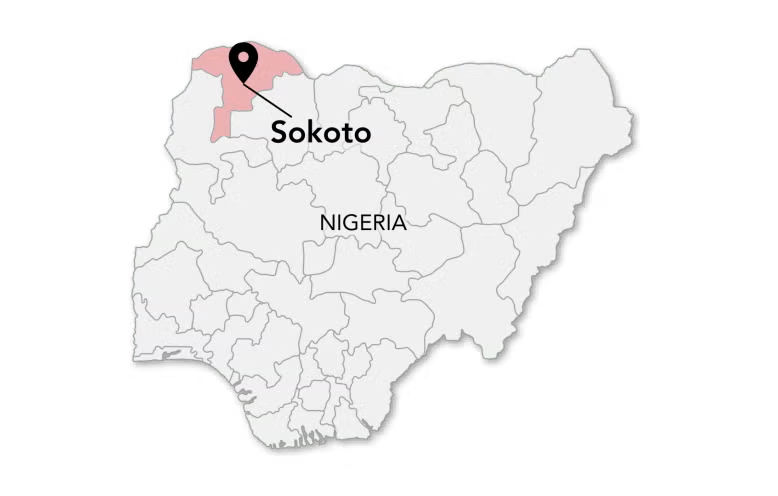
U.S. Africa Command (AFRICOM) confirmed that American forces conducted the strikes in Sokoto State, which borders Niger to the north, describing the operation as having been carried out “in coordination with Nigerian authorities.”
According to AFRICOM’s initial assessment, multiple Islamic State terrorists were killed in the attacks, which targeted militant camps in remote areas of the state.
A U.S. official told CNN that the strikes included Tomahawk cruise missiles launched from a U.S. Navy vessel, striking at least two camps believed to be used by Islamic State-affiliated fighters. Such weapons indicate a high level of U.S. operational involvement and intelligence-gathering, reflecting Washington’s growing concern over jihadist expansion in West Africa.
Defense Secretary Pete Hegseth, writing on social media, suggested that the operation may not be a one-off, stating that there was “more to come,” while expressing gratitude for the cooperation of the Nigerian government.
Nigerian Government Approval and Diplomatic Coordination
Nigeria’s Foreign Minister Yusuf Tuggar confirmed Friday that the strike was conducted with the full knowledge and approval of Abuja. Tuggar told CNN that he had spoken with U.S. Secretary of State Marco Rubio prior to the operation and that President Bola Ahmed Tinubu personally authorized the action.
“This is not about religion,” Tuggar emphasized. “It is about Nigerians, innocent civilians, and the wider region as a whole.”
Tuggar stressed that terrorism in Nigeria affects all communities, regardless of faith, pointing out that the Sahel region, which has seen the fastest growth in violent extremist activity on the African continent, is predominantly Muslim.
“When you talk about the Sahel, the majority are Muslims. They’re not Christians,” he said. “Whoever is prepared to work with us to fight terrorism, we’re ready, willing and able. We demonstrated this yesterday.”
Trump’s Focus on Christians and Religious Framing
Despite Nigerian officials’ efforts to downplay religious framing, Trump has repeatedly emphasized the plight of Christians in Nigeria in recent months, making it a central theme of his foreign policy rhetoric.
In November, he publicly called on Defense Secretary Hegseth to “prepare for possible action,” warning that the U.S. would intervene “guns-a-blazing” if attacks on Christians continued.
“I have previously warned these Terrorists that if they did not stop the slaughtering of Christians, there would be hell to pay, and tonight, there was,” Trump wrote on Truth Social.
“The Department of War executed numerous perfect strikes, as only the United States is capable of doing.”
The president, who spent the Christmas holiday at his Palm Beach estate, concluded his post with a characteristic flourish:
“Under my leadership, our Country will not allow Radical Islamic Terrorism to prosper. May God Bless our Military, and MERRY CHRISTMAS to all, including the dead Terrorists, of which there will be many more if their slaughter of Christians continues.”
Who Was Targeted? ISIS, Lakurawa, and Hybrid Threats
Nigerian authorities did not publicly identify the specific militant group targeted in the strikes. However, security analysts suggest that Lakurawa, a lesser-known but increasingly violent group operating in northwestern Nigeria, may have been among the targets.
According to analysts cited by Reuters, Lakurawa has grown more deadly over the past year, staging attacks on remote rural communities and Nigerian security forces, often operating from forests that span state boundaries. In January, Nigeria officially designated Lakurawa a terrorist organization, banning its activities nationwide.
The group is believed to have developed links with Islamic State affiliates, contributing to what experts describe as a hybrid crime-terrorism threat. While banditry, kidnapping for ransom, cattle rustling, and village raids has long plagued northwestern Nigeria, jihadist ideology has increasingly blended with criminal networks.
Sokoto State and the Reality on the Ground
Sokoto State, home to approximately four million people, is overwhelmingly Muslim and historically known as a center of Islamic scholarship and leadership in West Africa. It was once the seat of the Sokoto Caliphate, a powerful pre-colonial Islamic state whose legacy still shapes religious leadership in northern Nigeria.
Analysts note that the region’s insecurity is not primarily driven by religious conflict, but by weak governance, poverty, porous borders, and the spillover of extremist movements from Niger, Mali, and Burkina Faso.
Importantly, Nigerian Muslims have also been victims of targeted attacks by Islamist groups seeking to impose their extreme interpretation of Islamic law. Villages, mosques, markets, and transport routes have all been targeted in recent years.
This reality complicates narratives that frame Nigeria’s violence solely as an assault on Christians.
Nigeria’s Broader Security Crisis
Nigeria has grappled for over a decade with multiple overlapping security crises, including:
Boko Haram and Islamic State West Africa Province (ISWAP) insurgencies in the northeast
Banditry and jihadist-linked violence in the northwest | Separatist unrest in the southeast | Farmer–herder conflicts across the Middle Belt | Urban crime and kidnappings nationwide
Observers note that these conflicts are driven by a mix of religious extremism, ethnic tensions, climate stress, economic inequality, and governance failures.
Both Christians and Muslims—the two dominant religious groups in Nigeria’s population of more than 230 million people have suffered devastating losses.
Nigeria’s Conflict Zones at a Glance
While often discussed as a single crisis, Nigeria’s insecurity is regionalized and fragmented, with different threats dominating different parts of the country.
Northeast (Borno, Yobe, Adamawa)
Epicenter of the Boko Haram insurgency since 2009 | Home to Islamic State West Africa Province (ISWAP) | Millions displaced, repeated attacks on civilians and military bases
Northwest (Sokoto, Zamfara, Katsina, Kebbi)
Dominated by banditry, mass kidnappings, and cattle rustling | Growing jihadist infiltration, including ISIS-linked cells | Porous borders with Niger facilitate arms and fighter movement
North-Central (Middle Belt)
Farmer–herder clashes over land and water | Religious and ethnic violence involving Christian and Muslim communities
Southeast
Separatist unrest involving the Indigenous People of Biafra (IPOB)
Southwest and Urban Centers
Rising kidnapping-for-ransom and organized crime
The U.S. strike occurred in the northwest, a region once viewed primarily as a criminal problem but now increasingly seen as part of the broader Sahelian jihadist corridor.
Tinubu’s Message of Religious Unity
On Christmas Eve, President Bola Tinubu sought to strike a conciliatory tone, issuing a Christmas Goodwill Message in which he extended greetings to Christians at home and abroad while emphasizing unity and tolerance.
“I stand committed to doing everything within my power to enshrine religious freedom in Nigeria and to protect Christians, Muslims, and all Nigerians from violence,” Tinubu wrote in a post on X.
His message underscored the Nigerian government’s effort to balance international partnerships with domestic sensitivities in a country where religious and ethnic divisions remain politically volatile.
U.S. Conservative Pressure and Religious Freedom Policy
The plight of Nigeria’s Christians has long been a rallying point for American conservative politicians and advocacy groups. Figures such as Sen. Ted Cruz have repeatedly accused Nigeria’s government of failing to protect Christian communities, calling for stronger U.S. intervention.
Earlier this year, Trump designated Nigeria a “Country of Particular Concern” under the International Religious Freedom Act, a classification used when governments are deemed to have engaged in or tolerated “systematic, ongoing, and egregious violations of religious freedom.”
The designation has been controversial, with Nigerian officials and independent analysts arguing that it oversimplifies a far more complex security landscape.
Analysts Warn of Dangerous Simplification
Security experts caution that religious framing risks inflaming tensions rather than resolving them.
Oluwole Oyewale, a Dakar-based African security analyst, told CNN that Trump’s rhetoric does not reflect realities on the ground.
“Trump’s binary framing of the issue as attacks targeting Christians does not resonate with the reality on the ground,” Oyewale said.
“In a country that is largely divided—not only politically, but in terms of religion, these are serious connotations. It goes a long way to open the fault lines of division that already exist in the country.”
Analysts warn that portraying U.S. military action as a defense of one religious group could be exploited by extremists for recruitment and propaganda.
Trump’s Foreign Policy Contradictions
The Nigeria strikes highlight a broader contradiction in Trump’s foreign policy. While he has repeatedly cast himself as a peacemaker and vowed to limit U.S. military interventions abroad, his return to power has also seen aggressive uses of force.
Since re-entering office, Trump has:
Ordered strikes on Iran’s nuclear infrastructure | Overseen a major military buildup around Venezuela | Issued repeated threats of force against adversaries
The Nigeria operation adds Africa to a growing list of regions where Trump has demonstrated a willingness to use U.S. military power decisively.
U.S.– Nigeria Military Cooperation Through the Years
The U.S. strike did not emerge in a vacuum. Washington and Abuja have cooperated on security for decades, though the relationship has waxed and waned.
Cold War Era
Nigeria aligned largely with the Non-Aligned Movement | Limited U.S. military involvement
Post–9/11 Era
U.S. support expanded under counterterrorism cooperation | Training, intelligence sharing, and surveillance assistance
Boko Haram Insurgency (2010s)
U.S. provided:
ISR (intelligence, surveillance, reconnaissance) | Training for Nigerian special forces | Arms sales, including Super Tucano aircraft
Tensions arose over human rights concerns, briefly halting weapons sales under the Obama administration
Future Cooperation
While initial assessments suggest the strikes were tactically successful, analysts stress that airstrikes alone cannot resolve Nigeria’s security crisis. Without sustained investment in governance, intelligence-sharing, regional cooperation, and civilian protection, militant groups are likely to regroup.
For now, Washington and Abuja appear aligned in their determination to confront terrorism. But the long-term impact of the strikes—politically, socially, and strategically remains uncertain.
As Nigeria continues to battle insecurity on multiple fronts, the challenge for both governments will be ensuring that counterterrorism efforts unite rather than divide, and protect all civilians regardless of religion from violence.