
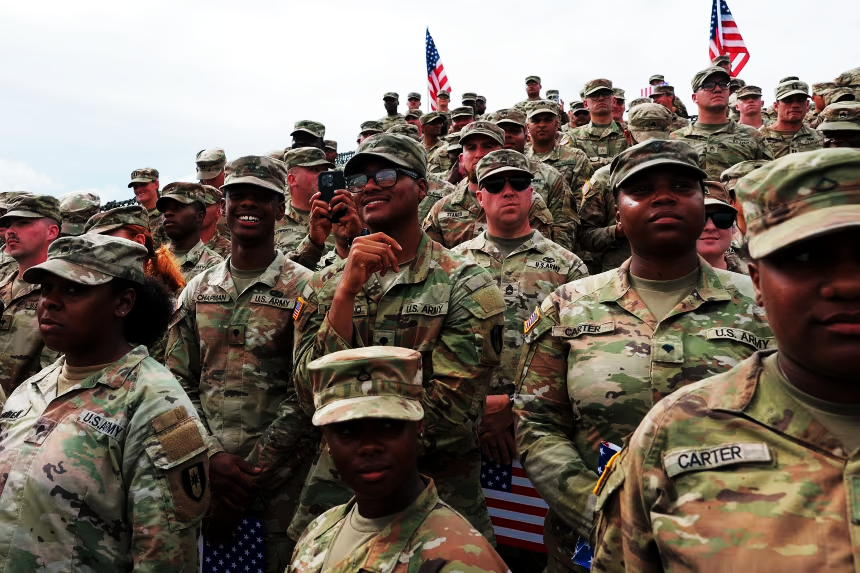
President Donald Trump announced on Wednesday that members of the U.S. military will receive $1,776 payments, a move he described as a “Warrior Dividend” honoring the nation’s founding in 1776.
Speaking during a televised address, Trump said approximately 1.45 million service members will receive the payments before Christmas, adding that the checks are already being distributed.
Trump said the funds were made possible by higher-than-expected revenue from tariffs, though he did not provide specific details on how the initiative would be financed.
Defense Secretary Pete Hegseth has directed the Pentagon to allocate about $2.6 billion for the program, classifying it as a one-time Basic Allowance for Housing supplement for eligible service members in pay grades O-6 and below, according to a senior administration official.
The payment will go to roughly 1.28 million active-duty troops and about 174,000 reserve personnel. The official said Congress approved $2.9 billion earlier this year as part of Trump’s policy agenda to supplement housing benefits for military members.
The White House has referred to the United States Department of Defense as the Department of War under the administration’s rebranding effort.
A senior official said the one-time payment reflects the department’s continued focus on improving housing support and overall quality of life for service members and their families.
Military Pay, Benefits, and Cost-of-Living Pressures
The announcement comes at a time when financial pressures on U.S. service members have been the subject of growing concern. While military compensation includes base pay, housing allowances, healthcare, and other benefits, many troops—particularly those in lower and mid-level ranks—have reported difficulty keeping up with rising housing costs, inflation, and the general cost of living in major metropolitan areas.
The Basic Allowance for Housing (BAH), which this one-time payment supplements, is designed to help cover rental costs for service members living off base. However, fluctuations in local housing markets have sometimes outpaced adjustments to the allowance, leaving gaps that service members must cover out of pocket.
Advocacy groups and military family organizations have repeatedly called for reforms to ensure that compensation better reflects economic realities. Rising rents in cities with large military populations—such as San Diego and Norfolk—have intensified these concerns in recent years.
Against this backdrop, the “Warrior Dividend” has been framed by the administration as a targeted effort to provide immediate financial relief, even if only temporarily.
Tariffs and Federal Revenue Debate
Trump’s claim that the payments are funded through tariff revenue reflects a broader economic policy approach that has defined much of his political career. Tariffs—taxes imposed on imported goods were a central feature of his administration’s trade strategy, particularly during disputes with major trading partners such as China.
Supporters of tariffs argue that they generate revenue for the federal government while protecting domestic industries from foreign competition. Critics, however, contend that tariffs can lead to higher consumer prices and retaliatory measures from other countries, ultimately affecting economic growth.
Economists have long debated whether tariff revenue can reliably fund large-scale government programs. In this case, the lack of detailed financing information has prompted questions from policy analysts about how sustainable such funding mechanisms might be if similar payments were to be considered in the future.
Legislative and Congressional Role
The funding for the program is tied to a broader legislative package approved by Congress earlier in the year. Lawmakers authorized approximately $2.9 billion to enhance housing-related benefits for military personnel, reflecting bipartisan recognition of the challenges facing service members and their families.
While the “Warrior Dividend” is being presented as a distinct initiative, it draws from these previously allocated funds, highlighting the complex relationship between executive proposals and congressional appropriations.
Members of Congress from both parties have historically supported measures aimed at improving military quality of life, though disagreements often arise over the scale and structure of such programs. Some lawmakers have emphasized the importance of long-term solutions such as adjusting base pay or permanently increasing housing allowances rather than one-time payments.
Rebranding and Institutional Identity
The administration’s decision to refer to the United States Department of Defense as the “Department of War” represents a symbolic shift that has drawn attention in policy and political circles.
Historically, the department was known as the War Department until it was reorganized in 1947 under the National Security Act, which aimed to modernize and unify the U.S. military structure in the aftermath of World War II. The change to “Department of Defense” was intended to reflect a broader mission focused not only on warfare but also on deterrence, stability, and international cooperation.
Reintroducing the older terminology has been interpreted by some analysts as an effort to emphasize military strength and readiness, while others view it as largely rhetorical.
Impact on Service Members and Families
For many service members, the $1,776 payment represents a tangible, if temporary, boost to household finances. Military families often face unique financial challenges, including frequent relocations, spousal employment disruptions, and childcare costs.
The timing of the payments just before the holiday season has been highlighted by the administration as an effort to provide relief when expenses tend to increase. For junior enlisted personnel and mid-level officers, the additional funds could help cover rent, utilities, or other essential costs.
At the same time, some experts caution that one-time payments do not address underlying structural issues in military compensation. Long-term financial stability for service members, they argue, depends on consistent and predictable income adjustments rather than episodic bonuses.
Broader Political and Public Reaction
The announcement has generated a range of reactions from political leaders, veterans’ groups, and the public. Supporters have praised the initiative as a meaningful recognition of the sacrifices made by military personnel, particularly at a time when recruitment and retention have become pressing concerns.
Critics, however, have questioned the lack of detailed funding explanations and the broader fiscal implications of the program. Some have also raised concerns about the precedent set by linking military benefits to specific revenue sources such as tariffs.
Within the military community, reactions appear to be mixed but generally appreciative. Many service members welcome the additional financial support, even as they continue to advocate for more comprehensive reforms to pay and benefits.
Military Bonuses and Incentives
The concept of providing financial bonuses to military personnel is not new. Throughout U.S. history, the government has used various forms of incentives including enlistment bonuses, hazard pay, and retention bonuses to attract and retain service members.
During periods of conflict, such as the wars in Iraq and Afghanistan, additional payments were often used to compensate for the increased risks and demands placed on troops. In peacetime, bonuses have been employed to address specific challenges, such as shortages in critical skills or declining recruitment numbers.
The “Warrior Dividend” fits within this broader tradition, though its framing as a symbolic payment tied to the nation’s founding sets it apart from more conventional incentive programs.
As the payments are distributed, attention is likely to shift toward their impact and the possibility of similar initiatives in the future. Policymakers will need to assess whether one-time supplements can effectively address the financial challenges faced by service members or whether more comprehensive reforms are necessary.
The program also raises broader questions about federal spending priorities, revenue sources, and the role of symbolic gestures in public policy.
For now, the “Warrior Dividend” stands as a notable example of how economic policy, political messaging, and military support can intersect. Whether it will lead to lasting changes in how the United States approaches military compensation remains to be seen.