
Two men who chopped down the “irreplaceable” Sycamore Gap tree in what a judge described as an act of “sheer bravado” have each been jailed for four years and three months.
Daniel Michael Graham, 39, and Adam Carruthers, 32, both from Cumbria, were convicted of criminal damage after filming themselves using a chainsaw to illegally fell the landmark tree beside Hadrian’s Wall in Northumberland.
Sentencing them at Newcastle Crown Court, Mrs Justice Lambert rejected their claim of “drunken stupidity” and said that although their full motive was unclear, the men appeared to gain “some sort of thrill” from toppling the tree and the public outrage that followed.
The National Trust, which owned the more than 100-year-old tree, said the loss of the celebrated landmark was devastating and that it could “never be replaced.”
The court heard that the pair’s friendship quickly collapsed after the public reaction made clear the scale of their actions. In the early hours of 28 September 2023, the men drove to the site under cover of darkness and used the winds of Storm Agnes to help bring down the tree onto the Unesco World Heritage Site wall.
Prosecutors valued the tree at about £458,000 while Graham’s team put the figure closer to £150,000, but the judge said the precise sum did not matter, calling the Sycamore Gap tree a symbol of Northumberland and of the “untamed beauty” of the landscape along Hadrian’s Wall.
She said the tree was a place of “peace and tranquillity” that held deep personal significance for many people who visited it year after year. Carruthers used spray paint to mark the trunk before cutting a wedge into it with a chainsaw while Graham recorded the act on his mobile phone.
Mrs Justice Lambert said she was confident that “sheer bravado” was a major factor and that the outrage that followed had given the men a sense of excitement. They then “revelled in their notoriety,” she added.
The judge also dismissed Carruthers’s claim of heavy intoxication, saying the task required coordination, competence and a “high degree” of planning by the two “experienced tree surgeons.”
Planted in the late 1800s as a “feature in the landscape,” the Sycamore Gap tree grew into one of Britain’s most recognisable natural landmarks. Its global profile rose after it appeared in the 1991 film Robin Hood: Prince of Thieves and it became a favourite for photographers, walkers and artists.
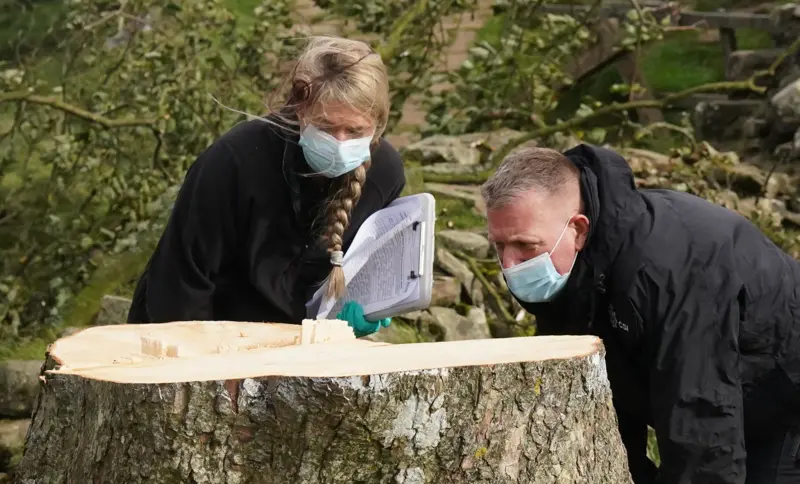
In a statement to the court, National Trust manager Andrew Poad said the “iconic” tree “belonged to the people” and described the reaction to its destruction as an “unprecedented outpouring of love and emotion.” The vandalism, he said, was “malicious,” “mindless” and “beyond comprehension,” with the decision to fell it across the Roman wall “reckless in the extreme.” He added that there were now “signs of life” in the stump, and that saplings grown from its seeds would be planted across the country.
Prosecutor Richard Wright KC said the felling involved “significant planning” and had been carried out in a “deliberate and professional” manner. Both men have since admitted their involvement to probation officers.
In mitigation, Carruthers’s barrister, Andrew Gurney, said the mechanic from Wigton would carry the burden of regret for his “stupid act” as a “personal penance.” He repeated that Carruthers attributed the incident to “drunken stupidity,” though the judge later rejected that argument.
Christopher Knox, representing Graham, said his client, a groundworker from near Carlisle, had faced multiple personal struggles and mental health difficulties, including a serious suicide attempt in December that led to a prolonged hospital stay before he was remanded into custody.
Knox said Graham had also faced vigilantism, including attacks on his caravan and hate mail that demonstrated “unpleasant” and “malign intent” toward him.