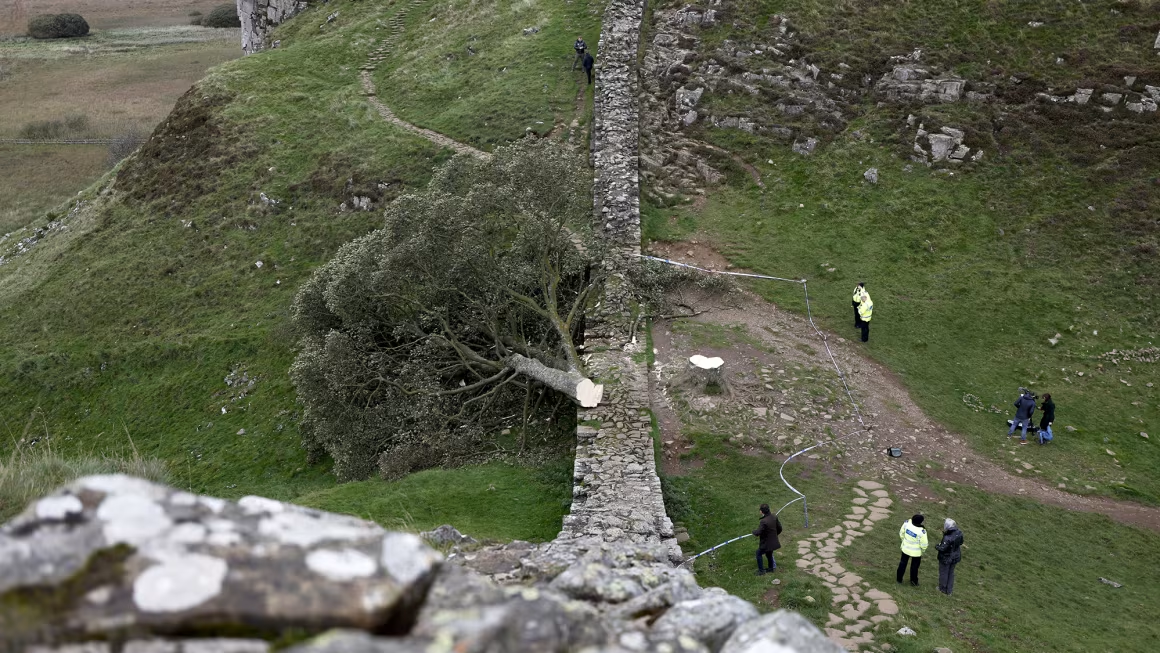
Authorities in England have arrested a 16-year-old boy after one of the world’s most recognizable trees was found cut down overnight on Thursday, shocking locals and nature enthusiasts alike.
The Sycamore Gap tree, also known as the “Robin Hood tree,” was deliberately felled early Thursday, officials confirmed. The landmark had grown in a dramatic dip beside Hadrian’s Wall in Northumberland, one of the United Kingdom’s most photographed and celebrated trees.
“Northumberland National Park Authority can confirm that sadly, the famous tree at Sycamore Gap has come down overnight,” the park said in a statement. “We have reason to believe it has been deliberately felled.”
Northumbria Police later announced that a 16-year-old boy had been arrested in connection with the incident.
“He remains in police custody at this time and is assisting officers with their enquiries,” the force said on X, formerly known as Twitter. “Given our investigation remains at a very early stage, we are keeping an open mind.”
Police added that they were working with other agencies and partners “with an interest in this iconic North East landmark” and would release more details as the investigation develops.
Estimated to be around 300 years old, the Sycamore Gap tree had thrived for centuries in a gully along Hadrian’s Wall, a UNESCO World Heritage Site built in 122 A.D. to mark the northern boundary of Roman Britain. Its unique position, framed by the steep-sided valley of the wall, created one of the most striking natural vistas in England.
The tree gained international fame after appearing in the 1991 film Robin Hood: Prince of Thieves, starring Kevin Costner, earning it the nickname “Robin Hood tree.” It became a magnet for photographers, tourists, and nature lovers, who often visited the tree for picnics, proposals, and quiet moments of reflection.
The felling prompted widespread outrage.
“I can’t express how angry I am at the vandalism of the tree at Sycamore Gap,” North of Tyne Mayor Jamie Driscoll wrote on X before news of the arrest. “People have had their ashes scattered there. People have proposed there. I’ve picnicked there with my wife and kids. It’s part of our collective soul.”
The tree was voted English Tree of the Year in 2016, a recognition of both its beauty and its cultural significance. For decades, it has served as a symbol of Northumberland’s landscapes, connecting people to the history and romance of the area.
Writer Katy Madgwick, describing her family’s first visit to the tree in May, said:
“It felt genuinely mythical. I’m a bit heartbroken, tbh. My kids will be too.” For many, the tree represented not only a scenic landmark but also an emotional connection to the North East, a living monument to both nature and heritage.
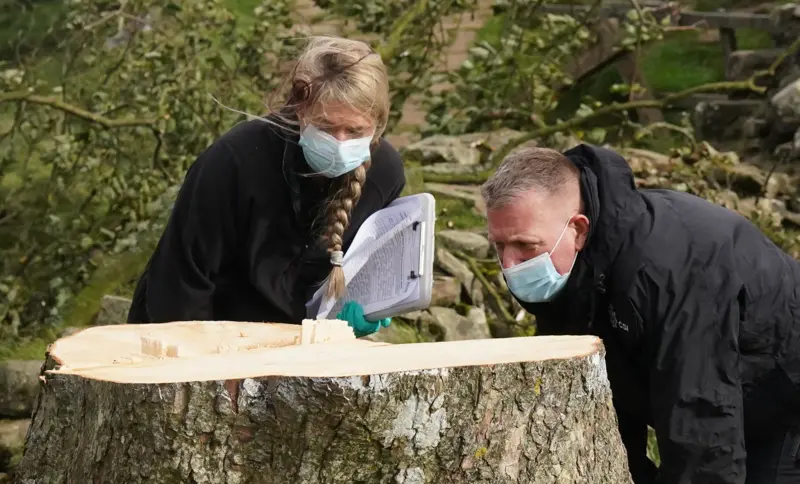
As the investigation continues, conservation efforts are underway to salvage the tree through regrowth, grafting, or starting new saplings from seeds collected before the incident. Jeannette Heard of the National Trust, which manages the site, said:
“We believe the tree to be around 200 years old. We are going to protect the remaining tree stump to see if it may grow again so that at least the legacy from the original tree endures.”
The National Trust’s rangers are collecting scion wood and seeds, aiming to preserve the tree’s unique genetic material.
“Regrowth from the original stump should be possible, but it’s too early to tell,” Heard explained. “Even if successful, the tree’s dramatic effect wouldn’t be the same, as multiple stems would emerge rather than one. We are doing everything possible to propagate saplings and retain its lineage.”
The Sycamore Gap tree’s destruction comes at a time when environmentalists are calling attention to broader concerns about biodiversity and tree cover in England. Just one day before news of the felling, the National Trust and other conservation groups released the UK’s 2023 State of Nature report, highlighting that the country’s most important natural habitats are in poor condition and that less than half of the nation’s biodiversity remains due to human activity.
“The loss of the Sycamore Gap tree is a stark reminder of how fragile our natural landmarks can be,” said a spokesperson from the London-based charity Trees for Streets. “It’s not just about one tree. It is a wake-up call for the need to protect the natural world, upon which we are completely dependent.”
The tree’s cultural significance is inseparable from its natural beauty. Planted in the 18th or 19th century, it grew to become a visual symbol of the rugged Northumberland countryside.
Its image has appeared in films, postcards, and countless photographs, serving as a gateway to understanding the layered history of the region.
Visitors often spoke of a sense of peace and timelessness when standing in its shadow, a connection to both nature and history that transcended generations.
Historically, Hadrian’s Wall itself represents a key chapter in Britain’s Roman past. Stretching over 73 miles, the wall marked the northern frontier of Roman Britannia and served as a defensive fortification.
The Sycamore Gap tree’s location along this ancient site provided an arresting natural counterpoint to the human history of the region, blending ecology and heritage in a way that few landscapes can achieve.
The tree stood near the village of Once Brewed, roughly an hour’s drive west of Newcastle upon Tyne. Locals and tourists alike are leaving flowers and mementos at the site, honoring both the tree and the memories it holds.
“I honestly got teary when I saw the news,” wrote one visitor on social media. “Especially for us Geordies, it is such a special place — an iconic symbol.”
Efforts to regrow the tree from its stump or propagate it through grafting are a testament to the dedication of conservationists to preserve what can be saved. Even as a single tree, its symbolic and ecological value remains vast.
The felling also underscores a tension between human behavior and environmental preservation. Unlike trees lost to storms, disease, or natural causes, the deliberate act of vandalism raises urgent questions about the protection of natural heritage and the enforcement of environmental law.
The Sycamore Gap tree will continue to inspire efforts to restore England’s natural landscapes. While its iconic single trunk may be gone, its legacy will live on in saplings grown from its seeds, in the photographs and films that immortalized it, and in the memories of those who visited the tree for generations.
“This is about more than one tree,” said Heard of the National Trust. “It’s about the broader struggle to protect our natural world and to recognize the cultural, historical, and emotional significance of landmarks like this. We hope that from this tragedy, a new generation of trees, and the stories they carry will rise.”