In a bold new chapter of its space programme, China launches a mission where it sends its youngest astronaut into orbit alongside four black mice bound for the Tiangong “Heavenly Palace” space station. The event underscores how Beijing is accelerating its ambitions in space while blending engineering, biology and national pride into one launch.
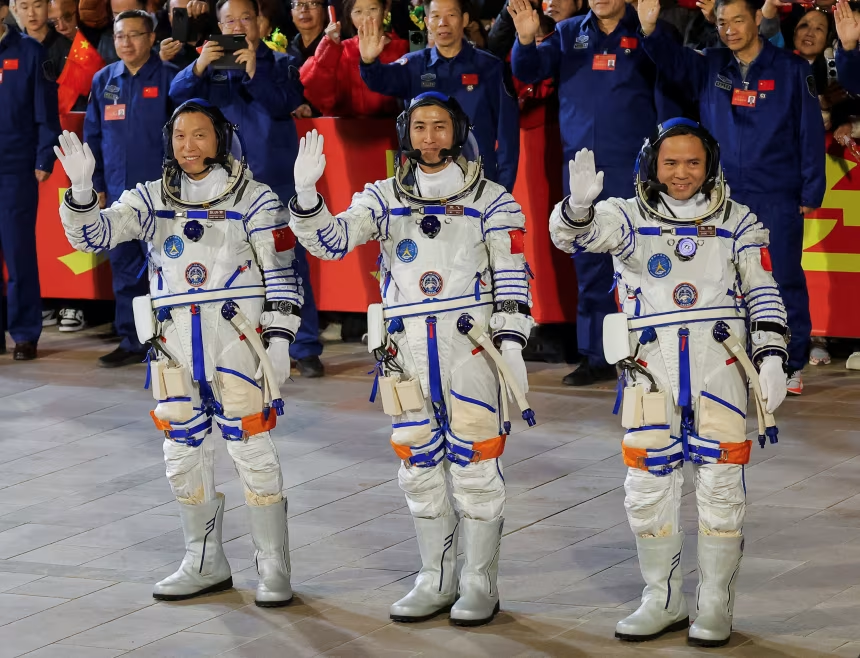
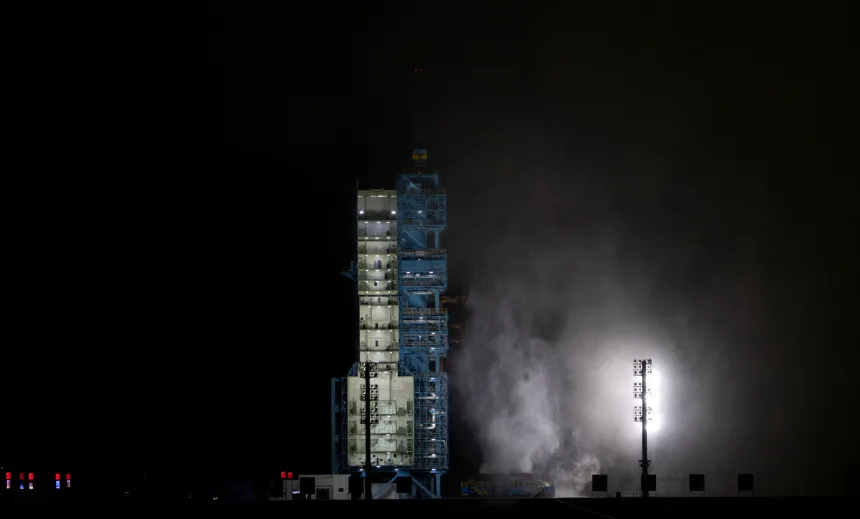
China’s Shenzhou-21 mission lifted off from the Jiuquan Satellite Launch Center using a Long March-2F rocket. The crew included Commander Zhang Lu (48), payload specialist Zhang Hongzhang (39) and engineer Wu Fei (32) – making Wu the youngest Chinese astronaut ever in space. Once docked to the Tiangong station, the trio began a six-month stay involving 27 scientific experiments across biotechnology, aerospace medicine and materials.
In an added landmark, the mission carried four black mice, two males and two females, marking the first small mammals ever sent to the Chinese space station. Their role: reproduction experiments and behavioral studies in microgravity. This biological step adds a new layer to China’s overall space ambitions.
Beyond science, the mission sends a clear message. China has completed seven crewed missions to Tiangong since the station was completed in 2022. With each launch, the average age of taikonauts is decreasing, signalling a generational shift in the astronaut corps. Meanwhile, the biological experiments aboard reflect Beijing’s push to master space-adapted life systems — a critical capability for long-term stations or lunar outposts.
This move raises questions in Washington, where officials note that China’s fast-paced space programme appears designed not just for exploration, but also for geopolitical positioning. With the U.S. and China competing for lunar dominance and space governance, “sends its youngest astronaut” is part of a strategy to establish China as a peer space power.
The inclusion of small mammals aboard Tiangong points to a future where China envisions astronauts and mammalian organisms living and working in orbit for extended periods. These experiments test resilience, reproduction and adaptation key steps if humans are to travel to the Moon or Mars. From a broader view, the “China sends youngest astronaut” story highlights how space missions now encompass human, animal and robotic systems as part of a larger ecosystem.
For Wu Fei, the new astronaut, the mission represents a moment of national pride and personal achievement. For China, it’s a calculated step into the future.
When China sends its youngest astronaut along with mice to Tiangong, it isn’t just another space launch. It reflects the convergence of youth, science and ambition under one flag. As the mission progresses, it will offer insights into China’s plans for lunar missions, long-term habitation in space and the broader race for influence above Earth.