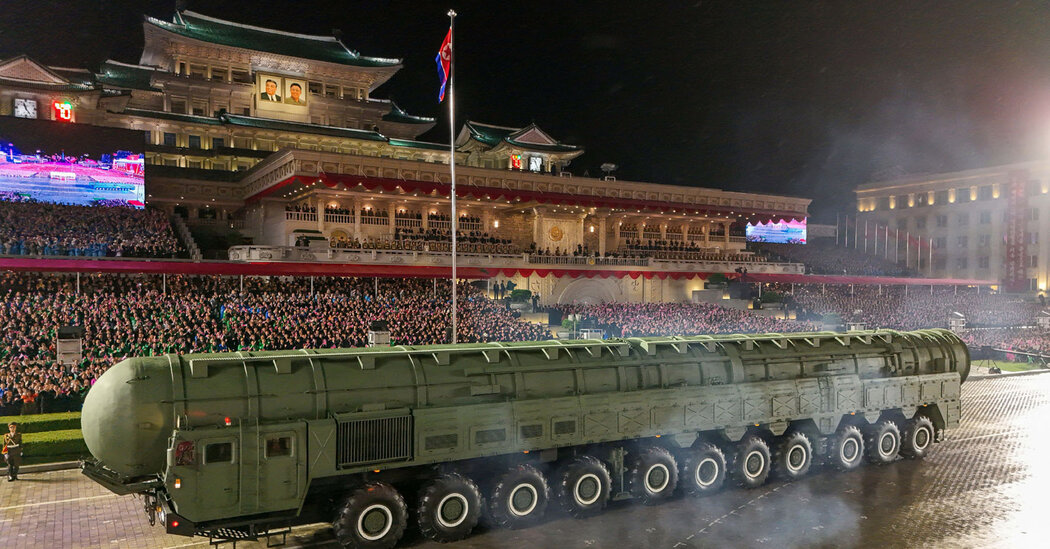
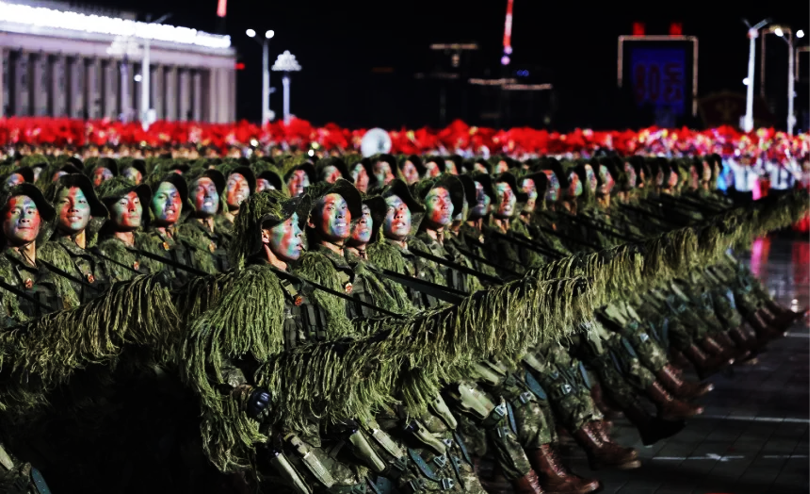
To celebrate its 80th anniversary, North Korea’s ruling Workers’ Party staged a military parade with spectacle and symbolism. In the spotlight was a new hypersonic weapon ICBM unveiled by Kim Jong Un. This display wasn’t just about pomp. It was a message: Pyongyang aims to show it has advanced missile capabilities and resolve. The parade brought foreign dignitaries, military hardware, and a sharp tone—one that suggests North Korea wants the world to know it is changing its threat calculus.
The celebration framed itself as both internal pride and external warning. High-ranking foreign officials, including China’s premier, Russia’s ex-president, and Vietnam’s party leader, attended the event in Pyongyang. Their presence added weight. It signaled that North Korea is leaning on allies even as it deepens its show of force.
During the parade, Kim Jong Un walked past ranks of soldiers, inspected weapon systems, and delivered a speech that praised North Korea’s development of “invincible strategic arms.” State media later broadcast images of the new system mounted on a massive 11-axle transporter. The reveal blended ceremony and deterrence.
The star of the parade was the Hwasong-20, a solid-fuel intercontinental ballistic missile. It’s touted as North Korea’s most powerful strategic weapon yet. State media called it the “strongest nuclear strategic weapon system.” The missile may be capable of carrying multiple warheads—a design choice that, if true, could challenge existing missile defenses.
Earlier in September, North Korea conducted what it described as the final ground test of the missile’s solid-fuel carbon-fiber engine. The test produced about 1,971 kilonewtons of thrust, which is a considerable upgrade in power and materials technology. However, experts caution that while the engine test is real, full reliability and reentry capability remain unverified. North Korea has not yet proven that a warhead can survive atmospheric reentry or navigation at intercontinental ranges.
Also featured was a hypersonic missile system, possibly a glide-vehicle variant. Among models shown was the Hwasong-11E, a short- or medium-range missile with a hypersonic glide vehicle, currently under development. Another reference is the older Hwasong-8, which Pyongyang had claimed earlier incorporates a hypersonic glide vehicle. The idea is that such weapons travel faster than Mach 5, maneuvering in mid-course to evade defenses.
Displaying both a new ICBM and hypersonic systems signals North Korea’s ambition to elevate its threat from regional to intercontinental. The dual showcase suggests it wants to challenge both U.S. deterrents and deliver tactical options closer to its borders.
North Korea faces strategic isolation and sanctions. A display like this projects strength and may enhance its bargaining power in negotiations. By demonstrating a credible ICBM with hypersonic capabilities, Pyongyang seeks to deter adversaries and extract concessions in diplomacy.
Inviting high-level representatives from Beijing, Moscow, and Hanoi underlines North Korea’s attempts to strengthen trilateral or multipolar ties. The regime wants to show it has partners in a shifting global alignment. Showing off advanced weapons with representatives from Russia and China makes the announcement more than domestic theater it becomes part of a broader geopolitical script.
For domestic audiences, the new hypersonic weapon ICBM reveal bolsters the image of Kim’s regime as the guarantor of security and sovereignty. At a moment when citizens face economic hardship, emphasizing national strength reinforces loyalty and deters dissent. Doing so on the party’s 80th birthday amplifies the symbolism.
What Works, What Is Unproven
Engine test success: The ground test of the solid-fuel engine has firmer evidence behind it. Solid-fuel rockets are faster to launch and harder to detect than liquid-fuel ones.
Multi-warhead claims: Pyongyang claims multiple warheads (MIRV capability). But deploying reliable MIRVs requires extremely precise guidance and reentry control—capabilities not confirmed for North Korea.
Hypersonic glide vehicles: These systems can evade defense radars and maneuver mid-flight. North Korea’s representation of them may be conceptual or developmental rather than fully operational.
Reentry, guidance, thermal management, and survivability remain major challenges. A missile is only as good as its ability to deliver a payload accurately under stress. Analysts believe North Korea still needs further tests to validate performance under full launch conditions. Until then, much of what was shown is a statement, not proven deterrence.
South Korea, Japan, and the U.S. will view this reveal as a serious escalation. It changes threat assessments: no longer is North Korea just a regional concern; it may now aim for deeper strategic relevance. Missile defense systems may be pushed to upgrade.
Washington is likely to condemn the move. The reveal may prompt renewed calls for sanctions, tighter missile defense cooperation with allies, and diplomatic pressure. Yet the new hypersonic weapon ICBM also complicates talks—if North Korea insists it now holds strategic parity, incentives for negotiation may shift.
North Korea’s public display sends a message to other nuclear states and rising powers. It seeks to be seen not just as a troublesome rogue state, but as a military actor with sophisticated systems. The timing—on the party’s 80th anniversary—underscores that Pyongyang wants this moment etched into history.
Resource strain: Building and maintaining reliable ICBMs and hypersonics is expensive. North Korea’s economy is constrained; misallocation may weaken other sectors.
International countermeasures: Neighboring states and the U.S. may escalate sanctions, intelligence posturing, or military deployments in response.
Credibility risks: If North Korea fails future tests, the propaganda benefit may backfire.
Diplomatic isolation: Some countries view blatant atomic posturing as crossing red lines, which can provoke stern backlash.
As North Korea’s ruling party turned 80, Kim Jong Un’s unveiling of a new hypersonic weapon ICBM served more than ceremony. It was a strategic signal: Pyongyang claims to be upgrading its deterrence and demanding to be taken seriously. The Hwasong-20 and hypersonic systems displayed may not all be fully operational yet, but they represent North Korea’s ambition.
The reveal intensifies security tensions in East Asia and beyond. Whether the new weapons can deliver on promise remains to be seen, but their symbolic impact is already felt. In the days ahead, the world will watch not just whether Pyongyang can test them, but whether its rivals can respond credibly.
If North Korea truly achieves working hypersonic ICBMs, it changes strategic balance; until then, it remains a bold declaration backed by mystery and ambition.